CCSS.
The Standard
Solve real-world and mathematical problems by writing and solving equations of the form x + p = q and px = q for cases in which p, q and x are all nonnegative rational numbers.
Common Core State Standards for Mathematics · Expressions and Equations
Teacher's field guide
What This Standard Means
What Students Need to Do
- Students represent an unknown amount with a variable, write a one-step equation from a situation, and solve with an inverse operation. They work with whole numbers, fractions, and decimals, then check the answer in the equation and context.
What Mastery Looks Like
- A student can tell whether a situation calls for removing an added amount or dividing by a multiplier. They solve accurately with fractions and decimals, show the equation, and verify the value by substitution.
Common Misconceptions
- Students may add when they should subtract, or multiply when they should divide. They often read 3x as x + 3, mishandle fraction division, or give an answer that does not fit the situation.
How to Assess It
- Exit ticket: “Lena had x liters, added 1.75 liters, and now has 4.5 liters. Write and solve an equation.” Then solve 3/4x = 6 and check both answers.
Lesson moves
Ways to Teach It
Use balance mats, fraction strips, and covered cups to model x + 1/2 = 2 and 3x = 2 1/4.
Ask, “How do you know whether to subtract or divide?” Students compare two word problems and justify the operation in writing.
Play equation match: students pair situation cards, equation cards, and solution cards, then verify each match by substitution.
Give a grocery receipt with a fixed coupon or equal item prices; students write and solve an equation for the missing amount.
Free download
Printable 6.EE.B.7 Worksheet
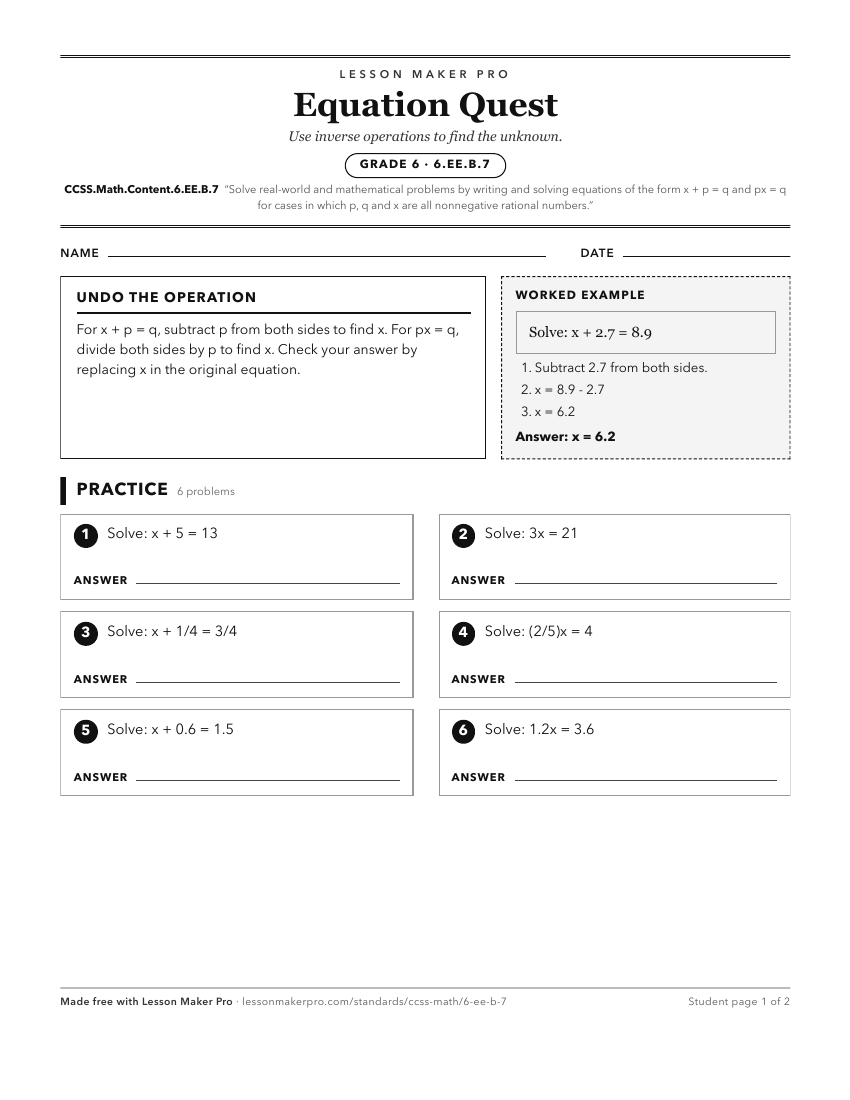
A ready-to-print activity worksheet aligned to CCSS.Math.Content.6.EE.B.7, with an answer key for the teacher on its own page. No account needed.
PDF, US Letter, prints cleanly in black and white.
Download the worksheetLearning progression
Where This Standard Sits
See the whole path on the Expressions & Equations progression map.
Before This Standard
If students are struggling here, check these first.
- CCSS.Math.Content.6.EE.B.5
Knowing a solution makes an equation true supports setting up and checking one-step equations with rational numbers.
- CCSS.Math.Content.6.EE.B.6
Understanding variables as unknown numbers supports writing the simple equations needed before solving x + p = q and px = q.
- CCSS.Math.Content.6.NS.B.3
Decimal addition, subtraction, multiplication, and division support computing the unknown in one-step equations when p and q are decimals.
What This Unlocks
Mastery here sets students up for these next.
- CCSS.Math.Content.7.EE.B.4a
Solving one-step rational equations prepares students for the inverse operations needed in two-step word-problem equations.
- CCSS.Math.Content.7.EE.B.4
Solving one-step equations with rational numbers is the foundation for writing and solving the two-step equations and inequalities in grade 7.
- CCSS.Math.Content.7.G.B.5
Solving one-step equations with rational numbers supports finding unknown angle measures from sums and products in angle relationships.
Keep exploring
Related Standards
- CCSS.Math.Content.7.NS.A.3
Solve real-world and mathematical problems involving the four operations with rational numbers.
- CCSS.Math.Content.8.EE.A.2
Use square root and cube root symbols to represent solutions to equations of the form x² = p and x³ = p, where p is a positive rational number. Evaluate square ...
- CCSS.Math.Content.7.EE.B.4b
Solve word problems leading to inequalities of the form px + q > r or px + q < r, where p, q, and r are specific rational numbers. Graph the solution set of the...
Turn this exact standard into a lesson
Grade, subject, topic, and the complete standard are prefilled. Create one free, no account needed.
Also for this standard:Make a WorksheetMake a QuizMake a Sub Lesson