CCSS.
The Standard
Solve two-step word problems using the four operations. Represent these problems using equations with a letter standing for the unknown quantity. Assess the reasonableness of answers using mental computation and estimation strategies including rounding.
Common Core State Standards for Mathematics · Operations and Algebraic Thinking
Teacher's field guide
What This Standard Means
What Students Need to Do
- Students solve word problems that require two operations, deciding what to find first and second. They write an equation with a letter for the unknown and use estimation or mental math to check the answer.
What Mastery Looks Like
- A student identifies the needed quantities, chooses operations that fit the situation, and shows both steps clearly. The student writes a matching equation, finds the unknown, labels the answer, and explains why the result is reasonable.
Common Misconceptions
- Students may use numbers in the order given or choose operations from key words without understanding the situation. They may stop after one step, think the letter must follow the equals sign, or accept an answer that does not fit their estimate.
How to Assess It
- Exit ticket: “A class has 6 boxes of 8 markers and gives 15 markers away. How many remain?” Students write one equation using m, solve it, and give a mental estimate that supports the answer.
Lesson moves
Ways to Teach It
Give pairs counters and cups to model a two-step story, then have them write one matching equation with a letter.
Ask students to write: “Which step must happen first, and what detail in the story proves it?”
Play Equation Match with cards showing word problems, equations, solutions, and estimates; teams assemble four-card sets and explain each match.
Use a classroom store receipt: students calculate the cost of several equal-priced items, subtract a coupon, and estimate the final total.
Free download
Printable 3.OA.D.8 Worksheet
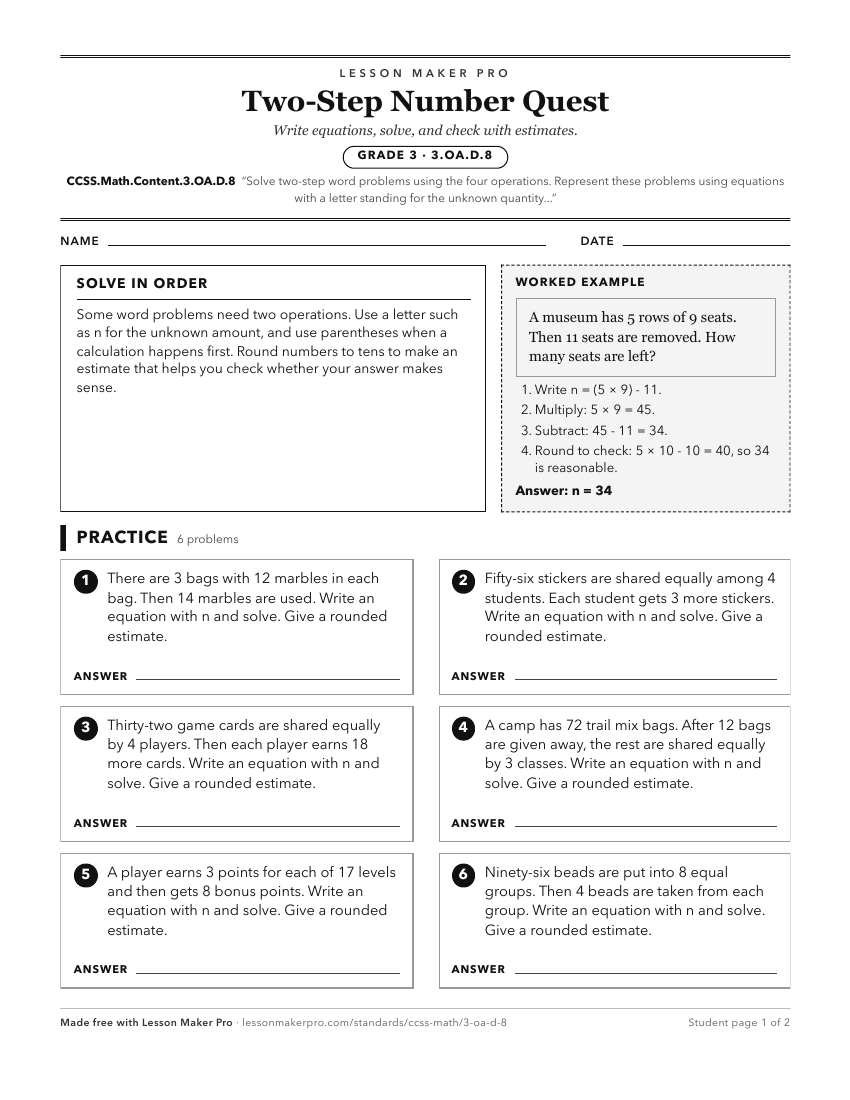
A ready-to-print activity worksheet aligned to CCSS.Math.Content.3.OA.D.8, with an answer key for the teacher on its own page. No account needed.
PDF, US Letter, prints cleanly in black and white.
Download the worksheetLearning progression
Where This Standard Sits
See the whole path on the Operations & Algebraic Thinking progression map.
Before This Standard
If students are struggling here, check these first.
- CCSS.Math.Content.2.OA.A.1
Students extend two-step problem modeling from addition and subtraction to all four operations, using equations with an unknown.
- CCSS.Math.Content.3.OA.A.3
Students extend multiplication and division problem models into two-step equations and combine them with addition or subtraction.
- CCSS.Math.Content.3.NBT.A.1
Rounding to tens or hundreds supports estimating and checking whether two-step word problem answers are reasonable.
What This Unlocks
Mastery here sets students up for these next.
- CCSS.Math.Content.4.OA.A.3
Fourth-grade problems extend two-step operation choices, equations for unknowns, and estimation checks to more steps and interpreted remainders.
- CCSS.Math.Content.5.OA.A.2
Representing two-step situations with equations supports writing and interpreting multi-operation numerical expressions and their calculation structure.
- CCSS.Math.Content.5.OA.A.1
Two-step equations give practice combining operations in a planned order, which supports later evaluating grouped numerical expressions.
- CCSS.Math.Content.4.MD.C.7
Writing equations for unknowns in word problems supports unknown-angle equations, but angle additivity is a distinct geometric concept.
Keep exploring
Related Standards
Turn this exact standard into a lesson
Grade, subject, topic, and the complete standard are prefilled. Create one free, no account needed.
Also for this standard:Make a WorksheetMake a QuizMake a Sub Lesson