CCSS.
The Standard
Solve multistep word problems posed with whole numbers and having whole-number answers using the four operations, including problems in which remainders must be interpreted. Represent these problems using equations with a letter standing for the unknown quantity. Assess the reasonableness of answers using mental computation and estimation strategies including rounding.
Common Core State Standards for Mathematics · Operations and Algebraic Thinking
Teacher's field guide
What This Standard Means
What Students Need to Do
- Students solve word problems that require two or more operations with whole numbers. They represent the situation with an equation, interpret remainders in context, and check whether answers make sense using estimation or mental math.
What Mastery Looks Like
- Students organize the given information, choose operations, and solve in a sensible order. They write an equation using a letter for the unknown and explain what any remainder means. They use rounding or mental math to show that the answer is reasonable.
Common Misconceptions
- Students may choose operations from keywords instead of considering what the problem asks. They may ignore a remainder, report it without context, or always round the quotient up. Some solve correctly but omit the equation, unknown letter, or estimate.
How to Assess It
- A museum trip has 238 students and 10 chaperones, and each bus holds 48 people. Ask students to write an equation with a letter, solve, explain the remainder, and check by rounding.
Lesson moves
Ways to Teach It
Give groups 67 counters and six cups; ask them to remove five counters, share the rest, and explain what the remainder represents.
Show two different equations for one word problem, then have students write which equation fits and explain why.
Play equation match: students pair word problem cards with equation cards, solve them, and earn a point for a reasonable estimate.
Have students plan buses for a field trip using class totals, bus capacity, adult counts, and the meaning of a leftover group.
Free download
Printable 4.OA.A.3 Worksheet
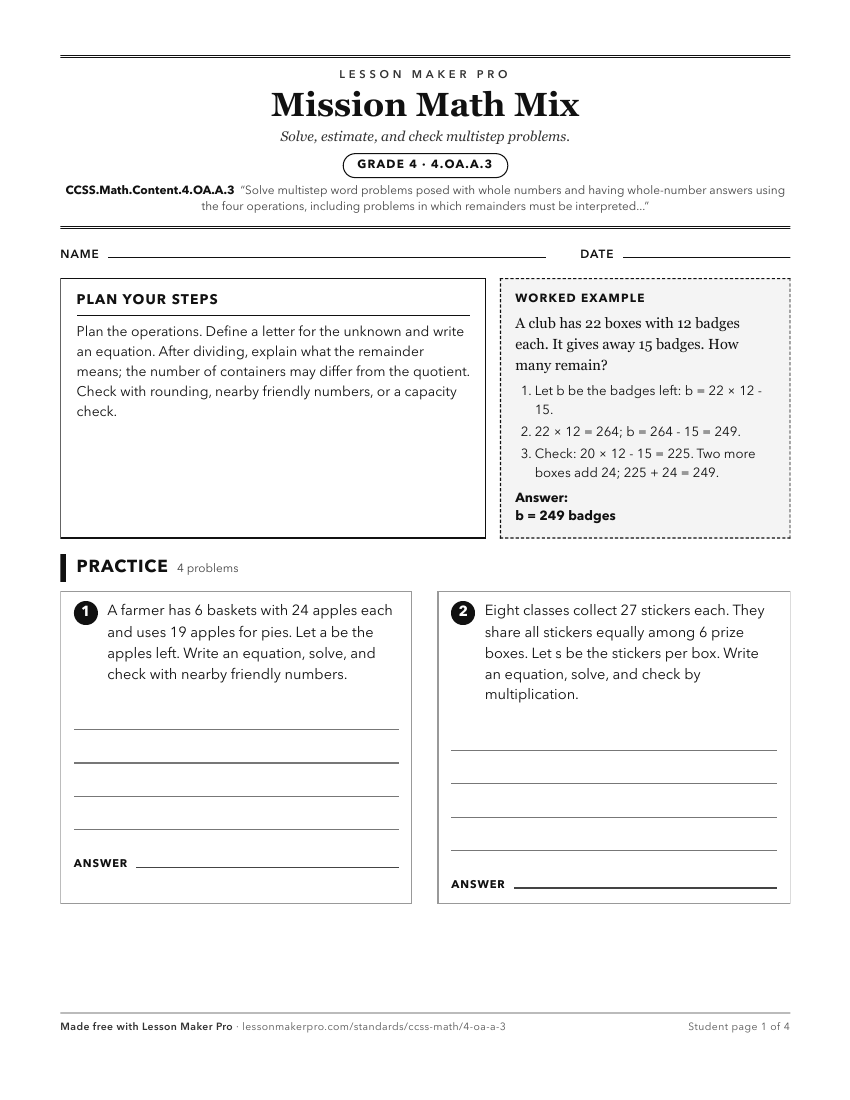
A ready-to-print activity worksheet aligned to CCSS.Math.Content.4.OA.A.3, with an answer key for the teacher on its own page. No account needed.
PDF, US Letter, prints cleanly in black and white.
Download the worksheetLearning progression
Where This Standard Sits
See the whole path on the Operations & Algebraic Thinking progression map.
Before This Standard
If students are struggling here, check these first.
- CCSS.Math.Content.3.OA.D.8
Fourth-grade problems extend two-step operation choices, equations for unknowns, and estimation checks to more steps and interpreted remainders.
- CCSS.Math.Content.3.OA.C.7
Multiplication and division fact fluency supports efficient computation, interpreting division, and checking answers in multistep whole-number problems.
- CCSS.Math.Content.3.NBT.A.1
Rounding whole numbers supports estimating and checking whether multistep word problem answers are reasonable.
What This Unlocks
Mastery here sets students up for these next.
- CCSS.Math.Content.5.OA.A.1
Multistep four-operation work supports seeing and computing grouped steps, but evaluating written grouping symbols is a distinct new notation skill.
- CCSS.Math.Content.5.OA.A.2
Writing equations for multistep problems supports seeing expressions as records of calculations and interpreting their operation structure.
Keep exploring
Related Standards
- CCSS.Math.Content.5.NF.A.2
Solve word problems involving addition and subtraction of fractions referring to the same whole, including cases of unlike denominators, e.g., by using visual f...
- CCSS.Math.Content.7.EE.B.3
Solve multi-step real-life and mathematical problems posed with positive and negative rational numbers in any form (whole numbers, fractions, and decimals), usi...
- CCSS.Math.Content.2.OA.A.1
Use addition and subtraction within 100 to solve one- and two-step word problems involving situations of adding to, taking from, putting together, taking apart,...
Turn this exact standard into a lesson
Grade, subject, topic, and the complete standard are prefilled. Create one free, no account needed.
Also for this standard:Make a WorksheetMake a QuizMake a Sub Lesson