CCSS.
The Standard
Prove that all circles are similar.
Common Core State Standards for Mathematics
Teacher's field guide
What This Standard Means
What Students Need to Do
- Students identify each circle's center and radius. They build a sequence of transformations, usually a translation followed by a dilation, that maps one circle onto another.
What Mastery Looks Like
- Given any two circles, students can translate one center onto the other and dilate by the ratio of the radii. They explain that every point maps correctly because its distance from the center scales by that ratio.
Common Misconceptions
- Students may think circles are similar only when they have equal radii. Others use a translation alone, confuse similarity with congruence, or reverse the radius ratio when finding the dilation factor.
How to Assess It
- Exit ticket: Circle A has center (-2, 1) and radius 3. Circle B has center (4, -5) and radius 7. Describe transformations that map A onto B and justify them.
Lesson moves
Ways to Teach It
Draw two circles on tracing paper, align their centers, and use marked radii to model the dilation from one circle to the other.
Write an explanation of why moving the center and scaling the radius maps every point on one circle to the other.
Sort circle equation cards into pairs, then race to write the translation vector and dilation factor for each pair.
Measure two round lids, calculate their radius ratio, and describe how to move and resize one outline to match the other.
Free download
Printable HSG-C.A.1 Worksheet
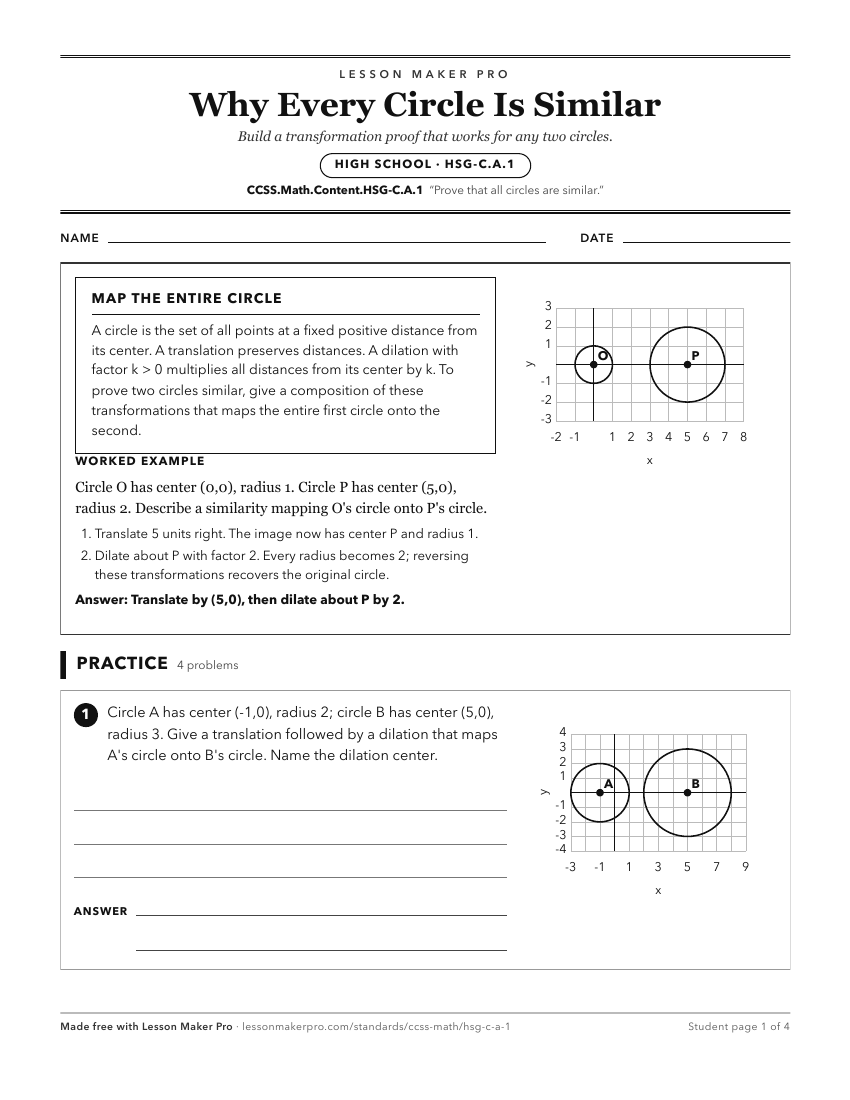
A ready-to-print activity worksheet aligned to CCSS.Math.Content.HSG-C.A.1, with an answer key for the teacher on its own page. No account needed.
PDF, US Letter, prints cleanly in black and white.
Download the worksheetLearning progression
Where This Standard Sits
Before This Standard
If students are struggling here, check these first.
- CCSS.Math.Content.HSG-CO.A.1
The proof uses the precise definition of a circle and radius to show a dilation maps one circle onto another.
- CCSS.Math.Content.HSG-SRT.A.1
Proving circles similar depends on using a dilation scale factor to map one radius, and all points, onto another circle.
- CCSS.Math.Content.HSG-SRT.A.2
Proving all circles are similar requires using similarity transformations to map centers and scale radii between any two circles.
What This Unlocks
Mastery here sets students up for these next.
Keep exploring
Related Standards
- CCSS.Math.Content.HSG-C.A
Understand and apply theorems about circles
- CCSS.Math.Content.HSG-SRT.A.3
Use the properties of similarity transformations to establish the AA criterion for two triangles to be similar.
- CCSS.Math.Content.HSG-SRT.B.5
Use congruence and similarity criteria for triangles to solve problems and to prove relationships in geometric figures.
- CCSS.Math.Content.HSG-SRT.B
Prove theorems involving similarity
Turn this exact standard into a lesson
Grade, subject, topic, and the complete standard are prefilled. Create one free, no account needed.
Also for this standard:Make a WorksheetMake a QuizMake a Sub Lesson