CCSS.
Standard Cluster
Prove theorems involving similarity
Common Core State Standards for Mathematics · High School — Geometry
Cluster contents
Standards in This Cluster
CCSS.Math.Content.HSG-SRT.B is a cluster heading. These are the individual standards under it.
Teacher's field guide
What This Cluster Means
What Students Need to Do
- Students identify similar triangles and justify the match using angle relationships and proportional sides. They use that similarity to prove side relationships and solve for unknown measures.
What Mastery Looks Like
- Students can identify corresponding parts, justify triangle similarity, and write correct proportions. They can use similarity in a clear proof of side-splitting results or the Pythagorean theorem.
Common Misconceptions
- Students may confuse similarity with congruence or assume triangles are similar because they look alike. They often match the wrong corresponding vertices, set up incorrect proportions, or use the result they are trying to prove.
How to Assess It
- Draw triangle ABC with D on AB, E on AC, and DE parallel to BC. Ask students to prove AD/DB = AE/EC and cite each reason.
Lesson moves
Ways to Teach It
Give students paper triangles, rulers, and protractors to group similar pairs, label corresponding vertices, and name the criterion supporting each match.
Ask students to explain why a line parallel to one side of a triangle creates proportional segments on the other two sides.
Use a card sort with mixed proof statements and reasons, then have teams arrange a valid similarity proof and defend the order.
Measure a flagpole and its shadow beside a meter stick, then use similar triangles to calculate the flagpole's height.
Free download
Printable HSG-SRT.B Worksheet
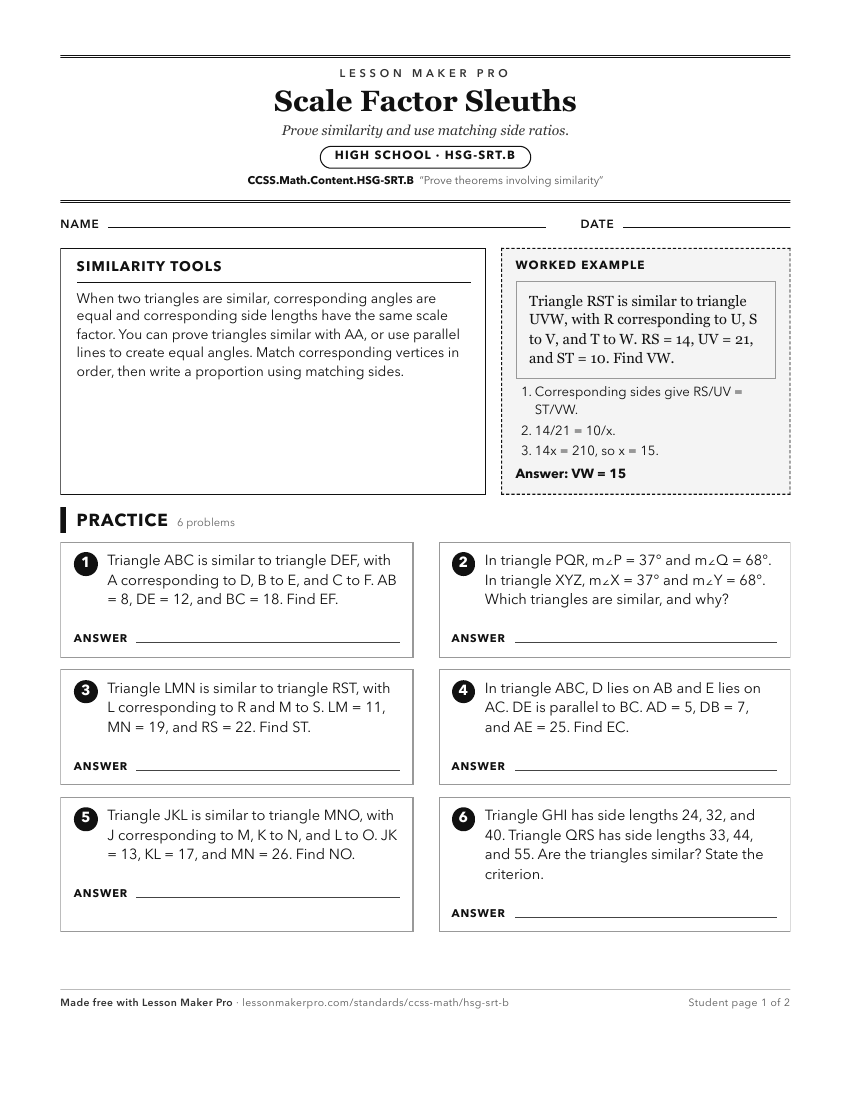
A ready-to-print activity worksheet aligned to CCSS.Math.Content.HSG-SRT.B, with an answer key for the teacher on its own page. No account needed.
PDF, US Letter, prints cleanly in black and white.
Download the worksheetKeep exploring
Related Standards
Turn this cluster into a lesson
Grade, subject, topic, and the complete cluster are prefilled. Create one free, no account needed.
Also for this cluster:Make a WorksheetMake a QuizMake a Sub Lesson