CCSS.
Standard Cluster
Understand and apply theorems about circles
Common Core State Standards for Mathematics · High School — Geometry
Cluster contents
Standards in This Cluster
CCSS.Math.Content.HSG-C.A is a cluster heading. These are the individual standards under it.
- CCSS.Math.Content.HSG-C.A.1
Prove that all circles are similar.
- CCSS.Math.Content.HSG-C.A.2
Identify and describe relationships among inscribed angles, radii, and chords.
- CCSS.Math.Content.HSG-C.A.3
Construct the inscribed and circumscribed circles of a triangle, and prove properties of angles for a quadrilateral inscribed in a circle.
- CCSS.Math.Content.HSG-C.A.4
(+) Construct a tangent line from a point outside a given circle to the circle.
Teacher's field guide
What This Cluster Means
What Students Need to Do
- Students identify relationships among arcs, chords, radii, tangents, central angles, and inscribed angles. They use those relationships to calculate measures and prove claims. They also construct inscribed figures, circumscribed figures, and tangent lines.
What Mastery Looks Like
- Students can find missing arc and angle measures in an unfamiliar circle diagram. They can write a clear proof using definitions and known relationships. They can also construct tangents or inscribed figures and explain why the construction works.
Common Misconceptions
- Students often confuse central angles with inscribed angles and forget the factor of two. They may assume any line touching a drawn circle is tangent or that every quadrilateral in a circle has four right angles. Some use a theorem without checking that angles intercept the same arc.
How to Assess It
- Exit ticket: In circle O, tangent PA meets chord AB at A, and the angle between PA and AB is 38°. Find the minor arc AB, angle ACB for C on the opposite arc, and angle OAP, then justify each answer.
Lesson moves
Ways to Teach It
Give pairs compasses, rulers, and patty paper to compare two circles by tracing and scaling radii, then record why circles are similar.
Display central and inscribed angles intercepting the same arc, then ask students to explain why their measures have a 2-to-1 relationship.
Run a card sort matching circle diagrams, theorem statements, missing measures, and reasons, with teams correcting any unmatched cards.
Place a bicycle wheel against the floor, mark the contact point, and explain why the spoke there is perpendicular to the floor.
Free download
Printable HSG-C.A Worksheet
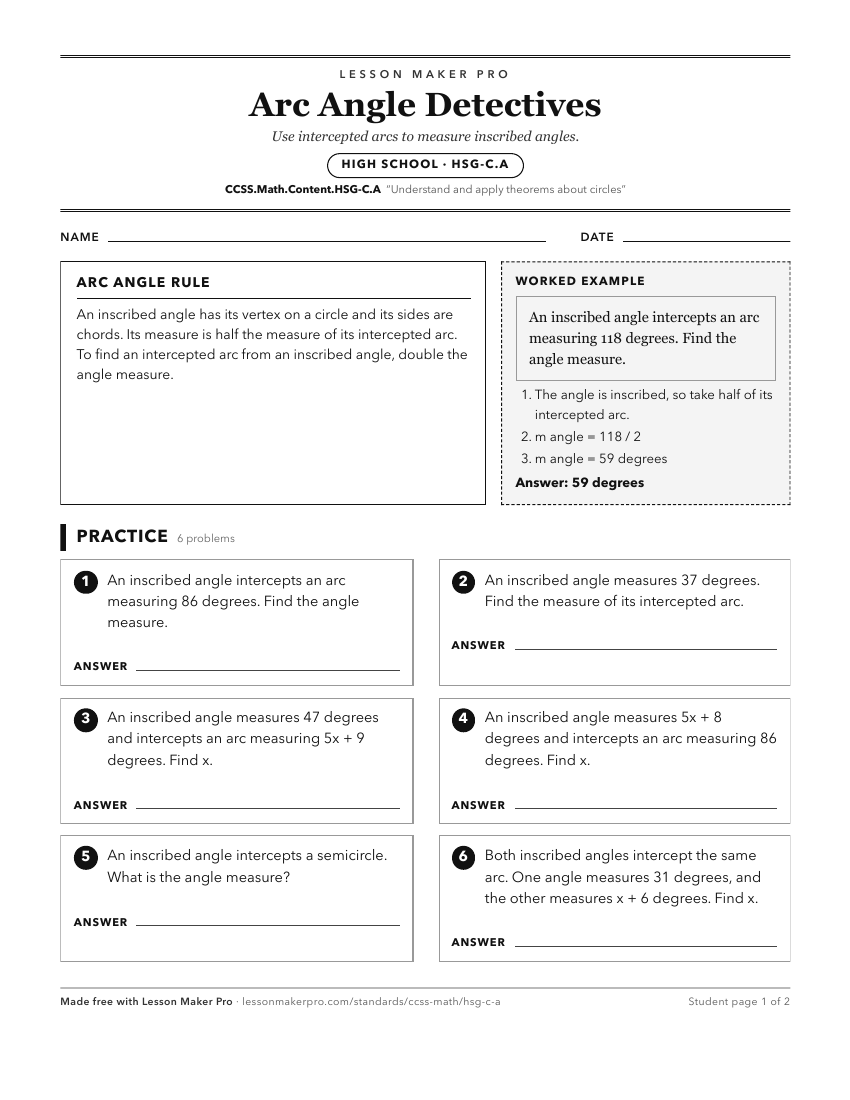
A ready-to-print activity worksheet aligned to CCSS.Math.Content.HSG-C.A, with an answer key for the teacher on its own page. No account needed.
PDF, US Letter, prints cleanly in black and white.
Download the worksheetKeep exploring
Related Standards
- CCSS.Math.Content.HSG-CO.C.9
Prove theorems about lines and angles.
- CCSS.Math.Content.HSG-CO.C
Prove geometric theorems
- CCSS.Math.Content.7.G.B.4
Know the formulas for the area and circumference of a circle and use them to solve problems; give an informal derivation of the relationship between the circumf...
Turn this cluster into a lesson
Grade, subject, topic, and the complete cluster are prefilled. Create one free, no account needed.
Also for this cluster:Make a WorksheetMake a QuizMake a Sub Lesson