CCSS.
The Standard
Know the formulas for the area and circumference of a circle and use them to solve problems; give an informal derivation of the relationship between the circumference and area of a circle.
Common Core State Standards for Mathematics · Geometry
Teacher's field guide
What This Standard Means
What Students Need to Do
- Students choose C = πd or C = 2πr for distance around a circle and A = πr² for space inside it. They use rearranged circle sectors to explain why half the circumference and the radius form the dimensions of a near-rectangle.
What Mastery Looks Like
- Given a radius or diameter, a student selects the correct formula and reports an exact answer with π or a sensible decimal. The student uses linear or square units correctly and can justify A = πr² with rearranged sectors.
Common Misconceptions
- Students may treat the diameter as the radius, use 2πr for area, or use πr² for circumference. They may leave area units unsquared or assume doubling the radius only doubles the area.
How to Assess It
- Exit ticket: A circular garden has a diameter of 12 meters. Using 3.14, find the fencing length and planting area, label units, and sketch the sector rearrangement behind the area formula.
Lesson moves
Ways to Teach It
Cut paper circles into equal sectors, alternate the sectors, and measure the near-rectangle to connect its dimensions to the circle.
Write and discuss: Why does doubling a circle’s radius double its circumference but make its area four times as large?
Play a card match with diagrams, radii, diameters, circumference values, area values, and correct units.
Measure a round table, then calculate the edge trim needed and the surface area available for place settings.
Free download
Printable 7.G.B.4 Worksheet
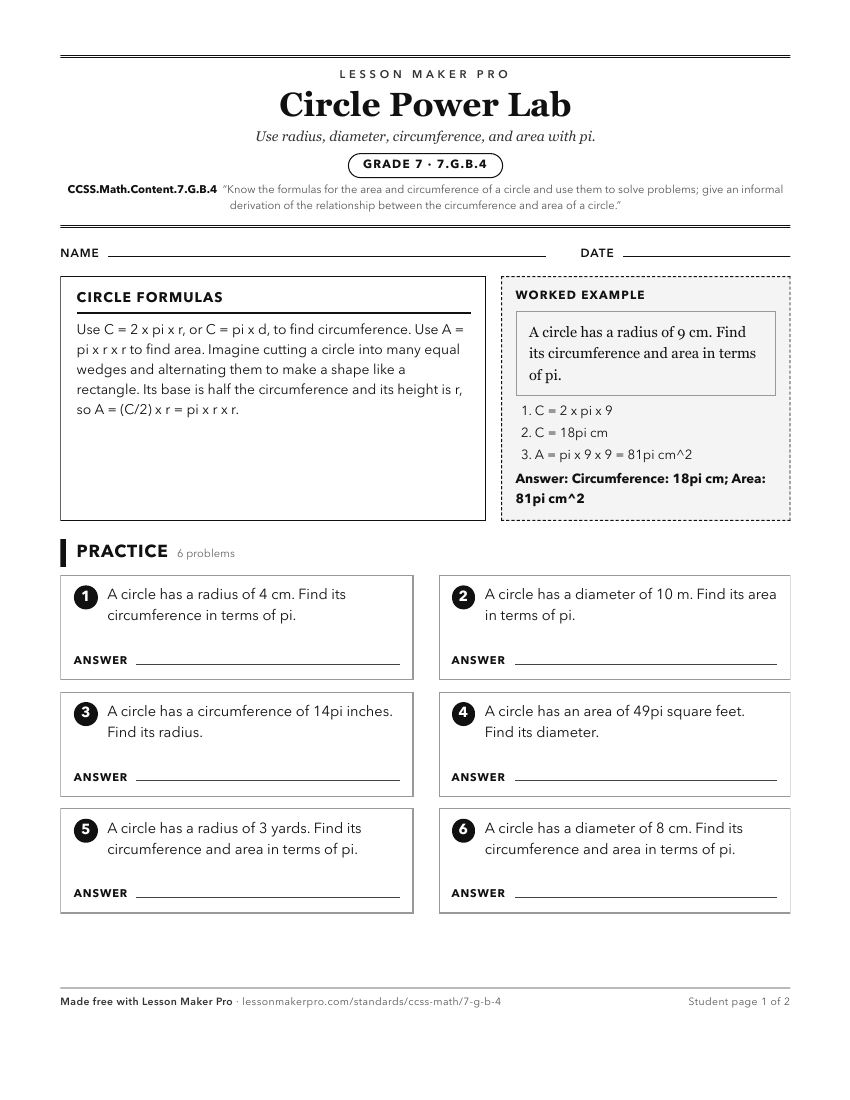
A ready-to-print activity worksheet aligned to CCSS.Math.Content.7.G.B.4, with an answer key for the teacher on its own page. No account needed.
PDF, US Letter, prints cleanly in black and white.
Download the worksheetBefore This Standard
If students are struggling here, check these first.
- CCSS.Math.Content.6.G.A.1
Decomposing shapes and using area formulas supports understanding the circle area derivation, though circumference adds new ideas.
- CCSS.Math.Content.6.EE.A.2c
Circle problems require substituting radius or diameter into formulas and correctly computing products, powers, and operation order.
- CCSS.Math.Content.6.RP.A.1
Circle circumference uses pi as a ratio of circumference to diameter, so ratio language supports understanding the formula.
What This Unlocks
Mastery here sets students up for these next.
- CCSS.Math.Content.8.G.C.9
Circle area and radius work carry into cylinder and cone volume formulas, especially using πr² as the base area.
- CCSS.Math.Content.HSF-TF.A.1
Circumference knowledge supports seeing a full unit circle has arc length 2π, grounding radian measure as arc length.
- CCSS.Math.Content.HSG-GMD.A.1
Knowing and informally deriving circle circumference and area supports later arguments for circle formulas and volumes with circular bases.
- CCSS.Math.Content.HSG-GMD.A.3
Circle area and radius relationships carry into cylinder and cone volume formulas, especially using πr² as the base area.
- CCSS.Math.Content.HSG-GMD.A.2
Cavalieri arguments for sphere volume require computing circular cross sections with the circle area formula.
- CCSS.Math.Content.HSG-C.B.5
Circle circumference and area formulas carry into arc length, radians, and sector area as fractions of a full circle.
Keep exploring
Related Standards
Turn this exact standard into a lesson
Grade, subject, topic, and the complete standard are prefilled. Create one free, no account needed.
Also for this standard:Make a WorksheetMake a QuizMake a Sub Lesson