CCSS.
The Standard
Derive using similarity the fact that the length of the arc intercepted by an angle is proportional to the radius, and define the radian measure of the angle as the constant of proportionality; derive the formula for the area of a sector.
Common Core State Standards for Mathematics
Teacher's field guide
What This Standard Means
What Students Need to Do
- Students compare sectors with the same central angle in similar circles and show that arc length scales with radius. They interpret the arc-length-to-radius ratio as radian measure. They use proportional reasoning to derive the sector area formula.
What Mastery Looks Like
- Students can explain why sectors with the same central angle have a constant arc-length-to-radius ratio. They can derive and use s = rθ and A = 1/2 r²θ when θ is in radians.
Common Misconceptions
- Students often use degree measures directly in formulas that require radians. They may confuse arc length with sector area, or treat the central angle as an arc length.
How to Assess It
- Exit ticket: A sector has radius 6 cm and central angle 2 radians. Find its arc length and area, then explain why both formulas depend on the radius.
Lesson moves
Ways to Teach It
Cut paper sectors with the same angle and different radii, measure each arc with string, then compare the ratios of arc length to radius.
Write an explanation for why doubling a sector’s radius doubles its arc length but multiplies its area by four.
Sort cards showing radii, radian angles, arc lengths, and sector areas into matching sets, then justify one set.
Model a rotating sprinkler, then calculate the outer arc and watered area from its reach and turning angle.
Free download
Printable HSG-C.B.5 Worksheet
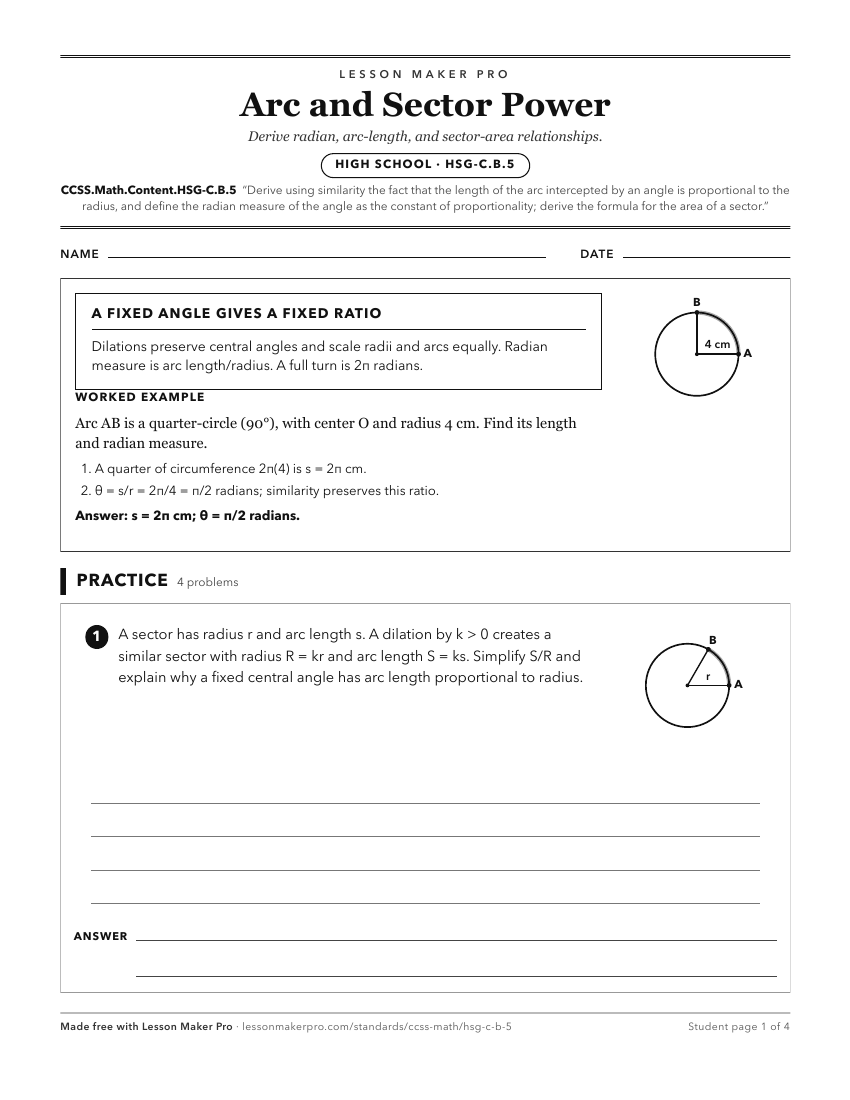
A ready-to-print activity worksheet aligned to CCSS.Math.Content.HSG-C.B.5, with an answer key for the teacher on its own page. No account needed.
PDF, US Letter, prints cleanly in black and white.
Download the worksheetLearning progression
Where This Standard Sits
Before This Standard
If students are struggling here, check these first.
- CCSS.Math.Content.HSG-C.A.1
Knowing circles are related by dilations supports showing matching arcs scale with radius for a fixed central angle.
- CCSS.Math.Content.HSG-SRT.A.2
Deriving radians and sector formulas depends on dilations showing similar circular sectors have proportional arc lengths and scaled areas.
- CCSS.Math.Content.7.G.B.4
Circle circumference and area formulas carry into arc length, radians, and sector area as fractions of a full circle.
What This Unlocks
Mastery here sets students up for these next.
Keep exploring
Related Standards
Turn this exact standard into a lesson
Grade, subject, topic, and the complete standard are prefilled. Create one free, no account needed.
Also for this standard:Make a WorksheetMake a QuizMake a Sub Lesson