CCSS.
The Standard
Understand the concept of a ratio and use ratio language to describe a ratio relationship between two quantities.
Common Core State Standards for Mathematics · Ratios and Proportional Relationships
Teacher's field guide
What This Standard Means
What Students Need to Do
- Students compare two quantities using ratio language. They write ratios in different forms and explain what each number represents in the stated order.
What Mastery Looks Like
- Students correctly identify which quantity comes first and write the ratio with words, a colon, or a fraction. They explain the relationship using accurate units and "for every" language.
Common Misconceptions
- Students may reverse the order of the quantities, writing 3:2 when the prompt asks for red to blue. They may use subtraction instead of multiplicative language, or confuse part-to-part ratios with part-to-whole ratios.
How to Assess It
- Show 8 circles and 12 squares. Ask students to write the ratio of circles to squares in two forms and explain it using "for every."
Lesson moves
Ways to Teach It
Give pairs colored counters and have students build a group with a 2:3 red-to-blue ratio, then describe the relationship aloud.
Display 6 pencils and 4 markers, then ask students to explain how pencil-to-marker and marker-to-pencil ratios differ.
Play ratio match with cards showing pictures, colon notation, fractions, and verbal descriptions that students must group into matching sets.
Use a drink recipe with 2 cups juice and 3 cups water, then have students state each possible part-to-part and part-to-whole ratio.
Free download
Printable 6.RP.A.1 Worksheet
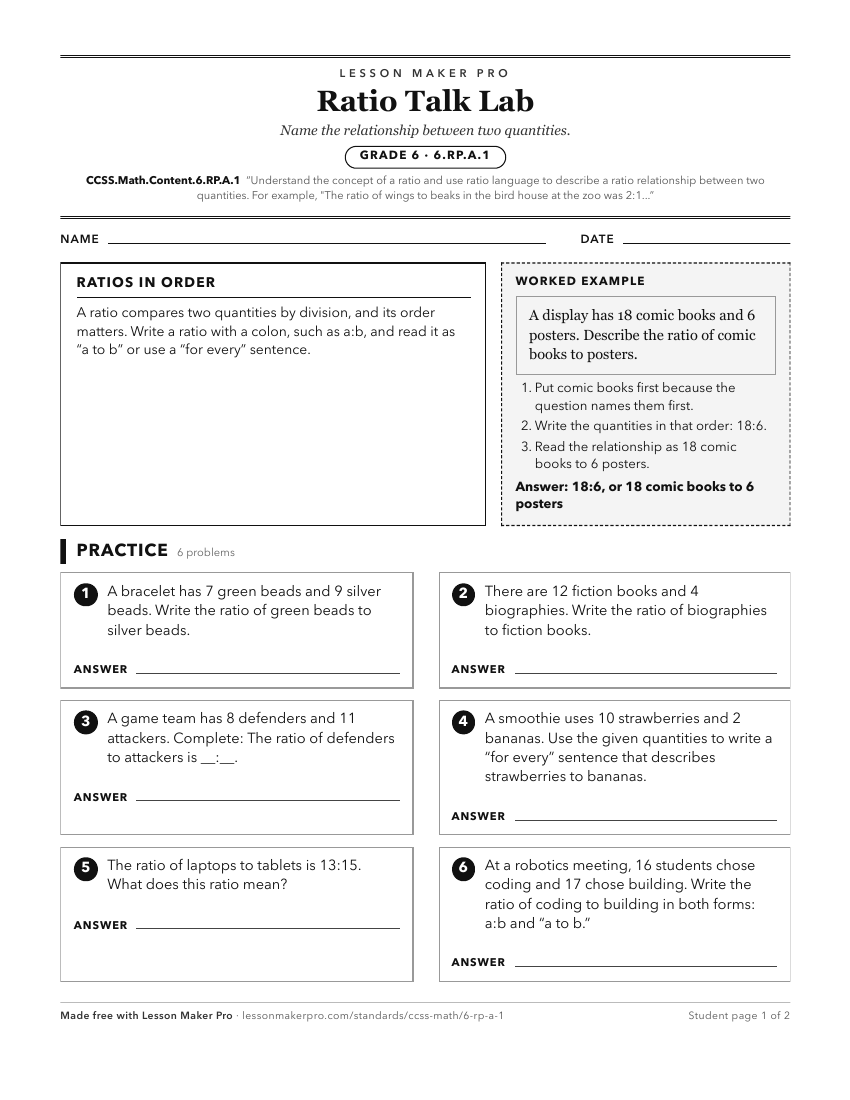
A ready-to-print activity worksheet aligned to CCSS.Math.Content.6.RP.A.1, with an answer key for the teacher on its own page. No account needed.
PDF, US Letter, prints cleanly in black and white.
Download the worksheetLearning progression
Where This Standard Sits
See the whole path on the Ratios & Proportional Relationships progression map.
Before This Standard
If students are struggling here, check these first.
- CCSS.Math.Content.4.OA.A.1
Multiplicative comparison prepares students to see two quantities in relative terms, which supports ratio language like “3 times as many.”
- CCSS.Math.Content.4.OA.A.2
Multiplicative comparison prepares students to see two quantities in times-as-many terms, which supports ratio language and relationships.
- CCSS.Math.Content.5.NF.B.3
Interpreting a/b as a division quotient supports seeing ratios as multiplicative comparisons that can be written and reasoned about fractionally.
What This Unlocks
Mastery here sets students up for these next.
- CCSS.Math.Content.7.SP.C.6
Relative frequency treats outcomes compared with total trials as a ratio, which supports estimating and predicting probability from data.
- CCSS.Math.Content.7.SP.C.7a
Uniform probability uses a ratio of favorable outcomes to total equally likely outcomes to describe and calculate event probabilities.
- CCSS.Math.Content.8.SP.A.4
Relative frequencies in two-way tables are ratios of counts, so ratio language supports calculating and comparing row or column percentages.
- CCSS.Math.Content.6.RP.A.3b
Unit rates are ratios measured per one unit, so students must understand ratio relationships before solving pricing or speed problems.
- CCSS.Math.Content.7.RP.A.1
Unit rates are ratios expressed per one unit, so students need ratio meaning and language before interpreting rates with fractions.
- CCSS.Math.Content.6.RP.A.3a
Students need to understand what a ratio compares before generating equivalent ratio tables, missing values, graphs, and comparisons.
Keep exploring
Related Standards
- CCSS.Math.Content.7.RP.A.2
Recognize and represent proportional relationships between quantities.
- CCSS.Math.Content.6.RP.A.3
Use ratio and rate reasoning to solve real-world and mathematical problems, e.g., by reasoning about tables of equivalent ratios, tape diagrams, double number l...
- CCSS.Math.Content.6.RP.A.2
Understand the concept of a unit rate a/b associated with a ratio a:b with b ≠ 0, and use rate language in the context of a ratio relationship.
- CCSS.Math.Content.6.RP.A
Understand ratio concepts and use ratio reasoning to solve problems.
Turn this exact standard into a lesson
Grade, subject, topic, and the complete standard are prefilled. Create one free, no account needed.
Also for this standard:Make a WorksheetMake a QuizMake a Sub Lesson