CCSS.
The Standard
Develop a uniform probability model by assigning equal probability to all outcomes, and use the model to determine probabilities of events.
Common Core State Standards for Mathematics
Teacher's field guide
What This Standard Means
What Students Need to Do
- Students build probability models for situations where every individual outcome has an equal chance. They use counts of favorable and total outcomes to find the probability of an event.
What Mastery Looks Like
- Students list all possible outcomes and assign each the same probability when the outcomes are equally likely. They find event probabilities by dividing favorable outcomes by total outcomes and explain their reasoning.
Common Misconceptions
- Students may count categories instead of individual outcomes, or treat unequal outcomes as equally likely. They may also reverse favorable and total outcomes when writing a probability fraction.
How to Assess It
- Give this exit ticket: “A bag holds 4 red, 3 blue, and 1 green counter. Find the probability of drawing red or blue.”
Lesson moves
Ways to Teach It
Put eight equal-sized colored counters in a bag, list each possible draw, then calculate and test event probabilities with 40 draws.
Ask students to explain in writing why selecting one named student differs from selecting any student wearing glasses.
Play a card-draw game where pairs earn points by correctly finding probabilities for events such as drawing a face card or red card.
Use a classroom raffle list to calculate the chance that one student, a seventh grader, or a bus rider is selected.
Free download
Printable 7.SP.C.7a Worksheet
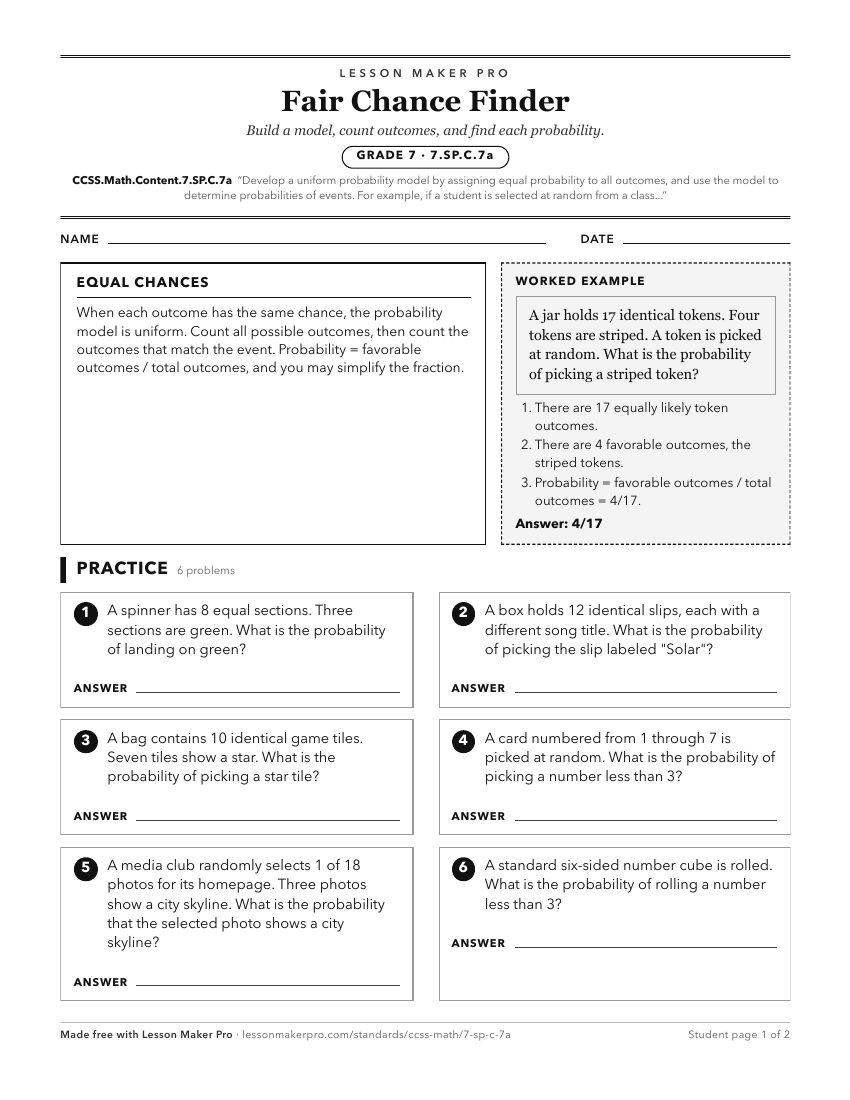
A ready-to-print activity worksheet aligned to CCSS.Math.Content.7.SP.C.7a, with an answer key for the teacher on its own page. No account needed.
PDF, US Letter, prints cleanly in black and white.
Download the worksheetLearning progression
Where This Standard Sits
Before This Standard
If students are struggling here, check these first.
- CCSS.Math.Content.6.RP.A.1
Uniform probability uses a ratio of favorable outcomes to total equally likely outcomes to describe and calculate event probabilities.
- CCSS.Math.Content.7.SP.C.5
Understanding probability as a 0 to 1 likelihood scale supports assigning equal outcome probabilities and interpreting event probabilities.
- CCSS.Math.Content.5.NF.B.3
Uniform probability uses fractions as favorable outcomes divided by total equally likely outcomes, so fraction-as-division supports the model.
What This Unlocks
Mastery here sets students up for these next.
- CCSS.Math.Content.7.SP.C.8a
Students need favorable-outcomes-over-total reasoning from uniform simple-event models before applying the same fraction idea to compound sample spaces.
- CCSS.Math.Content.HSS-MD.B.6
Fair decision methods rely on assigning equal chances to outcomes and checking that each person or option has the same probability.
Keep exploring
Related Standards
- CCSS.Math.Content.HSS-CP.B
Use the rules of probability to compute probabilities of compound events in a uniform probability model
- CCSS.Math.Content.7.SP.C.7
Develop a probability model and use it to find probabilities of events. Compare probabilities from a model to observed frequencies; if the agreement is not good...
- CCSS.Math.Content.7.SP.C.7b
Develop a probability model (which may not be uniform) by observing frequencies in data generated from a chance process.
- CCSS.Math.Content.7.SP.C
Investigate chance processes and develop, use, and evaluate probability models.
Turn this exact standard into a lesson
Grade, subject, topic, and the complete standard are prefilled. Create one free, no account needed.
Also for this standard:Make a WorksheetMake a QuizMake a Sub Lesson