CCSS.
Standard Cluster
Use the rules of probability to compute probabilities of compound events in a uniform probability model
Common Core State Standards for Mathematics · High School — Statistics and Probability
Cluster contents
Standards in This Cluster
CCSS.Math.Content.HSS-CP.B is a cluster heading. These are the individual standards under it.
- CCSS.Math.Content.HSS-CP.B.6
Find the conditional probability of A given B as the fraction of B's outcomes that also belong to A, and interpret the answer in terms of the model.
- CCSS.Math.Content.HSS-CP.B.7
Apply the Addition Rule, P(A or B) = P(A) + P(B) - P(A and B), and interpret the answer in terms of the model.
- CCSS.Math.Content.HSS-CP.B.8
(+) Apply the general Multiplication Rule in a uniform probability model, P(A and B) = P(A)P(B|A) = P(B)P(A|B), and interpret the answer in terms of the model.
- CCSS.Math.Content.HSS-CP.B.9
(+) Use permutations and combinations to compute probabilities of compound events and solve problems.
Teacher's field guide
What This Cluster Means
What Students Need to Do
- Students represent compound events with lists, tables, tree diagrams, or set notation. They count equally likely outcomes and use addition, multiplication, complements, and conditional probability without double-counting overlap.
What Mastery Looks Like
- Given cards, dice, or another uniform model, students choose a useful representation and calculate the probability of an “and,” “or,” or “at least one” event. They justify whether events overlap or are independent and show each count or rule used.
Common Misconceptions
- Students often add probabilities for “and” events or multiply probabilities for “or” events without checking the situation. They may double-count overlapping outcomes, assume independence after sampling without replacement, or reverse P(A given B) and P(B given A).
How to Assess It
- Exit ticket: A bag has 3 red and 2 blue counters, and two are drawn without replacement. Find the probability of getting at least one blue counter, and show the rule or sample space used.
Lesson moves
Ways to Teach It
Roll two dice, list all 36 ordered outcomes on a grid, shade sums above eight or doubles, and calculate the shaded proportion.
Discuss a student's claim that heart or king equals 13/52 plus 4/52, then write a correction for the overlap.
Run a Rule Sort relay where teams classify scenario cards as addition, multiplication, or complement, then solve one card from each group.
Use a 100-ticket raffle with three prizes to calculate the chance that a student holding two tickets wins at least once.
Free download
Printable HSS-CP.B Worksheet
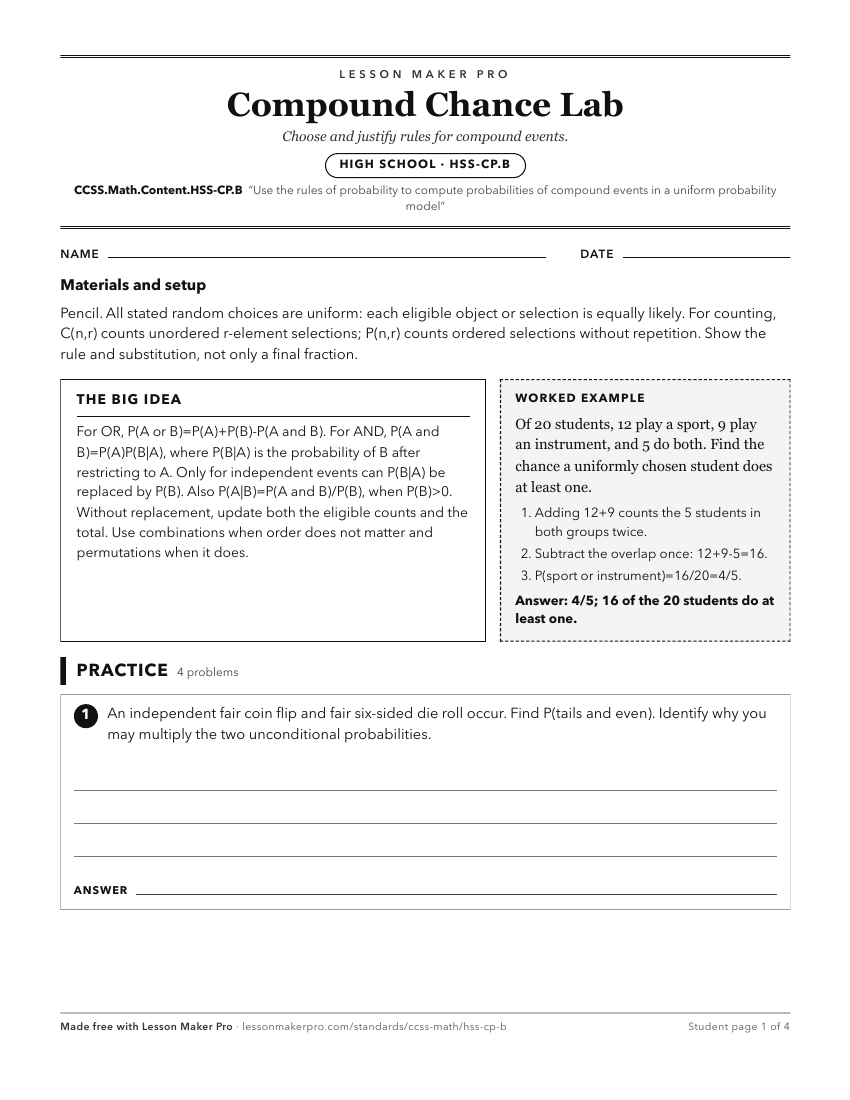
A ready-to-print activity worksheet aligned to CCSS.Math.Content.HSS-CP.B, with an answer key for the teacher on its own page. No account needed.
PDF, US Letter, prints cleanly in black and white.
Download the worksheetKeep exploring
Related Standards
- CCSS.Math.Content.7.SP.C.8a
Understand that, just as with simple events, the probability of a compound event is the fraction of outcomes in the sample space for which the compound event oc...
- CCSS.Math.Content.7.SP.C.7a
Develop a uniform probability model by assigning equal probability to all outcomes, and use the model to determine probabilities of events.
- CCSS.Math.Content.7.SP.C.8
Find probabilities of compound events using organized lists, tables, tree diagrams, and simulation.
Turn this cluster into a lesson
Grade, subject, topic, and the complete cluster are prefilled. Create one free, no account needed.
Also for this cluster:Make a WorksheetMake a QuizMake a Sub Lesson