CCSS.
The Standard
Find the conditional probability of A given B as the fraction of B's outcomes that also belong to A, and interpret the answer in terms of the model.
Common Core State Standards for Mathematics
Teacher's field guide
What This Standard Means
What Students Need to Do
- Students narrow the possible outcomes to the group named after “given.” They count how many outcomes in that group also meet the other condition, form a fraction, and explain its meaning.
What Mastery Looks Like
- Students can find conditional probabilities from a two-way table, tree diagram, or written situation. They choose the correct restricted group as the denominator and explain the result in context.
Common Misconceptions
- Students often use the total sample size as the denominator instead of the number in the given group. They may reverse the conditions or count only one event instead of the overlap.
How to Assess It
- Exit ticket: Of 30 students, 12 play an instrument and 8 of those play a sport. Find the probability a student plays a sport given that they play an instrument, then explain your denominator.
Lesson moves
Ways to Teach It
Give pairs number cards, keep only even cards, then find the probability that a remaining card is greater than six.
Ask students to explain why the chance of playing soccer given tenth grade may differ from being in tenth grade given soccer.
Play a table-reading relay where teams identify the given group, overlap count, and conditional probability for each two-way table.
Use cafeteria survey data to find the probability of a food allergy among students who chose a specific lunch.
Free download
Printable HSS-CP.B.6 Worksheet
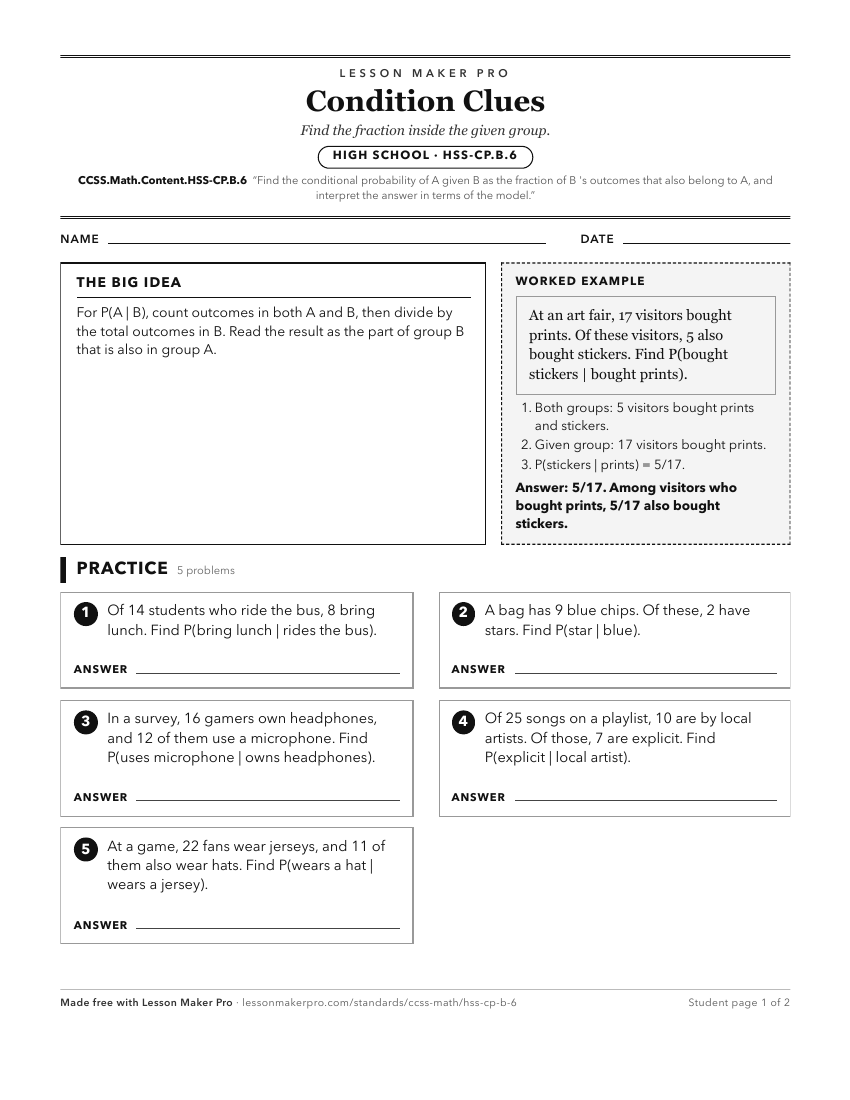
A ready-to-print activity worksheet aligned to CCSS.Math.Content.HSS-CP.B.6, with an answer key for the teacher on its own page. No account needed.
PDF, US Letter, prints cleanly in black and white.
Download the worksheetLearning progression
Where This Standard Sits
Before This Standard
If students are struggling here, check these first.
- CCSS.Math.Content.HSS-CP.A.1
Conditional probability requires seeing A and B as event sets and counting their overlap within the restricted sample space B.
- CCSS.Math.Content.HSS-CP.A.3
Students must know conditional probability as the ratio of overlap to the given event before calculating and interpreting it from outcomes.
- CCSS.Math.Content.HSS-CP.A.4
Two-way tables give the sample-space counts needed to see conditional probability as the part of B that is also A.
What This Unlocks
Mastery here sets students up for these next.
Keep exploring
Related Standards
- CCSS.Math.Content.HSS-CP.B.7
Apply the Addition Rule, P(A or B) = P(A) + P(B) - P(A and B), and interpret the answer in terms of the model.
- CCSS.Math.Content.7.SP.C.7a
Develop a uniform probability model by assigning equal probability to all outcomes, and use the model to determine probabilities of events.
Turn this exact standard into a lesson
Grade, subject, topic, and the complete standard are prefilled. Create one free, no account needed.
Also for this standard:Make a WorksheetMake a QuizMake a Sub Lesson