CCSS.
The Standard
Understand the conditional probability of A given B as P(A and B)/P(B), and interpret independence of A and B as saying that the conditional probability of A given B is the same as the probability of A, and the conditional probability of B given A is the same as the probability of B.
Common Core State Standards for Mathematics
Teacher's field guide
What This Standard Means
What Students Need to Do
- Students calculate the chance of an event after restricting the sample space to cases where another event occurred. They compare conditional and overall probabilities to decide whether two events are independent.
What Mastery Looks Like
- Given a two-way table, tree diagram, or context, a student selects the correct restricted total and computes accurately. The student supports an independence claim with matching probabilities, not intuition.
Common Misconceptions
- Students often divide by the full sample size instead of the size of the given group. They may treat “A given B” as “A and B.” They also confuse independent events with mutually exclusive events.
How to Assess It
- Exit ticket: Of 100 students, 40 play a sport, 30 play in band, and 12 do both. Find the probability that a student plays a sport given that the student plays in band, then decide whether the events are independent.
Lesson moves
Ways to Teach It
Sort a standard deck into a two-way table for red cards and face cards, then calculate conditional probabilities and test independence.
Ask students to write: How does learning that a card is red change the chance that it is a face card?
Play Independence Match, where teams pair event cards with probability cards and justify each match using conditional and overall probabilities.
Use a school survey on club membership and bus ridership to test whether the two traits appear independent.
Free download
Printable HSS-CP.A.3 Worksheet
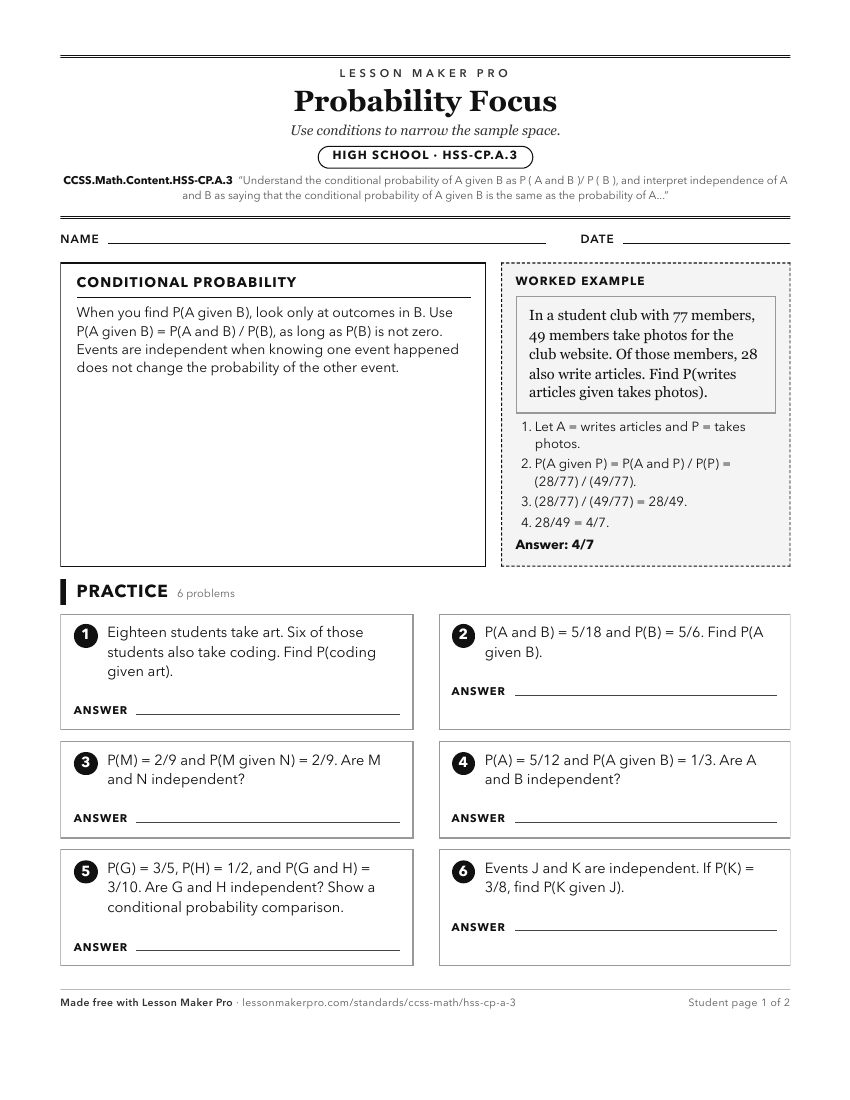
A ready-to-print activity worksheet aligned to CCSS.Math.Content.HSS-CP.A.3, with an answer key for the teacher on its own page. No account needed.
PDF, US Letter, prints cleanly in black and white.
Download the worksheetLearning progression
Where This Standard Sits
Before This Standard
If students are struggling here, check these first.
- CCSS.Math.Content.HSS-CP.A.2
Students carry forward the product test for independence to connect conditional probabilities matching original probabilities.
- CCSS.Math.Content.HSS-CP.A.1
Conditional probability and independence require seeing events as sets and interpreting A and B as their overlap within the sample space.
- CCSS.Math.Content.7.SP.C.8a
Conditional probability requires finding the probability of the joint event A and B within a sample space.
What This Unlocks
Mastery here sets students up for these next.
- CCSS.Math.Content.HSS-CP.A.4
Students use the formula and independence test from A.3 to interpret table entries as conditional probabilities and independence evidence.
- CCSS.Math.Content.HSS-CP.B.8
The multiplication rule is a rearrangement of conditional probability, so students must understand P(B|A) and P(A|B).
- CCSS.Math.Content.HSS-CP.A.5
Formal conditional probability and independence give students the meanings they must translate into everyday situations and explanations.
- CCSS.Math.Content.HSS-CP.B.6
Students must know conditional probability as the ratio of overlap to the given event before calculating and interpreting it from outcomes.
- CCSS.Math.Content.HSS-MD.B.7
Conditional probability and independence support evaluating tests and strategies where outcomes depend on prior events or changing information.
Keep exploring
Related Standards
Turn this exact standard into a lesson
Grade, subject, topic, and the complete standard are prefilled. Create one free, no account needed.
Also for this standard:Make a WorksheetMake a QuizMake a Sub Lesson