CCSS.
The Standard
(+) Apply the general Multiplication Rule in a uniform probability model, P(A and B) = P(A)P(B|A) = P(B)P(A|B), and interpret the answer in terms of the model.
Common Core State Standards for Mathematics
Teacher's field guide
What This Standard Means
What Students Need to Do
- Students find the probability that two events both happen by multiplying one event's probability by the other's conditional probability. They can start with either event and interpret the result using equally likely outcomes.
What Mastery Looks Like
- Students choose the correct marginal and conditional probabilities, then calculate the joint probability accurately. They show that either product form gives the same result and explain what that result means.
Common Misconceptions
- Students often multiply P(A) and P(B) even when the events are dependent, or use P(B|A) as if it were P(B). They may reverse the condition, add instead of multiply, or report a number without naming the joint event.
How to Assess It
- Exit ticket: A bag has 4 blue and 6 yellow counters. Two are drawn without replacement. Let A be first blue and B be second blue. Find P(A and B) using both product forms, then interpret the result.
Lesson moves
Ways to Teach It
Draw two colored tiles without replacement, record ordered outcomes, and compare the observed probability of two reds with P(red first)P(red second|red first).
Explain why P(A and B) may differ from P(A)P(B), using a card draw without replacement as evidence.
Match joint-probability cards with equivalent marginal-times-conditional expressions, then justify each match to a partner.
Use school survey counts to find the probability that a randomly selected student plays a sport and takes music, then interpret it.
Free download
Printable HSS-CP.B.8 Worksheet
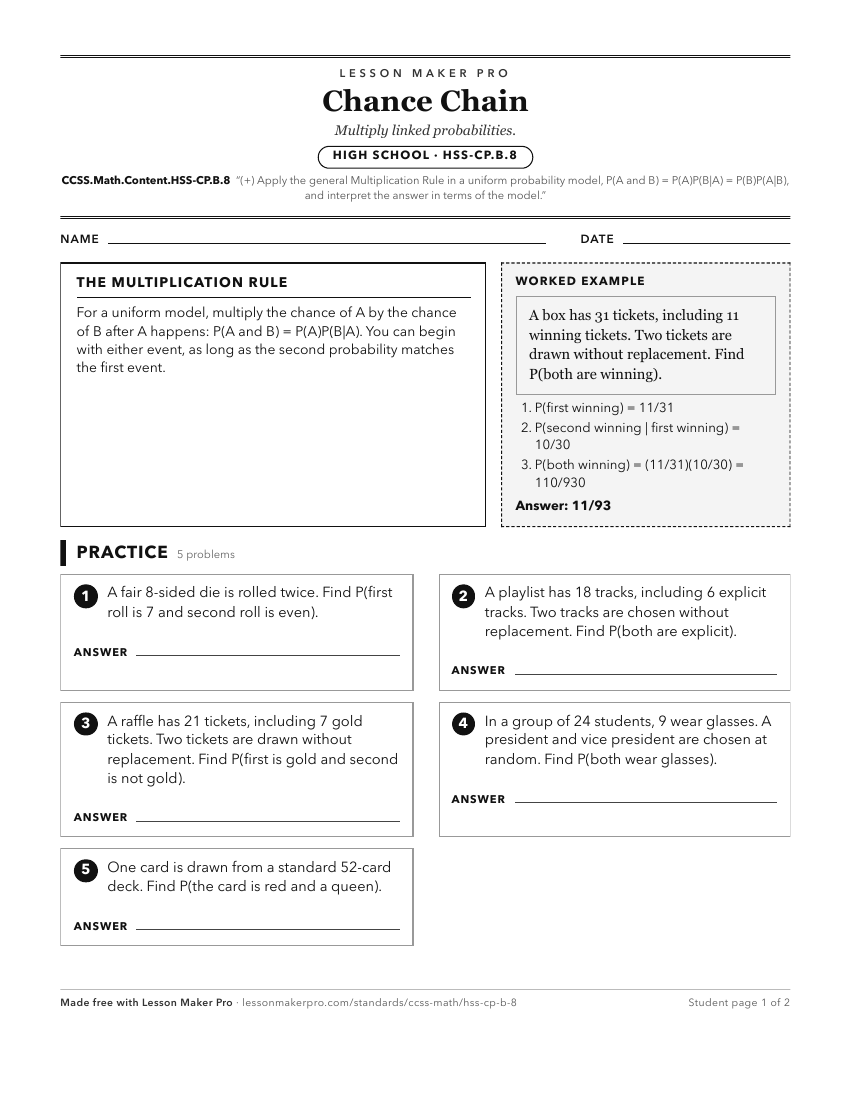
A ready-to-print activity worksheet aligned to CCSS.Math.Content.HSS-CP.B.8, with an answer key for the teacher on its own page. No account needed.
PDF, US Letter, prints cleanly in black and white.
Download the worksheetLearning progression
Where This Standard Sits
Before This Standard
If students are struggling here, check these first.
- CCSS.Math.Content.HSS-CP.A.3
The multiplication rule is a rearrangement of conditional probability, so students must understand P(B|A) and P(A|B).
- CCSS.Math.Content.HSS-CP.B.6
The multiplication rule uses conditional probabilities, so students must understand them as parts of a given event's outcomes.
- CCSS.Math.Content.HSS-CP.A.1
Students must understand events as sets and “A and B” as an intersection before applying the multiplication rule.
Keep exploring
Related Standards
Turn this exact standard into a lesson
Grade, subject, topic, and the complete standard are prefilled. Create one free, no account needed.
Also for this standard:Make a WorksheetMake a QuizMake a Sub Lesson