CCSS.
The Standard
Apply the Addition Rule, P(A or B) = P(A) + P(B) - P(A and B), and interpret the answer in terms of the model.
Common Core State Standards for Mathematics
Teacher's field guide
What This Standard Means
What Students Need to Do
- Students find the probability that at least one of two events occurs. They add the individual probabilities, remove the overlap counted twice, and explain the result in context.
What Mastery Looks Like
- Students identify each event and the shared outcomes in a table, diagram, or word problem. They calculate the probability correctly and explain what it means for the situation.
Common Misconceptions
- Students often add both probabilities without subtracting outcomes that belong to both events. They may also treat “or” as exclusive and leave out the overlap entirely.
How to Assess It
- Exit ticket: Of 40 students, 22 play a sport, 18 play an instrument, and 8 do both. Find the probability that a student does either activity and explain your answer.
Lesson moves
Ways to Teach It
Have students place name cards in a floor Venn diagram for two class preferences, then calculate the probability of either preference.
Ask why the overlap must be subtracted, then have students explain with a two-circle Venn diagram and one numerical example.
Run a card game where teams calculate probabilities for prompts such as drawing a heart or a face card.
Use school survey data to find the probability that a student joins either of two clubs, including students who join both.
Free download
Printable HSS-CP.B.7 Worksheet
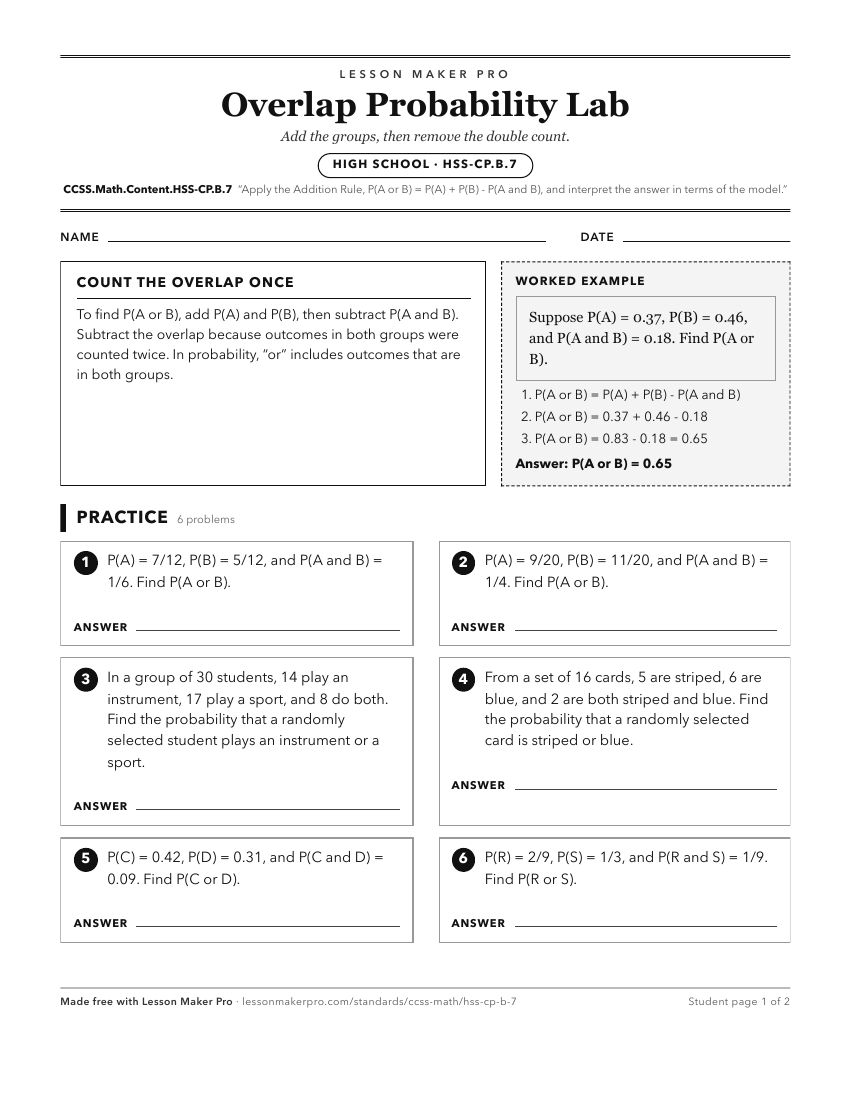
A ready-to-print activity worksheet aligned to CCSS.Math.Content.HSS-CP.B.7, with an answer key for the teacher on its own page. No account needed.
PDF, US Letter, prints cleanly in black and white.
Download the worksheetLearning progression
Where This Standard Sits
Before This Standard
If students are struggling here, check these first.
- CCSS.Math.Content.HSS-CP.A.1
Students must recognize events, “or” unions, and “and” intersections to apply the addition rule and interpret the probability.
- CCSS.Math.Content.7.SP.C.8a
Students need to see “A or B” and “A and B” as compound events before using the Addition Rule meaningfully.
- CCSS.Math.Content.7.NS.A.3
Adding and subtracting rational probabilities supports using the addition rule, though the main new work is probability relationships.
Keep exploring
Related Standards
- CCSS.Math.Content.HSS-CP.A.3
Understand the conditional probability of A given B as P(A and B)/P(B), and interpret independence of A and B as saying that the conditional probability of A gi...
- CCSS.Math.Content.HSS-CP.B.6
Find the conditional probability of A given B as the fraction of B's outcomes that also belong to A, and interpret the answer in terms of the model.
- CCSS.Math.Content.HSS-CP.B.8
(+) Apply the general Multiplication Rule in a uniform probability model, P(A and B) = P(A)P(B|A) = P(B)P(A|B), and interpret the answer in terms of the model.
- CCSS.Math.Content.HSS-CP.A.2
Understand that two events A and B are independent if the probability of A and B occurring together is the product of their probabilities, and use this characte...
Turn this exact standard into a lesson
Grade, subject, topic, and the complete standard are prefilled. Create one free, no account needed.
Also for this standard:Make a WorksheetMake a QuizMake a Sub Lesson