CCSS.
The Standard
Find probabilities of compound events using organized lists, tables, tree diagrams, and simulation.
Common Core State Standards for Mathematics · Statistics and Probability
Teacher's field guide
What This Standard Means
What Students Need to Do
- Students organize all possible outcomes for two or more chance events using lists, tables, or tree diagrams. They find probabilities from those outcomes and run simulations to estimate probabilities when needed.
What Mastery Looks Like
- A student lists every possible outcome once and clearly identifies the outcomes that match the event. They calculate the probability as favorable outcomes over total equally likely outcomes. They can use simulation results to estimate probability and explain why estimates may vary.
Common Misconceptions
- Students may leave out outcomes or count the same outcome twice. They often add probabilities when events must both occur, or multiply when either event can occur. They may also ignore whether items are replaced between selections.
How to Assess It
- Give this exit ticket: “Flip a coin and roll a six-sided die. Use a table or tree diagram to find the probability of tails and a number greater than 4.”
Lesson moves
Ways to Teach It
Have pairs flip two coins 30 times, record outcomes in a table, and compare experimental probabilities with the complete sample space.
Ask students to explain in writing why getting heads and rolling an even number differs from getting heads or an even number.
Play a tree diagram relay where teams complete branches, list outcomes, and calculate a compound event probability for each card.
Use a lunch menu with three entrees and four sides to list meal combinations and find the probability of randomly receiving a chosen pairing.
Free download
Printable 7.SP.C.8 Worksheet
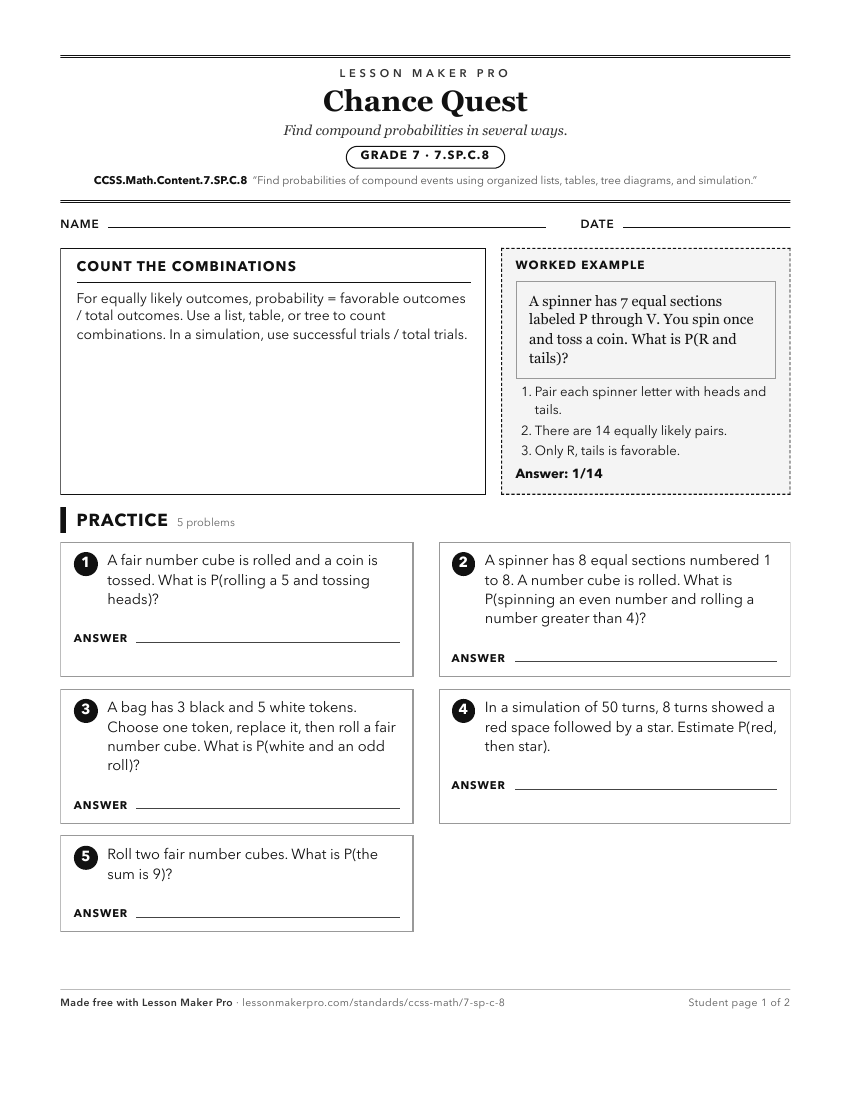
A ready-to-print activity worksheet aligned to CCSS.Math.Content.7.SP.C.8, with an answer key for the teacher on its own page. No account needed.
PDF, US Letter, prints cleanly in black and white.
Download the worksheetLearning progression
Where This Standard Sits
See the whole path on the Statistics & Probability progression map.
Before This Standard
If students are struggling here, check these first.
- CCSS.Math.Content.7.SP.C.5
Students must understand probability values from 0 to 1 before calculating and interpreting probabilities for compound events.
- CCSS.Math.Content.7.SP.C.8a
Students must connect favorable outcomes to the whole sample space before using lists, tables, trees, or simulations to find compound probabilities.
- CCSS.Math.Content.7.SP.C.7
Using probability models for simple events supports finding compound event probabilities with lists, tables, trees, and simulations.
What This Unlocks
Mastery here sets students up for these next.
- CCSS.Math.Content.HSS-CP.A.2
Finding compound event probabilities with tables or tree diagrams supports comparing P(A and B) to P(A)P(B) for independence.
- CCSS.Math.Content.HSS-CP.B.9
Counting outcomes with lists, tables, and tree diagrams prepares students to use permutations and combinations for compound event probabilities.
Keep exploring
Related Standards
- CCSS.Math.Content.7.SP.C.8c
Design and use a simulation to generate frequencies for compound events.
- CCSS.Math.Content.HSS-CP.B
Use the rules of probability to compute probabilities of compound events in a uniform probability model
- CCSS.Math.Content.7.SP.C.8b
Represent sample spaces for compound events using methods such as organized lists, tables and tree diagrams. For an event described in everyday language (e.g., ...
Turn this exact standard into a lesson
Grade, subject, topic, and the complete standard are prefilled. Create one free, no account needed.
Also for this standard:Make a WorksheetMake a QuizMake a Sub Lesson