CCSS.
The Standard
(+) Use permutations and combinations to compute probabilities of compound events and solve problems.
Common Core State Standards for Mathematics
Teacher's field guide
What This Standard Means
What Students Need to Do
- Students count possible outcomes for events with several choices. They decide whether order matters, use permutations or combinations, and use those counts to find probabilities.
What Mastery Looks Like
- Students correctly decide whether order matters and calculate the total and favorable outcomes. They form the probability as favorable outcomes over all outcomes and simplify it.
Common Misconceptions
- Students often use combinations when roles or order make outcomes different. They may multiply counts without checking restrictions, or divide by the wrong total number of possible outcomes.
How to Assess It
- Exit ticket: From eight students, three officers are assigned. Find the probability that Ana and Ben both receive offices, and explain your counting method.
Lesson moves
Ways to Teach It
Use name cards to form three-person committees and assign officers, then count outcomes and compare cases where roles matter or do not matter.
Have students explain why choosing three pizza toppings differs from assigning gold, silver, and bronze medals.
Run a card-sort game where pairs classify situations as permutations or combinations, then calculate one probability from each group.
Analyze the probability of matching selected lottery numbers, comparing a lottery where number order matters with one where it does not.
Free download
Printable HSS-CP.B.9 Worksheet
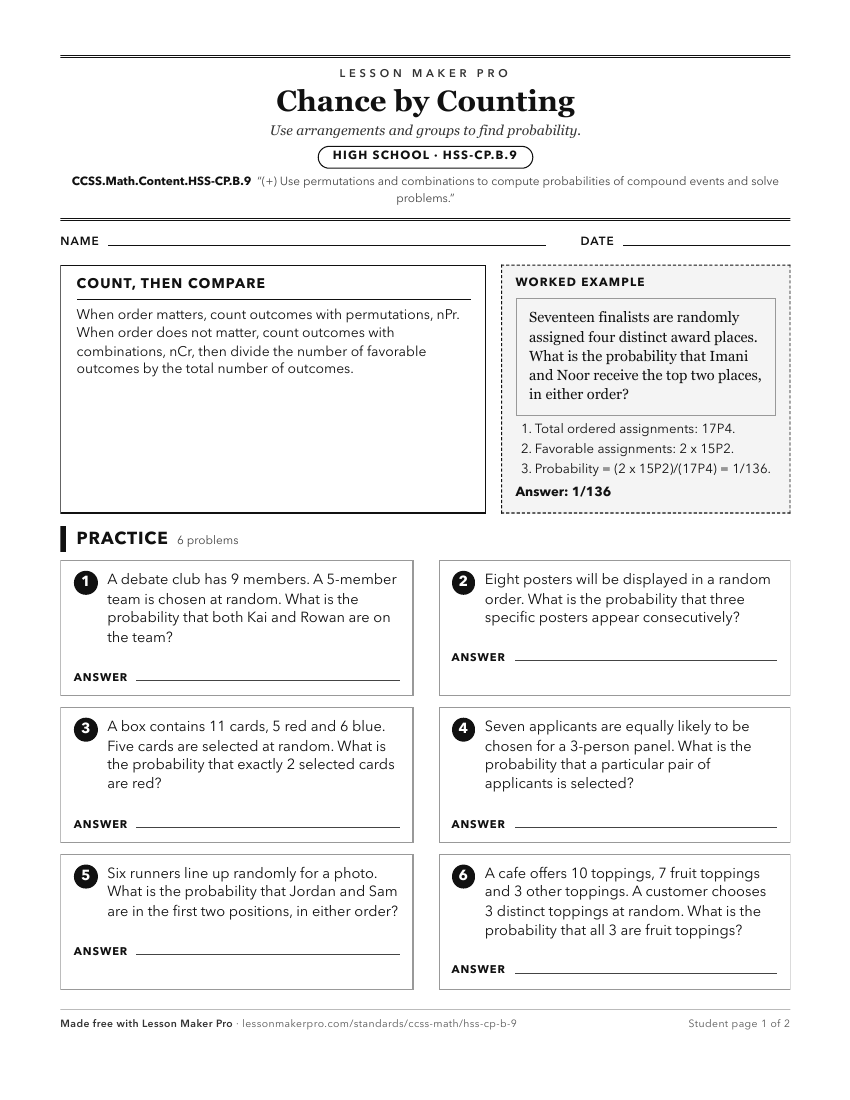
A ready-to-print activity worksheet aligned to CCSS.Math.Content.HSS-CP.B.9, with an answer key for the teacher on its own page. No account needed.
PDF, US Letter, prints cleanly in black and white.
Download the worksheetLearning progression
Where This Standard Sits
Before This Standard
If students are struggling here, check these first.
- CCSS.Math.Content.HSS-CP.A.1
Defining compound events with unions, intersections, and complements helps identify the favorable outcomes before counting them with permutations or combinations.
- CCSS.Math.Content.7.SP.C.8b
Listing outcomes and matching events to them prepares students to count outcomes efficiently with permutations and combinations.
- CCSS.Math.Content.7.SP.C.8
Counting outcomes with lists, tables, and tree diagrams prepares students to use permutations and combinations for compound event probabilities.
Keep exploring
Related Standards
- CCSS.Math.Content.HSS-MD.B.6
(+) Use probabilities to make fair decisions (e.g., drawing by lots, using a random number generator).
- CCSS.Math.Content.HSS-CP.B
Use the rules of probability to compute probabilities of compound events in a uniform probability model
- CCSS.Math.Content.HSS-MD.B.7
(+) Analyze decisions and strategies using probability concepts (e.g., product testing, medical testing, pulling a hockey goalie at the end of a game).
Turn this exact standard into a lesson
Grade, subject, topic, and the complete standard are prefilled. Create one free, no account needed.
Also for this standard:Make a WorksheetMake a QuizMake a Sub Lesson