CCSS.
The Standard
(+) Analyze decisions and strategies using probability concepts (e.g., product testing, medical testing, pulling a hockey goalie at the end of a game).
Common Core State Standards for Mathematics
Teacher's field guide
What This Standard Means
What Students Need to Do
- Students use probability models to compare possible decisions or strategies. They calculate likely outcomes, weigh risks and benefits, and justify a choice using numbers and stated assumptions.
What Mastery Looks Like
- A student can organize outcomes in a table or tree, calculate relevant probabilities or expected results, and compare options. The student explains how base rates, costs, or changing conditions can affect the best choice.
Common Misconceptions
- Students often treat a positive test as proof, ignoring false positives and the base rate. They may choose the most likely outcome without considering costs, or assume small samples will match theoretical probabilities exactly.
How to Assess It
- Exit ticket: A disease affects 2% of people. A test has 95% sensitivity and 90% specificity. For 10,000 people, estimate true and false positives, then explain whether positive results need confirmation.
Lesson moves
Ways to Teach It
Draw colored cards from a bag, treating red cards as defective, and compare accepting batches with testing three items first.
Write a recommendation: When should a hockey team pull its goalie, and which probabilities or costs must the coach estimate?
Play a dice game with safe and risky scoring choices, then compare each strategy's expected score with its observed results.
Analyze a medical screening table with prevalence, sensitivity, and specificity, then recommend whether positive results need confirmation.
Free download
Printable HSS-MD.B.7 Worksheet
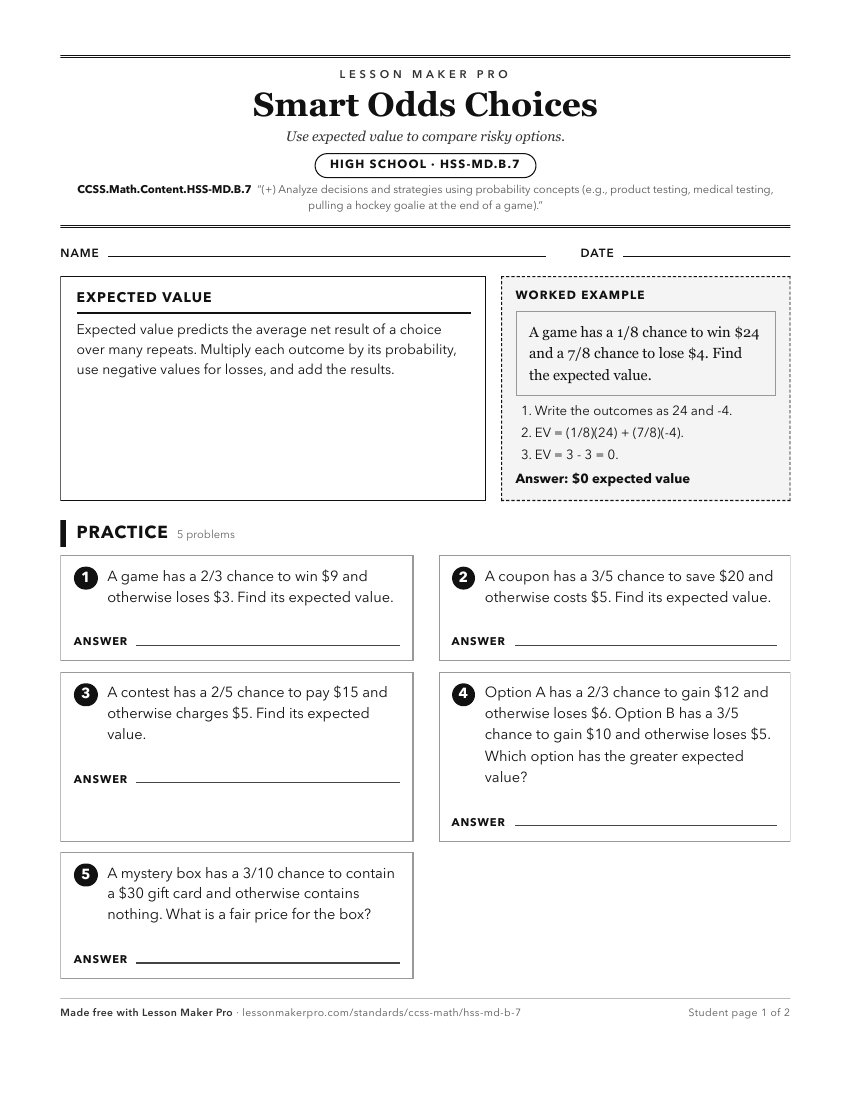
A ready-to-print activity worksheet aligned to CCSS.Math.Content.HSS-MD.B.7, with an answer key for the teacher on its own page. No account needed.
PDF, US Letter, prints cleanly in black and white.
Download the worksheetLearning progression
Where This Standard Sits
Before This Standard
If students are struggling here, check these first.
- CCSS.Math.Content.HSS-MD.B.5
Expected value work carries over to weighing uncertain outcomes, but B.7 also uses other probability tools for broader decisions.
- CCSS.Math.Content.HSS-MD.A.2
Expected value helps compare choices by long-run average outcome, a common tool for probability-based decision analysis.
- CCSS.Math.Content.HSS-CP.A.3
Conditional probability and independence support evaluating tests and strategies where outcomes depend on prior events or changing information.
Keep exploring
Related Standards
- CCSS.Math.Content.HSS-MD.B
Use probability to evaluate outcomes of decisions
- CCSS.Math.Content.HSS-MD.B.6
(+) Use probabilities to make fair decisions (e.g., drawing by lots, using a random number generator).
- CCSS.Math.Content.HSS-CP.B.9
(+) Use permutations and combinations to compute probabilities of compound events and solve problems.
Turn this exact standard into a lesson
Grade, subject, topic, and the complete standard are prefilled. Create one free, no account needed.
Also for this standard:Make a WorksheetMake a QuizMake a Sub Lesson