CCSS.
Standard Cluster
Use probability to evaluate outcomes of decisions
Common Core State Standards for Mathematics · High School — Statistics and Probability
Cluster contents
Standards in This Cluster
CCSS.Math.Content.HSS-MD.B is a cluster heading. These are the individual standards under it.
- CCSS.Math.Content.HSS-MD.B.5
(+) Weigh the possible outcomes of a decision by assigning probabilities to payoff values and finding expected values.
- CCSS.Math.Content.HSS-MD.B.5a
Find the expected payoff for a game of chance.
- CCSS.Math.Content.HSS-MD.B.5b
Evaluate and compare strategies on the basis of expected values.
- CCSS.Math.Content.HSS-MD.B.6
(+) Use probabilities to make fair decisions (e.g., drawing by lots, using a random number generator).
- CCSS.Math.Content.HSS-MD.B.7
(+) Analyze decisions and strategies using probability concepts (e.g., product testing, medical testing, pulling a hockey goalie at the end of a game).
Teacher's field guide
What This Cluster Means
What Students Need to Do
- Students identify possible outcomes, assign each a probability and payoff, and calculate expected value. They compare options and justify a choice using long-run gains, losses, and risk.
What Mastery Looks Like
- A student can build a probability and payoff table, include all outcomes, and find the correct weighted average. The student can compare two strategies and explain why the better long-run choice may not win every time.
Common Misconceptions
- Students may choose the largest possible payoff or the most likely outcome instead of calculating expected value. They may forget to subtract fees or losses. Some treat expected value as a guaranteed result rather than a long-run average.
How to Assess It
- Exit ticket: A $5 ticket pays $20 with probability 0.3 and $0 otherwise. Find the expected net gain and state whether repeated play is favorable.
Lesson moves
Ways to Teach It
Give pairs three red and seven blue cubes; charge $1 per draw, pay $4 for red, track 30 draws, and compare averages.
Have students answer, “Would you choose a guaranteed $40 or a 50% chance at $100?” and explain how expected value and risk shape their choice.
Run a card game where teams calculate expected value for four payoff tables, then rank the games from best to worst.
Compare two phone warranties using repair probabilities, replacement costs, and warranty prices, then write which option saves more over many purchases.
Free download
Printable HSS-MD.B Worksheet
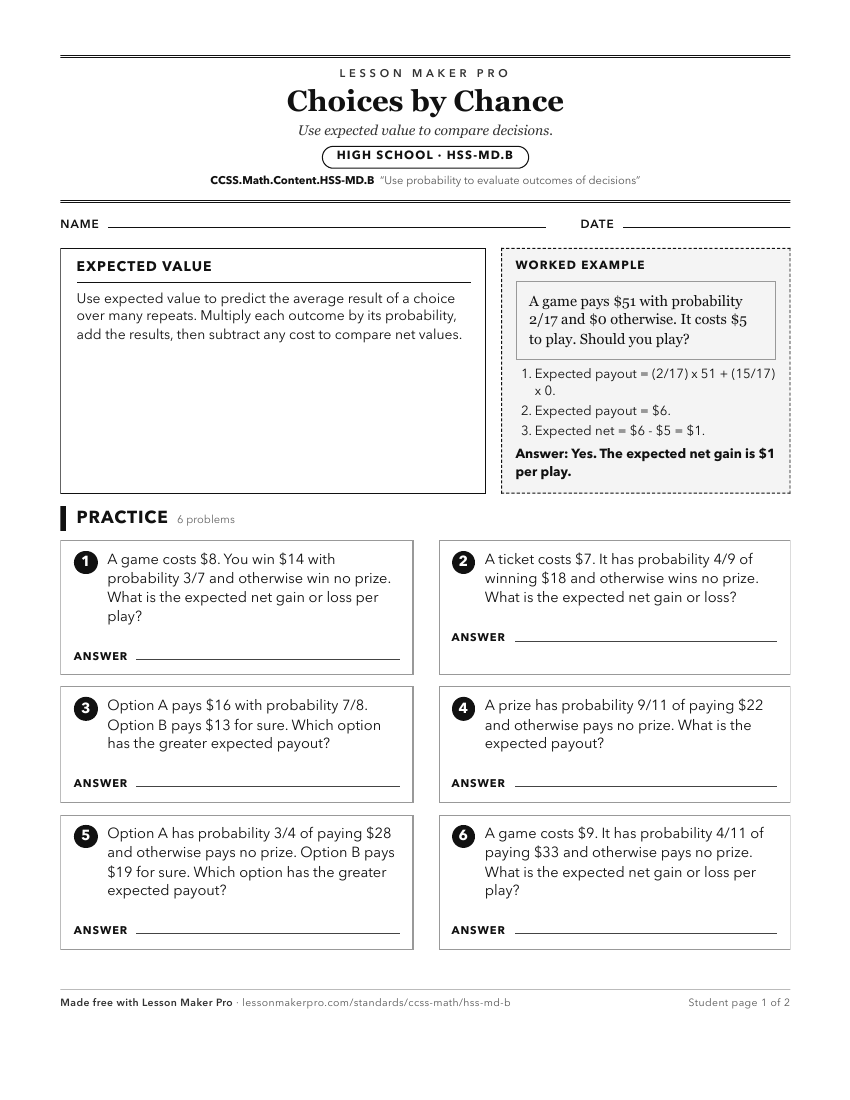
A ready-to-print activity worksheet aligned to CCSS.Math.Content.HSS-MD.B, with an answer key for the teacher on its own page. No account needed.
PDF, US Letter, prints cleanly in black and white.
Download the worksheetTurn this cluster into a lesson
Grade, subject, topic, and the complete cluster are prefilled. Create one free, no account needed.
Also for this cluster:Make a WorksheetMake a QuizMake a Sub Lesson