CCSS.
The Standard
Evaluate and compare strategies on the basis of expected values.
Common Core State Standards for Mathematics · Use probability to evaluate outcomes of decisions
Teacher's field guide
What This Standard Means
What Students Need to Do
- Students find the expected value of each possible strategy using probabilities and numerical outcomes. They compare those values and use the result to support a decision.
What Mastery Looks Like
- Students calculate expected value by multiplying each outcome by its probability and adding the products. They compare results and explain which strategy is preferable under the given assumptions.
Common Misconceptions
- Students may choose the option with the largest possible payoff instead of weighting every outcome by its probability. They may also treat expected value as a guaranteed result or mishandle costs as positive values.
How to Assess It
- Give two strategies with listed outcomes and probabilities. Ask students to calculate both expected values, choose one strategy, and justify the choice in one sentence.
Lesson moves
Ways to Teach It
Give groups cards showing probabilities and payoffs, then have them build and compare expected value tables for two strategies.
Ask students to write when a lower expected value might still be a reasonable choice because of risk or personal circumstances.
Run a dice game with two payoff rules, and have students predict, calculate, then test which rule gives the higher average return.
Compare two car insurance plans using premiums, deductibles, and given probabilities for no accident, minor damage, and major damage.
Free download
Printable HSS-MD.B.5b Worksheet
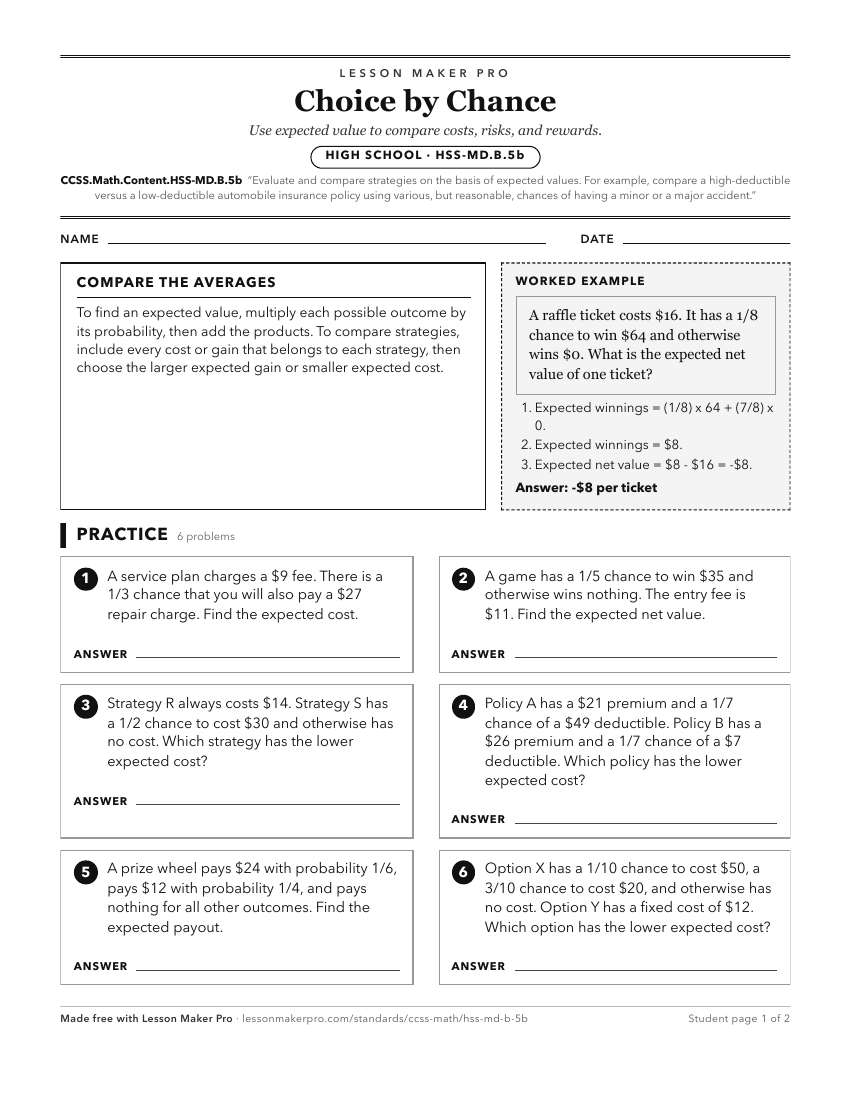
A ready-to-print activity worksheet aligned to CCSS.Math.Content.HSS-MD.B.5b, with an answer key for the teacher on its own page. No account needed.
PDF, US Letter, prints cleanly in black and white.
Download the worksheetLearning progression
Where This Standard Sits
Before This Standard
If students are struggling here, check these first.
- CCSS.Math.Content.HSS-MD.B.5
Comparing strategies by expected value requires assigning probabilities to payoffs and calculating each strategy’s expected value.
- CCSS.Math.Content.HSS-MD.B.5a
Comparing strategies by expected value requires calculating each strategy’s expected payoff in games or decisions under chance.
- CCSS.Math.Content.HSS-MD.A.2
Comparing strategies by expected value requires calculating and interpreting each strategy’s expected payoff as a probability-weighted mean.
Keep exploring
Related Standards
Turn this exact standard into a lesson
Grade, subject, topic, and the complete standard are prefilled. Create one free, no account needed.
Also for this standard:Make a WorksheetMake a QuizMake a Sub Lesson