CCSS.
The Standard
Find the expected payoff for a game of chance.
Common Core State Standards for Mathematics · Use probability to evaluate outcomes of decisions
Teacher's field guide
What This Standard Means
What Students Need to Do
- Students list every possible prize and its probability. They multiply each prize by its probability, add the products, then subtract the cost of playing.
What Mastery Looks Like
- A student can build a complete payoff table, check that probabilities total 1, and calculate the expected net gain or loss correctly. The student explains that the value predicts a long-run average, not one play.
Common Misconceptions
- Students may average prize amounts without weighting them by probability. They may forget the cost to play or treat expected payoff as the amount they will win next time.
How to Assess It
- Exit ticket: A game costs $2 and pays $10 with probability 0.10, or $0 otherwise. Find the expected net payoff and explain its meaning over many plays.
Lesson moves
Ways to Teach It
Give pairs dice, a payoff chart, and 30 counters; students simulate 30 rounds and compare average net payoff with calculated expectation.
Post: A $1 ticket pays $100 with probability 0.005 and nothing otherwise; students write and defend a buying recommendation.
Have teams match 12 game cards to probability tables and expected net payoffs, then correct one mismatched set.
Give students a scratch-ticket prize chart and ticket price; they calculate expected net payoff and compare it with the advertised jackpot.
Free download
Printable HSS-MD.B.5a Worksheet
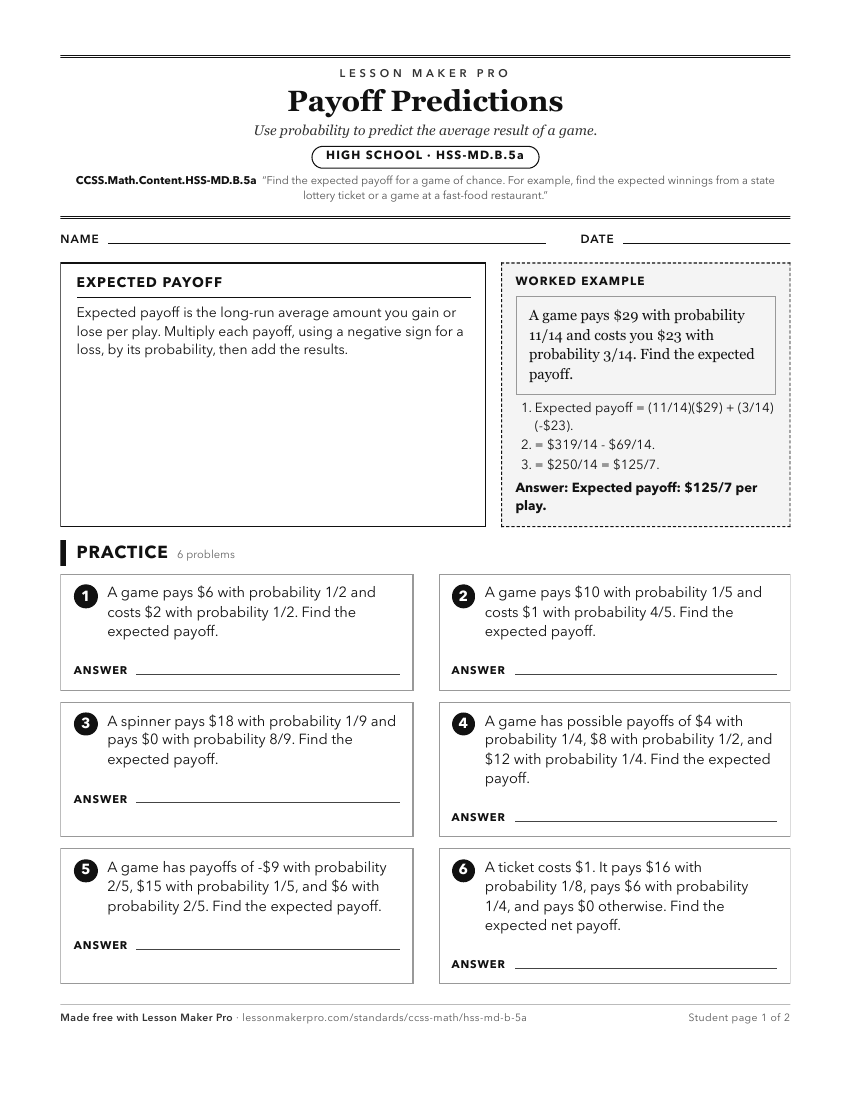
A ready-to-print activity worksheet aligned to CCSS.Math.Content.HSS-MD.B.5a, with an answer key for the teacher on its own page. No account needed.
PDF, US Letter, prints cleanly in black and white.
Download the worksheetLearning progression
Where This Standard Sits
Before This Standard
If students are struggling here, check these first.
- CCSS.Math.Content.HSS-MD.A.2
Expected payoff is the expected value of the payoff random variable, using probabilities and outcomes to compute a weighted mean.
- CCSS.Math.Content.HSS-MD.A.3
Expected payoff is the expected value of a payoff random variable, using outcome probabilities and payoff values.
- CCSS.Math.Content.7.NS.A.3
Expected payoff calculations require multiplying probabilities by gains or losses and adding rational values accurately.
What This Unlocks
Mastery here sets students up for these next.
Keep exploring
Related Standards
Turn this exact standard into a lesson
Grade, subject, topic, and the complete standard are prefilled. Create one free, no account needed.
Also for this standard:Make a WorksheetMake a QuizMake a Sub Lesson