CCSS.
The Standard
(+) Weigh the possible outcomes of a decision by assigning probabilities to payoff values and finding expected values.
Common Core State Standards for Mathematics
Teacher's field guide
What This Standard Means
What Students Need to Do
- Students list the possible results of a choice and assign a probability and payoff to each result. They calculate a probability weighted average and use it to compare options. They also explain what the value means for repeated decisions.
What Mastery Looks Like
- A student can build a complete payoff table and check that the probabilities sum to 1. They multiply each payoff by its probability, add the products with correct signs and units, and compare choices. They explain that the result is a long run average, not a guaranteed outcome.
Common Misconceptions
- Students often treat expected value as the amount they will receive in one trial or choose the most likely payoff instead. They may forget entry costs, record losses as positive amounts, or average payoffs without weighting them. Some use probabilities that do not sum to 1.
How to Assess It
- Exit ticket: A game costs $4 and pays $20 with probability 0.25, otherwise $0. Find the expected net payoff and decide whether the game has positive expected value, showing your calculation.
Lesson moves
Ways to Teach It
Give pairs a bag with colored counters and posted payouts; draw 30 times with replacement, record winnings, and compare the mean with expected value.
Ask students to write: Would you choose a guaranteed $40 or a 25% chance at $200, and why?
Run a card sort matching four payoff tables to expected values and decision statements, then have pairs check each match.
Compare two phone insurance plans using claim probabilities, premiums, deductibles, and expected yearly cost.
Free download
Printable HSS-MD.B.5 Worksheet
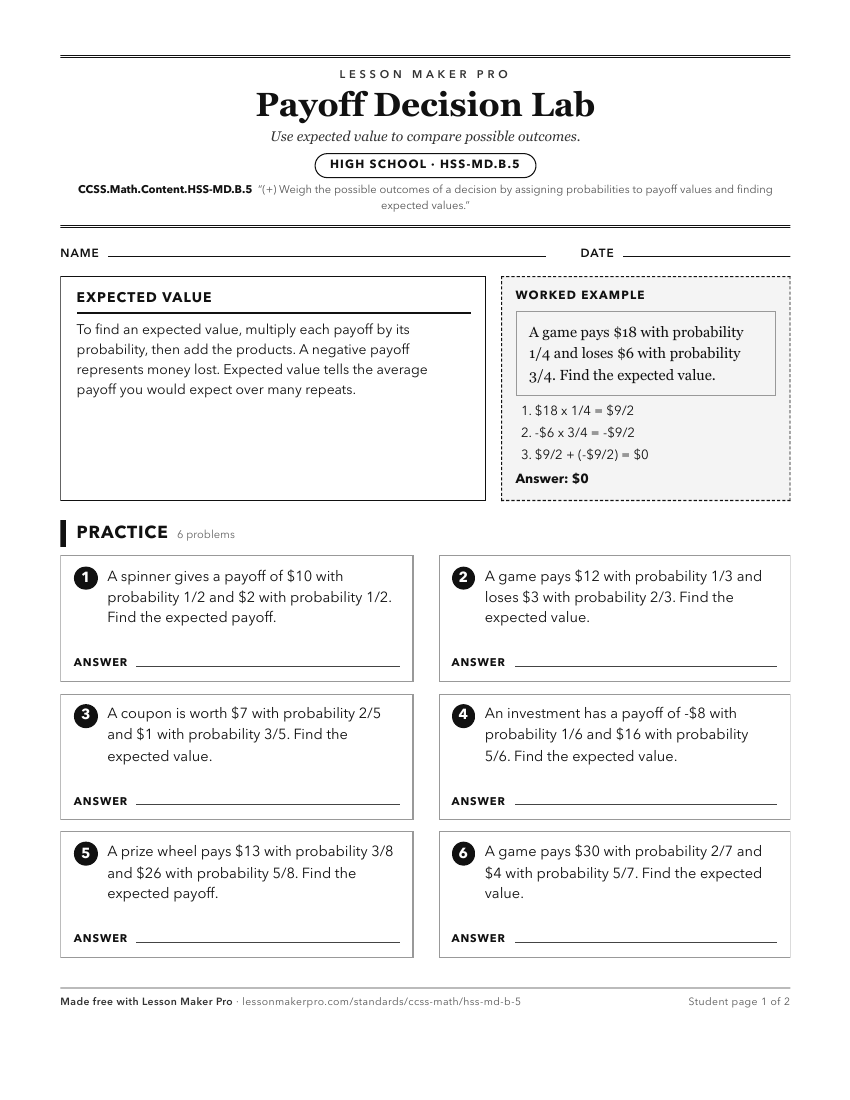
A ready-to-print activity worksheet aligned to CCSS.Math.Content.HSS-MD.B.5, with an answer key for the teacher on its own page. No account needed.
PDF, US Letter, prints cleanly in black and white.
Download the worksheetLearning progression
Where This Standard Sits
Before This Standard
If students are struggling here, check these first.
- CCSS.Math.Content.HSS-MD.A.2
Decision analysis requires assigning payoffs a probability distribution, then calculating and interpreting expected value as the average payoff.
- CCSS.Math.Content.HSS-MD.A.3
Students must connect outcomes, probabilities, and expected value before using payoff values to compare decisions.
- CCSS.Math.Content.HSS-MD.A.1
Expected value requires treating payoffs as a random variable with probabilities attached to each possible value.
What This Unlocks
Mastery here sets students up for these next.
- CCSS.Math.Content.HSS-MD.B.7
Expected value work carries over to weighing uncertain outcomes, but B.7 also uses other probability tools for broader decisions.
- CCSS.Math.Content.HSS-MD.B.5b
Comparing strategies by expected value requires assigning probabilities to payoffs and calculating each strategy’s expected value.
Keep exploring
Related Standards
Turn this exact standard into a lesson
Grade, subject, topic, and the complete standard are prefilled. Create one free, no account needed.
Also for this standard:Make a WorksheetMake a QuizMake a Sub Lesson