CCSS.
The Standard
(+) Use probabilities to make fair decisions (e.g., drawing by lots, using a random number generator).
Common Core State Standards for Mathematics
Teacher's field guide
What This Standard Means
What Students Need to Do
- Students design a chance process that gives each person or outcome the intended probability. They calculate the probabilities, run trials, and explain why the process is fair.
What Mastery Looks Like
- A student can match outcomes from dice, cards, spinners, or random numbers to participants without hidden advantages. The student verifies equal probabilities and distinguishes a fair process from equal results in a small trial.
Common Misconceptions
- Students often call a process unfair when a short run produces uneven results. They may count outcomes without checking whether those outcomes are equally likely, or assign leftover random numbers unevenly.
How to Assess It
- Exit ticket: Four students must be placed in random order using one six-sided die. Write a complete method, calculate each student's chance of going first, and justify its fairness.
Lesson moves
Ways to Teach It
Give groups a die, cards, and a spinner. Have them design and test a fair way to choose one of four students.
Prompt: A coin picked Ana three times in a row. Explain whether the method was unfair and defend your claim with probability.
Play Fair or Biased. Teams inspect selection rules, calculate each person's chance, and revise any rule that gives unequal probabilities.
Create a lunch duty lottery for 24 students, choose a random tool, and show that every student has the same chance.
Free download
Printable HSS-MD.B.6 Worksheet
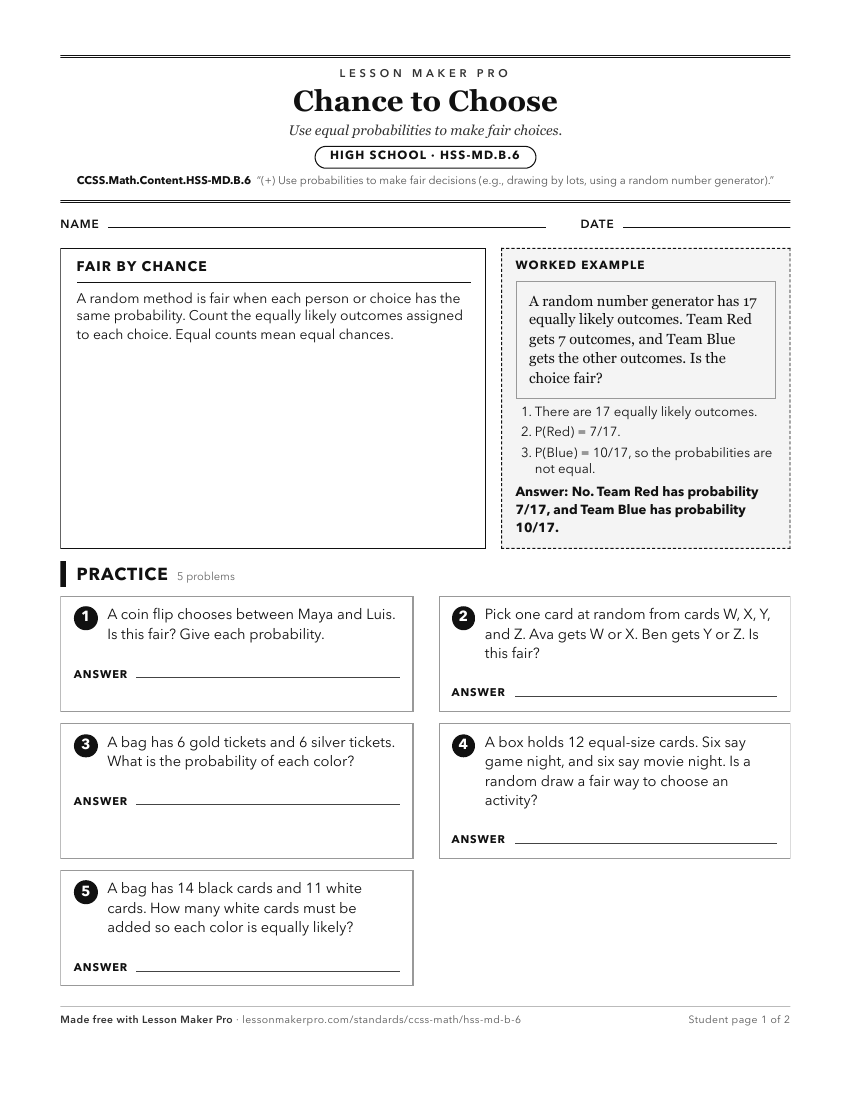
A ready-to-print activity worksheet aligned to CCSS.Math.Content.HSS-MD.B.6, with an answer key for the teacher on its own page. No account needed.
PDF, US Letter, prints cleanly in black and white.
Download the worksheetLearning progression
Where This Standard Sits
Before This Standard
If students are struggling here, check these first.
- CCSS.Math.Content.7.SP.C.7a
Fair decision methods rely on assigning equal chances to outcomes and checking that each person or option has the same probability.
- CCSS.Math.Content.7.SP.C.5
Fair decision methods require understanding probability values as likelihoods so each outcome can be checked for equal chance.
- CCSS.Math.Content.7.SP.C.8c
Simulating random events helps students connect random generators and frequencies to whether outcomes have equal chances in a fair process.
Keep exploring
Related Standards
- CCSS.Math.Content.HSS-MD.B
Use probability to evaluate outcomes of decisions
- CCSS.Math.Content.HSS-MD.B.5
(+) Weigh the possible outcomes of a decision by assigning probabilities to payoff values and finding expected values.
- CCSS.Math.Content.HSS-MD.B.7
(+) Analyze decisions and strategies using probability concepts (e.g., product testing, medical testing, pulling a hockey goalie at the end of a game).
- CCSS.Math.Content.HSS-CP.B.9
(+) Use permutations and combinations to compute probabilities of compound events and solve problems.
Turn this exact standard into a lesson
Grade, subject, topic, and the complete standard are prefilled. Create one free, no account needed.
Also for this standard:Make a WorksheetMake a QuizMake a Sub Lesson