CCSS.
The Standard
(+) Calculate the expected value of a random variable; interpret it as the mean of the probability distribution.
Common Core State Standards for Mathematics
Teacher's field guide
What This Standard Means
What Students Need to Do
- Students multiply each possible numerical outcome by its probability, then add those products. They explain the result as the average outcome expected over many repeated trials.
What Mastery Looks Like
- Students correctly multiply each outcome by its probability and add the products. They label the answer with appropriate units and describe it as a long-run average across many trials.
Common Misconceptions
- Students may average the listed outcomes without weighting them by their probabilities. They may treat expected value as the most likely result or assume it must be a possible single outcome.
How to Assess It
- Give this exit ticket: A game pays $10 with probability 0.2 and loses $3 otherwise. Find and interpret the expected value.
Lesson moves
Ways to Teach It
Have pairs roll two dice 50 times, record winnings from a payoff table, and compare the sample mean with the calculated expected value.
Ask students to explain why an expected value of 2.5 children does not predict that any family will have exactly 2.5 children.
Use matching cards with probability tables, expected values, and interpretations, then have groups justify each completed set.
Compare two carnival games by calculating expected winnings and deciding which ticket price would make each game fair.
Free download
Printable HSS-MD.A.2 Worksheet
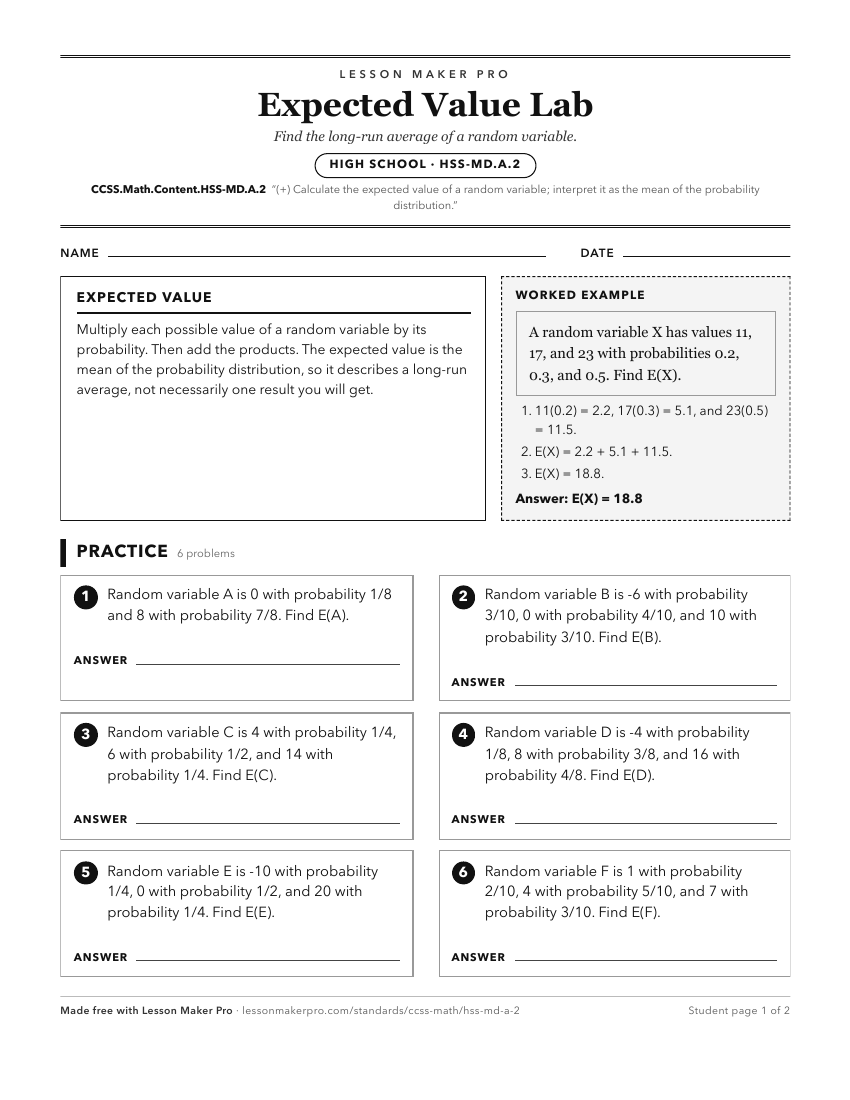
A ready-to-print activity worksheet aligned to CCSS.Math.Content.HSS-MD.A.2, with an answer key for the teacher on its own page. No account needed.
PDF, US Letter, prints cleanly in black and white.
Download the worksheetLearning progression
Where This Standard Sits
Before This Standard
If students are struggling here, check these first.
- CCSS.Math.Content.HSS-MD.A.1
Expected value uses the random variable’s numerical outcomes and probabilities, then interprets that distribution’s mean.
- CCSS.Math.Content.7.SP.C.7
Expected value uses probabilities from a model to weight outcomes and interpret the distribution's mean.
- CCSS.Math.Content.HSS-ID.A.2
Understanding mean as a distribution’s center supports interpreting expected value as the long-run mean of a probability distribution.
What This Unlocks
Mastery here sets students up for these next.
- CCSS.Math.Content.HSS-MD.A.3
Finding expected value from a theoretical probability distribution requires calculating and interpreting the distribution’s mean.
- CCSS.Math.Content.HSS-MD.B.5
Decision analysis requires assigning payoffs a probability distribution, then calculating and interpreting expected value as the average payoff.
- CCSS.Math.Content.HSS-MD.B.7
Expected value helps compare choices by long-run average outcome, a common tool for probability-based decision analysis.
- CCSS.Math.Content.HSS-MD.A.4
Students must know how to compute and interpret expected value before finding it from an empirically built distribution.
- CCSS.Math.Content.HSS-MD.B.5a
Expected payoff is the expected value of the payoff random variable, using probabilities and outcomes to compute a weighted mean.
- CCSS.Math.Content.HSS-MD.B.5b
Comparing strategies by expected value requires calculating and interpreting each strategy’s expected payoff as a probability-weighted mean.
Turn this exact standard into a lesson
Grade, subject, topic, and the complete standard are prefilled. Create one free, no account needed.
Also for this standard:Make a WorksheetMake a QuizMake a Sub Lesson