CCSS.
Standard Cluster
Calculate expected values and use them to solve problems
Common Core State Standards for Mathematics · High School — Statistics and Probability
Cluster contents
Standards in This Cluster
CCSS.Math.Content.HSS-MD.A is a cluster heading. These are the individual standards under it.
- CCSS.Math.Content.HSS-MD.A.1
(+) Define a random variable for a quantity of interest by assigning a numerical value to each event in a sample space; graph the corresponding probability dist...
- CCSS.Math.Content.HSS-MD.A.2
(+) Calculate the expected value of a random variable; interpret it as the mean of the probability distribution.
- CCSS.Math.Content.HSS-MD.A.3
(+) Develop a probability distribution for a random variable defined for a sample space in which theoretical probabilities can be calculated; find the expected ...
- CCSS.Math.Content.HSS-MD.A.4
(+) Develop a probability distribution for a random variable defined for a sample space in which probabilities are assigned empirically; find the expected value...
Teacher's field guide
What This Cluster Means
What Students Need to Do
- Students connect each possible outcome with its probability and use those pairs to find a weighted average. They use that long-run average to compare games, costs, risks, or choices.
What Mastery Looks Like
- Students build a probability distribution, multiply each outcome by its probability, and add the products. They interpret the result as a long-run average and use it to compare options or judge fairness.
Common Misconceptions
- Students may average the possible payoffs without weighting them by probability. They may ignore ticket costs, confuse expected value with a guaranteed result, or choose the largest possible prize.
How to Assess It
- Exit ticket: A $2 ticket pays $10 with probability 0.1 and $0 otherwise. Find the expected net gain and justify whether buying it is financially favorable.
Lesson moves
Ways to Teach It
Give pairs two dice and a payout table, then have them calculate the theoretical return and compare it with 30 recorded trials.
Ask students to write whether a negative expected return always means a person should reject an option, then defend their reasoning.
Run a card game where groups rank four payout rules by expected return before checking each calculation.
Compare the expected costs of two phone insurance plans using claim probabilities, deductibles, and annual premiums.
Free download
Printable HSS-MD.A Worksheet
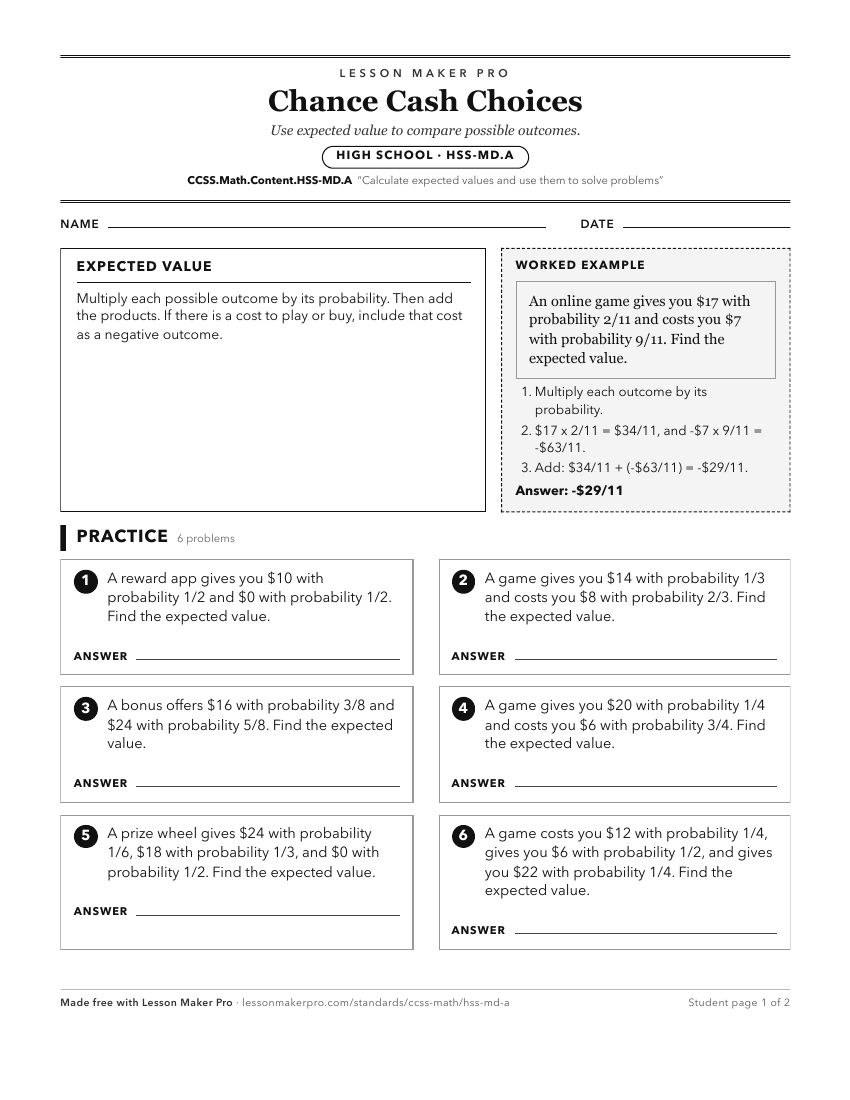
A ready-to-print activity worksheet aligned to CCSS.Math.Content.HSS-MD.A, with an answer key for the teacher on its own page. No account needed.
PDF, US Letter, prints cleanly in black and white.
Download the worksheetKeep exploring
Related Standards
Turn this cluster into a lesson
Grade, subject, topic, and the complete cluster are prefilled. Create one free, no account needed.
Also for this cluster:Make a WorksheetMake a QuizMake a Sub Lesson