CCSS.
The Standard
Design and use a simulation to generate frequencies for compound events.
Common Core State Standards for Mathematics
Teacher's field guide
What This Standard Means
What Students Need to Do
- Students turn a compound chance situation into a simulation using random digits, dice, spinners, or counters. They run many trials, record successes, and use relative frequency to estimate the probability.
What Mastery Looks Like
- A student can match outcomes from dice, spinners, counters, or random digits to the given probabilities. They define one complete trial and identify what counts as success. They use relative frequency to estimate the probability and explain the result in context.
Common Misconceptions
- Students may assign random digits in proportions that do not match the stated chance. They may count individual outcomes instead of complete trials, or read “at least four” as “exactly four.” They may treat a simulation estimate as exact or divide by the wrong number of trials.
How to Assess It
- Exit ticket: Rain has a 30% daily chance; assign digits 0 through 9 to rain and no rain. Use 02 84 71 29 30 15 68 22 47 90 11 36 52 08 74 20 95 13 66 27 as 20 two-day trials, then estimate the chance of rain on both days.
Lesson moves
Ways to Teach It
Use a bag with 3 red and 7 blue counters to run 30 four-draw trials, replacing each counter, then estimate at least one red.
Compare two digit models for a 20% event, digits 0 to 1 versus 0 to 2, and explain which model works.
Pairs roll two dice 40 times, tally sums above 9, and compete for the estimate closest to the theoretical probability.
Model a 10% defect rate with random digits, then estimate the chance that a box of five items contains a defect.
Free download
Printable 7.SP.C.8c Worksheet
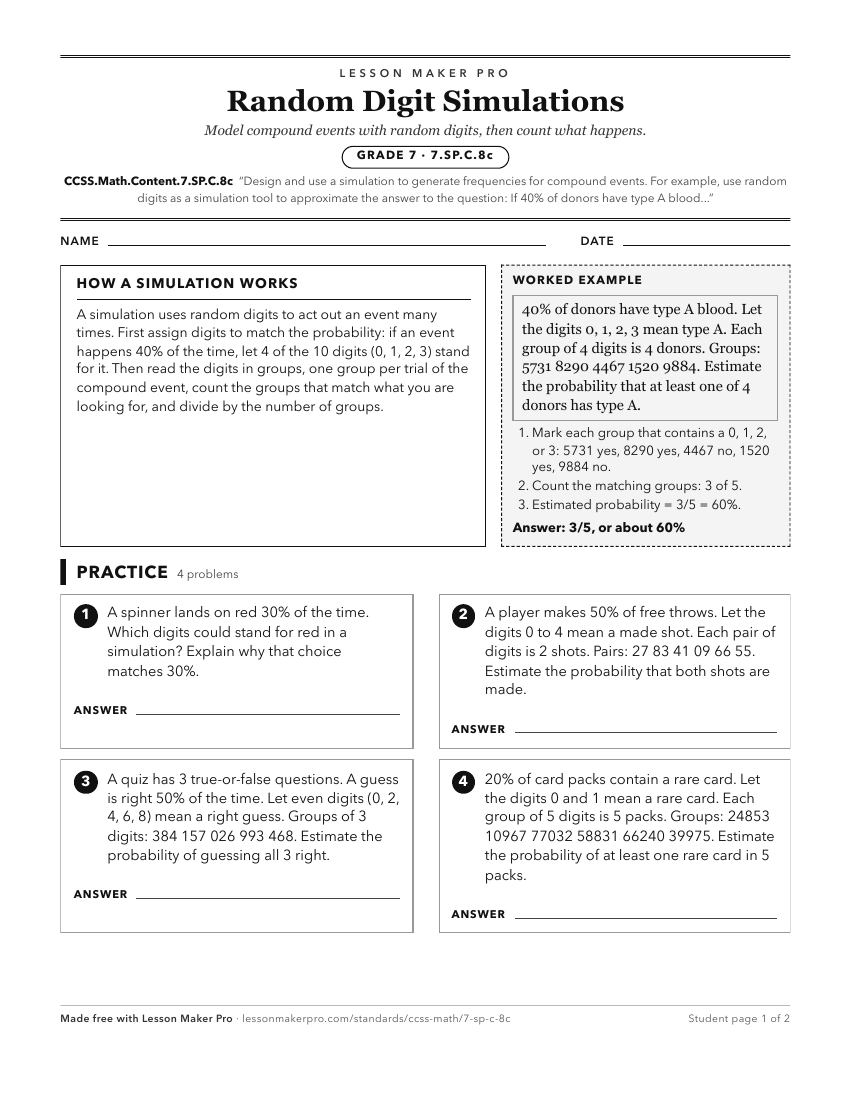
A ready-to-print activity worksheet aligned to CCSS.Math.Content.7.SP.C.8c, with an answer key for the teacher on its own page. No account needed.
PDF, US Letter, prints cleanly in black and white.
Download the worksheetLearning progression
Where This Standard Sits
Before This Standard
If students are struggling here, check these first.
- CCSS.Math.Content.7.SP.C.5
Students use the 0 to 1 likelihood scale to interpret simulated frequencies as probabilities for compound events.
- CCSS.Math.Content.7.SP.C.6
Using simulations for compound events relies on repeated trials and relative frequencies to estimate probabilities from data.
- CCSS.Math.Content.7.SP.C.8b
Simulation requires defining possible outcomes and which outcomes count as the compound event before tallying frequencies.
What This Unlocks
Mastery here sets students up for these next.
Keep exploring
Related Standards
- CCSS.Math.Content.HSS-CP.B
Use the rules of probability to compute probabilities of compound events in a uniform probability model
- CCSS.Math.Content.7.SP.C.8
Find probabilities of compound events using organized lists, tables, tree diagrams, and simulation.
- CCSS.Math.Content.7.SP.C.7b
Develop a probability model (which may not be uniform) by observing frequencies in data generated from a chance process.
Turn this exact standard into a lesson
Grade, subject, topic, and the complete standard are prefilled. Create one free, no account needed.
Also for this standard:Make a WorksheetMake a QuizMake a Sub Lesson