CCSS.
The Standard
Develop a probability model (which may not be uniform) by observing frequencies in data generated from a chance process.
Common Core State Standards for Mathematics
Teacher's field guide
What This Standard Means
What Students Need to Do
- Students run or examine repeated trials of a chance process. They use observed frequencies to estimate outcome probabilities and decide whether the outcomes appear equally likely.
What Mastery Looks Like
- Students collect repeated-trial data and use each outcome’s relative frequency as its estimated probability. They organize the probabilities in a table, check that they total about 1, and explain whether the model is uniform.
Common Misconceptions
- Students may assume all outcomes are equally likely because the process seems random. They may use a small sample, confuse frequency with probability, or ignore outcomes that do not fit their prediction.
How to Assess It
- Give each student results from 50 paper cup tosses: 27 side, 15 open end down, and 8 closed end down. Ask them to build a probability model and explain whether the outcomes appear equally likely.
Lesson moves
Ways to Teach It
Pairs toss a paper cup 40 times, record each landing position, and build a probability model from the relative frequencies.
Ask students to write whether a spinning penny has equally likely outcomes, then support their claim with class data.
Play Model Match by pairing cards showing trial results with cards showing corresponding experimental probability tables.
Use local weather records to estimate the probability of rain on a given month’s days, then compare predictions with later observations.
Free download
Printable 7.SP.C.7b Worksheet
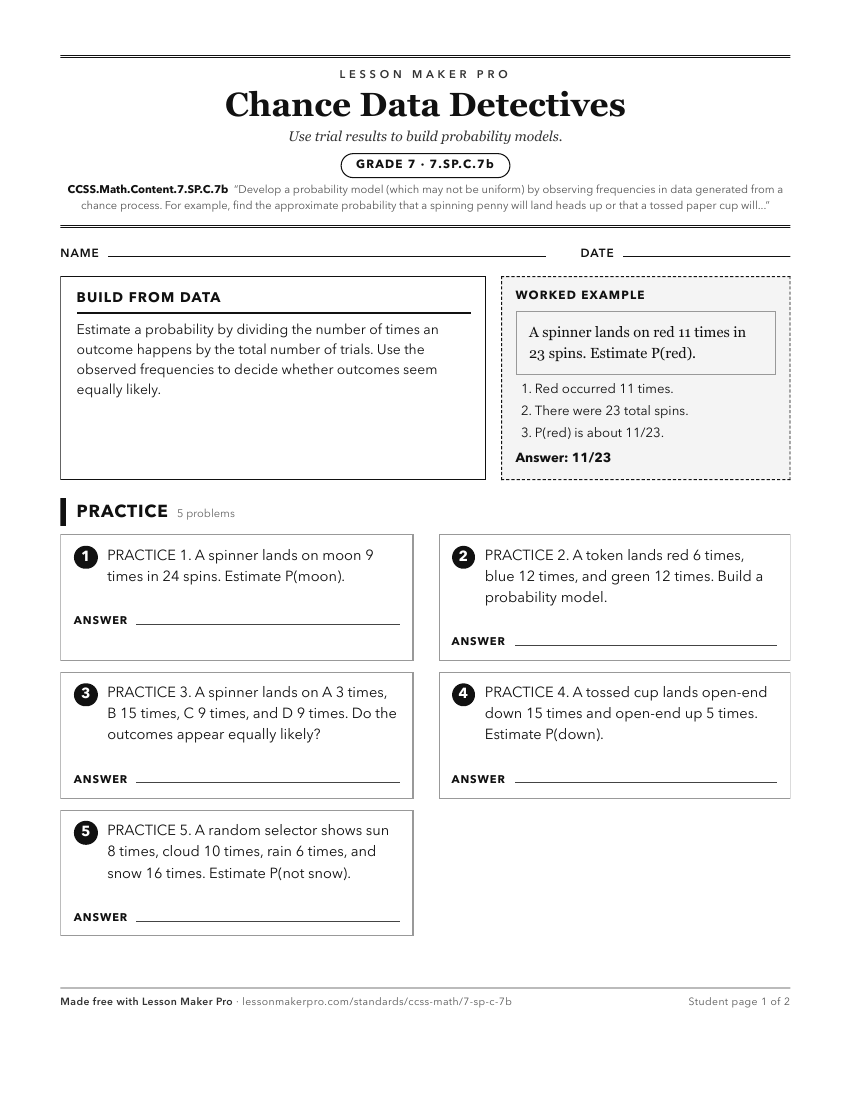
A ready-to-print activity worksheet aligned to CCSS.Math.Content.7.SP.C.7b, with an answer key for the teacher on its own page. No account needed.
PDF, US Letter, prints cleanly in black and white.
Download the worksheetLearning progression
Where This Standard Sits
Before This Standard
If students are struggling here, check these first.
- CCSS.Math.Content.7.SP.C.5
Students must understand probabilities as 0 to 1 likelihood values before using observed frequencies to assign model probabilities.
- CCSS.Math.Content.7.SP.C.6
Using observed frequencies to assign model probabilities requires understanding that long-run relative frequency approximates probability.
- CCSS.Math.Content.6.RP.A.3
Observed frequencies become relative frequencies, so ratio reasoning helps students turn counts from trials into probability estimates.
What This Unlocks
Mastery here sets students up for these next.
Keep exploring
Related Standards
- CCSS.Math.Content.7.SP.C.7a
Develop a uniform probability model by assigning equal probability to all outcomes, and use the model to determine probabilities of events.
- CCSS.Math.Content.7.SP.C.7
Develop a probability model and use it to find probabilities of events. Compare probabilities from a model to observed frequencies; if the agreement is not good...
- CCSS.Math.Content.7.SP.C
Investigate chance processes and develop, use, and evaluate probability models.
Turn this exact standard into a lesson
Grade, subject, topic, and the complete standard are prefilled. Create one free, no account needed.
Also for this standard:Make a WorksheetMake a QuizMake a Sub Lesson