CCSS.
The Standard
Approximate the probability of a chance event by collecting data on the chance process that produces it and observing its long-run relative frequency, and predict the approximate relative frequency given the probability.
Common Core State Standards for Mathematics · Statistics and Probability
Teacher's field guide
What This Standard Means
What Students Need to Do
- Students run or examine repeated chance trials and use the results to estimate an event's probability. They use a known or estimated probability to predict how often the event should occur.
What Mastery Looks Like
- Students calculate an experimental probability from collected results and use it to predict outcomes over more trials. They explain why an actual count may be close to, but not equal to, the prediction.
Common Misconceptions
- Students may expect the experimental result to match the predicted count exactly. They may use the number of successes instead of dividing by the total trials, or assume short runs reflect long-run probability.
How to Assess It
- Give this exit ticket: A spinner lands on red 28 times in 80 spins. Estimate the probability of red and predict red results in 200 spins.
Lesson moves
Ways to Teach It
Roll a number cube 60 times, record target outcomes, and graph how the cumulative relative frequency changes after every 10 rolls.
Ask students to explain why 50 coin flips may not produce exactly 25 heads, even though heads has probability one-half.
Play a prediction game where teams use trial data to estimate probabilities, predict 100 outcomes, and score points for reasonable estimates.
Use a basketball player's free-throw record to estimate the chance of a make and predict makes in the next 50 attempts.
Free download
Printable 7.SP.C.6 Worksheet
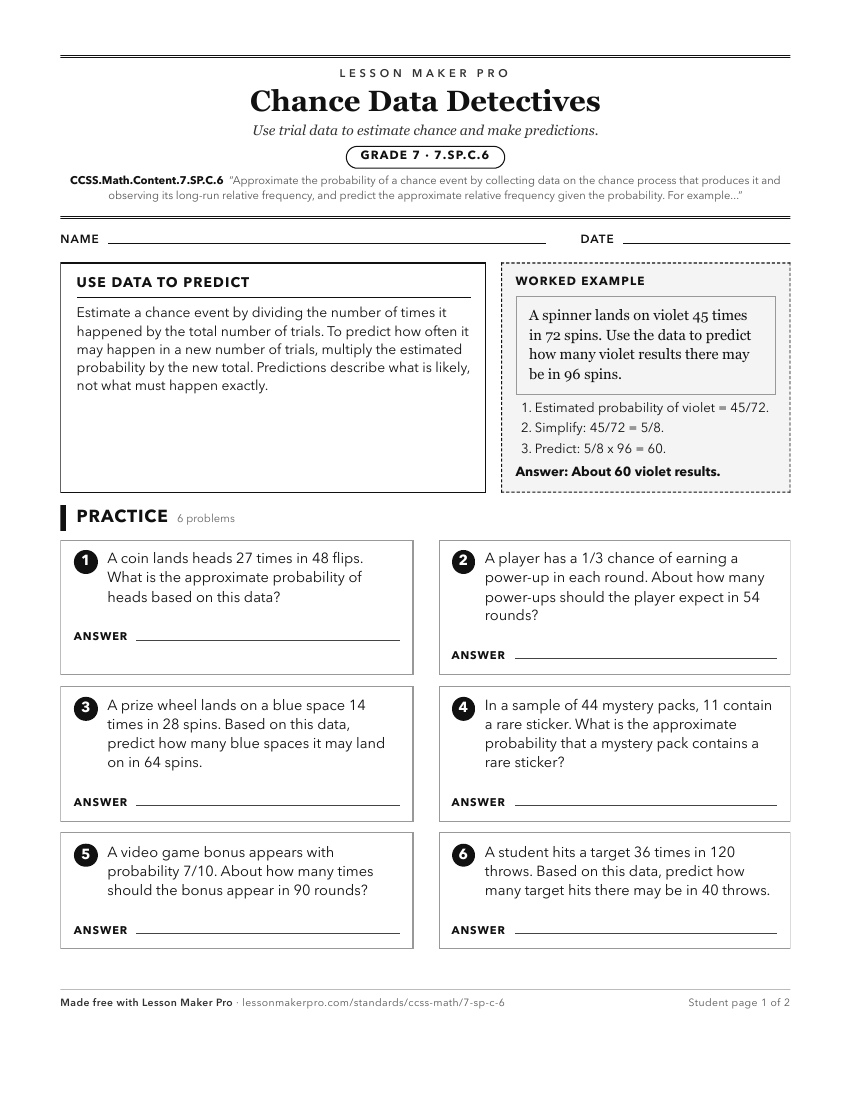
A ready-to-print activity worksheet aligned to CCSS.Math.Content.7.SP.C.6, with an answer key for the teacher on its own page. No account needed.
PDF, US Letter, prints cleanly in black and white.
Download the worksheetLearning progression
Where This Standard Sits
See the whole path on the Statistics & Probability progression map.
Before This Standard
If students are struggling here, check these first.
- CCSS.Math.Content.6.RP.A.1
Relative frequency treats outcomes compared with total trials as a ratio, which supports estimating and predicting probability from data.
- CCSS.Math.Content.7.SP.C.5
Interpreting relative frequency as a probability requires knowing probability as a 0 to 1 measure of likelihood.
- CCSS.Math.Content.6.RP.A.3
Relative frequency and probability use ratios of outcomes to trials, so ratio tables and rates support predicting counts from probabilities.
What This Unlocks
Mastery here sets students up for these next.
- CCSS.Math.Content.7.SP.C.7
Long-run relative frequency and predicted counts carry into checking whether a probability model matches observed data.
- CCSS.Math.Content.7.SP.C.8c
Using simulations for compound events relies on repeated trials and relative frequencies to estimate probabilities from data.
- CCSS.Math.Content.7.SP.C.7b
Using observed frequencies to assign model probabilities requires understanding that long-run relative frequency approximates probability.
- CCSS.Math.Content.HSS-IC.A.2
Students must use long-run relative frequencies from simulated or collected data to judge whether observed results fit a proposed model.
Keep exploring
Related Standards
Turn this exact standard into a lesson
Grade, subject, topic, and the complete standard are prefilled. Create one free, no account needed.
Also for this standard:Make a WorksheetMake a QuizMake a Sub Lesson