CCSS.
The Standard
Decide if a specified model is consistent with results from a given data-generating process, e.g., using simulation.
Common Core State Standards for Mathematics
Teacher's field guide
What This Standard Means
What Students Need to Do
- Students use a probability model to simulate many possible outcomes. They compare an observed result with the simulations and decide whether the result is plausible under the model.
What Mastery Looks Like
- Given a model and data, students can select a useful statistic, interpret a simulation distribution, and locate the observed value. They explain whether the result is common or unusually rare using simulated proportions.
Common Misconceptions
- Students often think one unexpected result proves a model is wrong. They may also rely on intuition instead of comparing the result with many simulated outcomes.
How to Assess It
- Exit ticket: A die is claimed fair. In 1,000 simulated sets of 20 rolls, 12 sets had at least 10 sixes. Should 10 sixes raise doubt? Explain.
Lesson moves
Ways to Teach It
In pairs, roll a die 30 times, then compare each result with 200 computer simulations of a fair die.
Write a response to this prompt: How rare should an outcome be before it makes you question a probability model?
Play Model Detective by matching observed results to simulation graphs and earning points for evidence-based judgments.
Compare a basketball player’s claimed free-throw rate with simulated sets of 20 shots and one real game record.
Free download
Printable HSS-IC.A.2 Worksheet
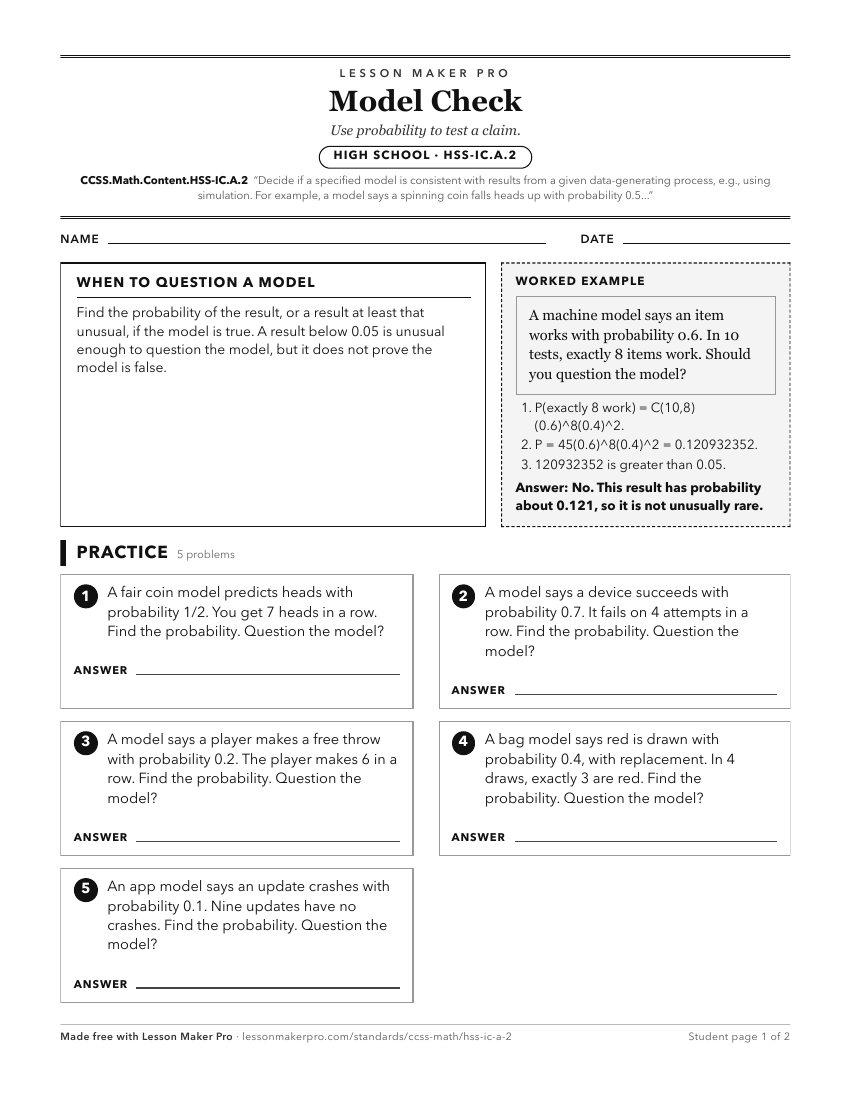
A ready-to-print activity worksheet aligned to CCSS.Math.Content.HSS-IC.A.2, with an answer key for the teacher on its own page. No account needed.
PDF, US Letter, prints cleanly in black and white.
Download the worksheetLearning progression
Where This Standard Sits
Before This Standard
If students are struggling here, check these first.
- CCSS.Math.Content.7.SP.C.7
Students must compare model-based probabilities with observed results before judging whether simulation data fit a specified model.
- CCSS.Math.Content.7.SP.C.6
Students must use long-run relative frequencies from simulated or collected data to judge whether observed results fit a proposed model.
- CCSS.Math.Content.HSS-IC.A.1
Understanding inference from random samples supports judging whether simulated data and model assumptions fit an observed data-generating process.
What This Unlocks
Mastery here sets students up for these next.
Keep exploring
Related Standards
Turn this exact standard into a lesson
Grade, subject, topic, and the complete standard are prefilled. Create one free, no account needed.
Also for this standard:Make a WorksheetMake a QuizMake a Sub Lesson