CCSS.
The Standard
Use data from a randomized experiment to compare two treatments; use simulations to decide if differences between parameters are significant.
Common Core State Standards for Mathematics
Teacher's field guide
What This Standard Means
What Students Need to Do
- Students compare results from groups formed through random assignment. They calculate an observed difference in means or proportions. They shuffle treatment labels repeatedly to see how often chance produces a difference at least that large.
What Mastery Looks Like
- Students identify the treatments and response variable, then calculate a difference in means or proportions. They use a simulated null distribution to judge whether the observed difference is unlikely under no treatment effect.
Common Misconceptions
- Students may confuse random assignment with random sampling. They may think any visible difference proves a treatment worked. They may also treat statistical significance as proof that the effect is large or useful.
How to Assess It
- Exit ticket: Two randomly assigned plant groups differ by 4 cm in mean growth. Only 3 of 100 label shuffles show a difference of 4 cm or more. Estimate the p-value and decide whether the result is significant at 0.05.
Lesson moves
Ways to Teach It
Randomly assign 24 paper helicopters to short or long blades, measure flight times, then shuffle labels to test the mean difference.
Write a claim explaining why a result seen in only 2 of 100 shuffles supports evidence of a treatment effect.
In pairs, draw cards showing simulated differences and race to classify each observed result as significant or not significant.
Analyze a mock clinical trial comparing recovery rates, then discuss whether statistical significance also means the treatment offers a meaningful benefit.
Free download
Printable HSS-IC.B.5 Worksheet
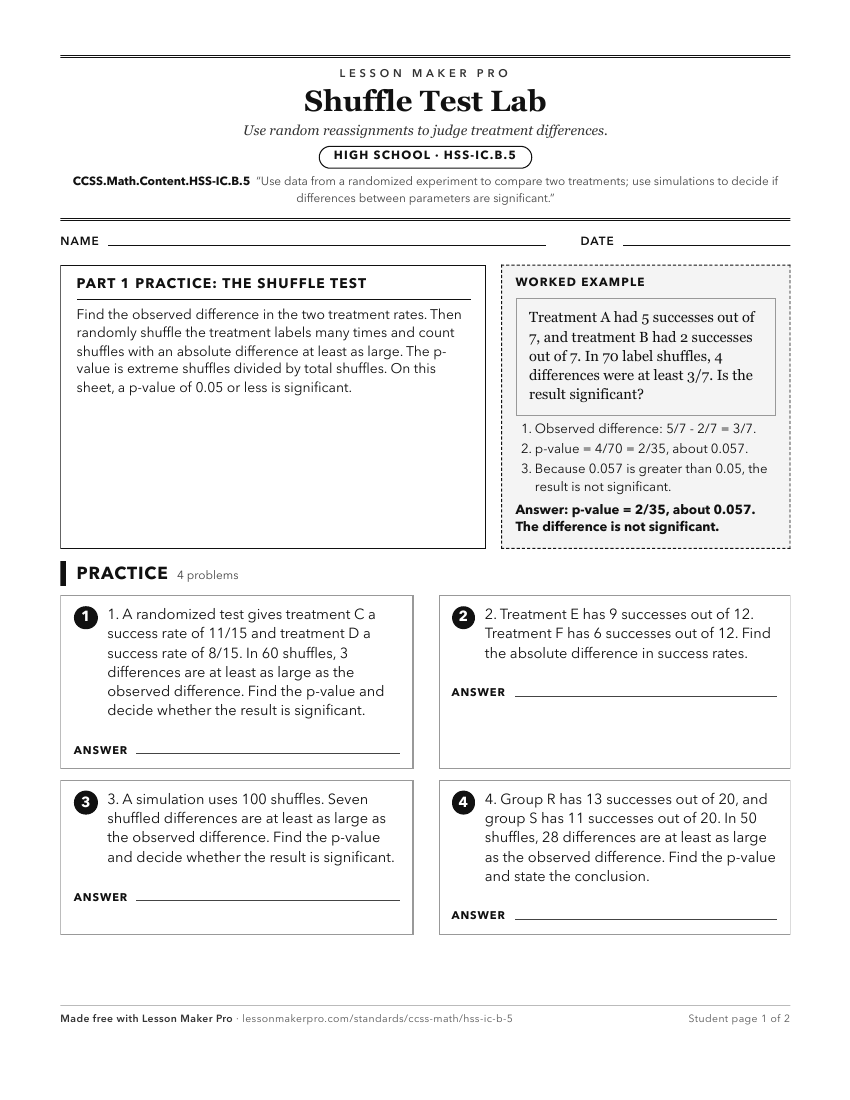
A ready-to-print activity worksheet aligned to CCSS.Math.Content.HSS-IC.B.5, with an answer key for the teacher on its own page. No account needed.
PDF, US Letter, prints cleanly in black and white.
Download the worksheetLearning progression
Where This Standard Sits
Before This Standard
If students are struggling here, check these first.
- CCSS.Math.Content.HSS-IC.A.1
Understanding samples, population parameters, and inference supports judging whether experimental treatment differences are likely due to random variation.
- CCSS.Math.Content.HSS-IC.A.2
Significance testing in experiments requires simulating a null model and judging whether observed treatment differences are consistent with it.
- CCSS.Math.Content.HSS-IC.B.3
Understanding experiments and randomization supports comparing treatments and judging whether observed differences are likely due to chance.
Keep exploring
Related Standards
- CCSS.Math.Content.HSS-IC.B.4
Use data from a sample survey to estimate a population mean or proportion; develop a margin of error through the use of simulation models for random sampling.
- CCSS.Math.Content.HSS-IC.A
Understand and evaluate random processes underlying statistical experiments
- CCSS.Math.Content.7.SP.A.2
Use data from a random sample to draw inferences about a population with an unknown characteristic of interest. Generate multiple samples (or simulated samples)...
Turn this exact standard into a lesson
Grade, subject, topic, and the complete standard are prefilled. Create one free, no account needed.
Also for this standard:Make a WorksheetMake a QuizMake a Sub Lesson