CCSS.
Standard Cluster
Understand and evaluate random processes underlying statistical experiments
Common Core State Standards for Mathematics · High School — Statistics and Probability
Cluster contents
Standards in This Cluster
CCSS.Math.Content.HSS-IC.A is a cluster heading. These are the individual standards under it.
- CCSS.Math.Content.HSS-IC.A.1
Understand statistics as a process for making inferences about population parameters based on a random sample from that population.
- CCSS.Math.Content.HSS-IC.A.2
Decide if a specified model is consistent with results from a given data-generating process, e.g., using simulation.
Teacher's field guide
What This Cluster Means
What Students Need to Do
- Students explain how random sampling or random assignment creates chance variation in results. They use repeated trials or simulations to judge whether an observed outcome is plausible under a proposed model.
What Mastery Looks Like
- Given a study, students identify the random process and predict how results could vary across repetitions. They compare an observed statistic with a simulated distribution and support a conclusion with evidence.
Common Misconceptions
- Students may think random means careless or that all outcomes must be equally likely. They may treat one unusual result as proof that a model is wrong. They may expect a simulation to reproduce the original data exactly.
How to Assess It
- Exit ticket: A coin gives 16 heads in 20 flips, and only 2 of 100 fair-coin simulations gave 16 or more heads. Is a fair-coin model reasonable? Explain using the simulation.
Lesson moves
Ways to Teach It
In pairs, toss a coin 20 times, pool the class proportions of heads, and graph how results vary.
Ask students to write whether an unusual result proves a model is wrong, then defend their answer with an example.
Play Model Match: teams pair observed outcomes with simulation dot plots and earn points for evidence-based justifications.
Use election polling data to discuss why two random samples from the same population can report different percentages.
Free download
Printable HSS-IC.A Worksheet
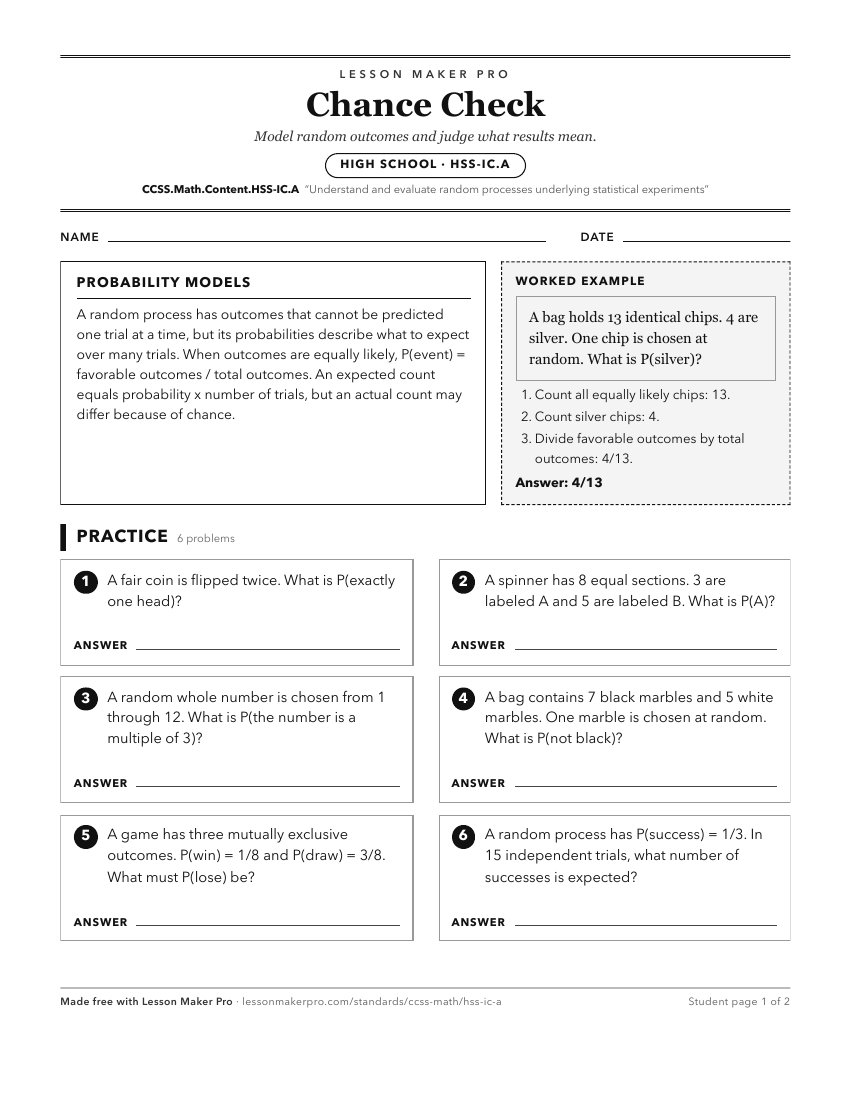
A ready-to-print activity worksheet aligned to CCSS.Math.Content.HSS-IC.A, with an answer key for the teacher on its own page. No account needed.
PDF, US Letter, prints cleanly in black and white.
Download the worksheetKeep exploring
Related Standards
Turn this cluster into a lesson
Grade, subject, topic, and the complete cluster are prefilled. Create one free, no account needed.
Also for this cluster:Make a WorksheetMake a QuizMake a Sub Lesson