CCSS.
The Standard
Understand statistics as a process for making inferences about population parameters based on a random sample from that population.
Common Core State Standards for Mathematics
Teacher's field guide
What This Standard Means
What Students Need to Do
- Students use results from a random sample to estimate an unknown feature of a larger population. They distinguish the sample statistic from the population parameter and explain why randomness matters.
What Mastery Looks Like
- Students correctly name the population, random sample, sample statistic, and population parameter in a study. They make a reasonable estimate and explain why it includes uncertainty.
Common Misconceptions
- Students may treat a sample result as the exact population value. They may call a convenience sample random or assume a large biased sample represents the population well.
How to Assess It
- Give this exit ticket: “A random sample of 80 students finds 52% prefer later start times. Identify the population, parameter, statistic, and a reasonable inference.”
Lesson moves
Ways to Teach It
Fill a bag with two colors of counters, draw random samples, calculate sample proportions, and compare them with the bag’s true proportion.
Ask students to write why surveying 50 randomly selected voters differs from surveying 50 people leaving one campaign event.
Give groups scenario cards to sort into population, sample, parameter, or statistic, then require a reason for each placement.
Read a current poll report and identify who was sampled, the target population, the reported statistic, and any limits on the conclusion.
Free download
Printable HSS-IC.A.1 Worksheet
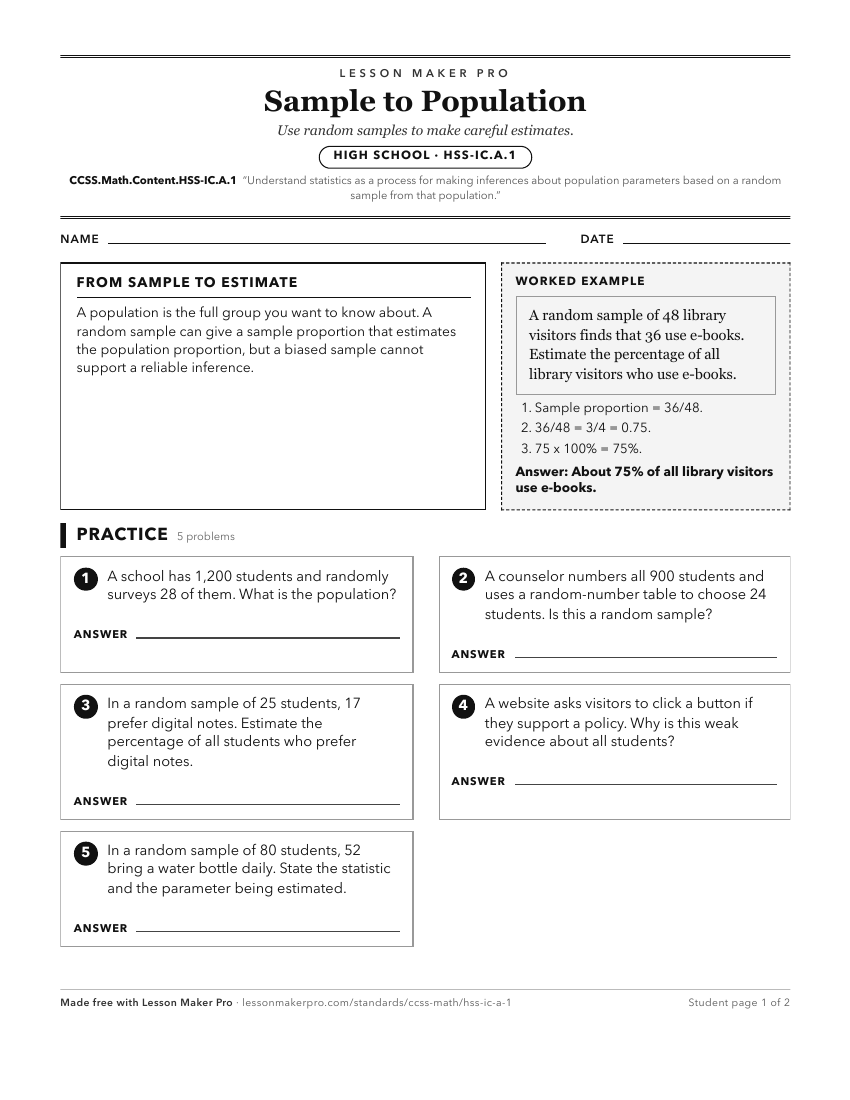
A ready-to-print activity worksheet aligned to CCSS.Math.Content.HSS-IC.A.1, with an answer key for the teacher on its own page. No account needed.
PDF, US Letter, prints cleanly in black and white.
Download the worksheetLearning progression
Where This Standard Sits
Before This Standard
If students are struggling here, check these first.
- CCSS.Math.Content.7.SP.A.2
Using random samples to infer population traits and see sample variation prepares students for formal inference about population parameters.
- CCSS.Math.Content.7.SP.A.1
Students need the population, sample, random sampling, and valid inference ideas before reasoning about estimating population parameters.
- CCSS.Math.Content.HSS-ID.A.2
Understanding mean, median, and variability helps students see how sample statistics can estimate population parameters.
What This Unlocks
Mastery here sets students up for these next.
- CCSS.Math.Content.HSS-IC.B.6
Understanding random samples and population inference helps students judge whether a data report’s conclusions are justified.
- CCSS.Math.Content.HSS-IC.B.3
Understanding random samples and population inference supports why surveys generalize, while target adds experiments, observational studies, and randomization roles.
- CCSS.Math.Content.HSS-IC.B.4
Estimating population means or proportions with margins of error requires understanding random samples as evidence about population parameters.
- CCSS.Math.Content.HSS-IC.B.5
Understanding samples, population parameters, and inference supports judging whether experimental treatment differences are likely due to random variation.
- CCSS.Math.Content.HSS-IC.A.2
Understanding inference from random samples supports judging whether simulated data and model assumptions fit an observed data-generating process.
Keep exploring
Related Standards
Turn this exact standard into a lesson
Grade, subject, topic, and the complete standard are prefilled. Create one free, no account needed.
Also for this standard:Make a WorksheetMake a QuizMake a Sub Lesson