CCSS.
The Standard
Develop a probability model and use it to find probabilities of events. Compare probabilities from a model to observed frequencies; if the agreement is not good, explain possible sources of the discrepancy.
Common Core State Standards for Mathematics · Statistics and Probability
Teacher's field guide
What This Standard Means
What Students Need to Do
- Students list possible outcomes and assign a probability to each one. They use the model to calculate event probabilities, then compare predictions with repeated trial results and explain mismatches.
What Mastery Looks Like
- A student can organize outcomes and probabilities in a table and check that the probabilities total 1. The student can calculate an event probability, predict a count, compare it with trial data, and give a reasonable explanation for differences.
Common Misconceptions
- Students may assume all outcomes are equally likely, even when a spinner or sample space shows otherwise. They may expect observed results to match predicted counts exactly. They may overlook small sample size, uneven materials, or inconsistent procedures as causes of a mismatch.
How to Assess It
- Exit ticket: A bag contains 3 red and 2 blue counters. In 20 draws with replacement, red appears 8 times. Find the predicted probability of red, compare it with the result, and explain one reason for the difference.
Lesson moves
Ways to Teach It
Have pairs spin a four-section spinner 40 times, record outcomes, build a probability table, and compare expected and observed counts.
Ask students to write: Why might two groups using the same probability model collect different results after 20 trials?
Play a card-matching game where students pair sample spaces, event descriptions, probability values, and expected counts.
Give students 20 archived rain forecasts and outcomes, then compare each forecast group with how often rain occurred.
Free download
Printable 7.SP.C.7 Worksheet
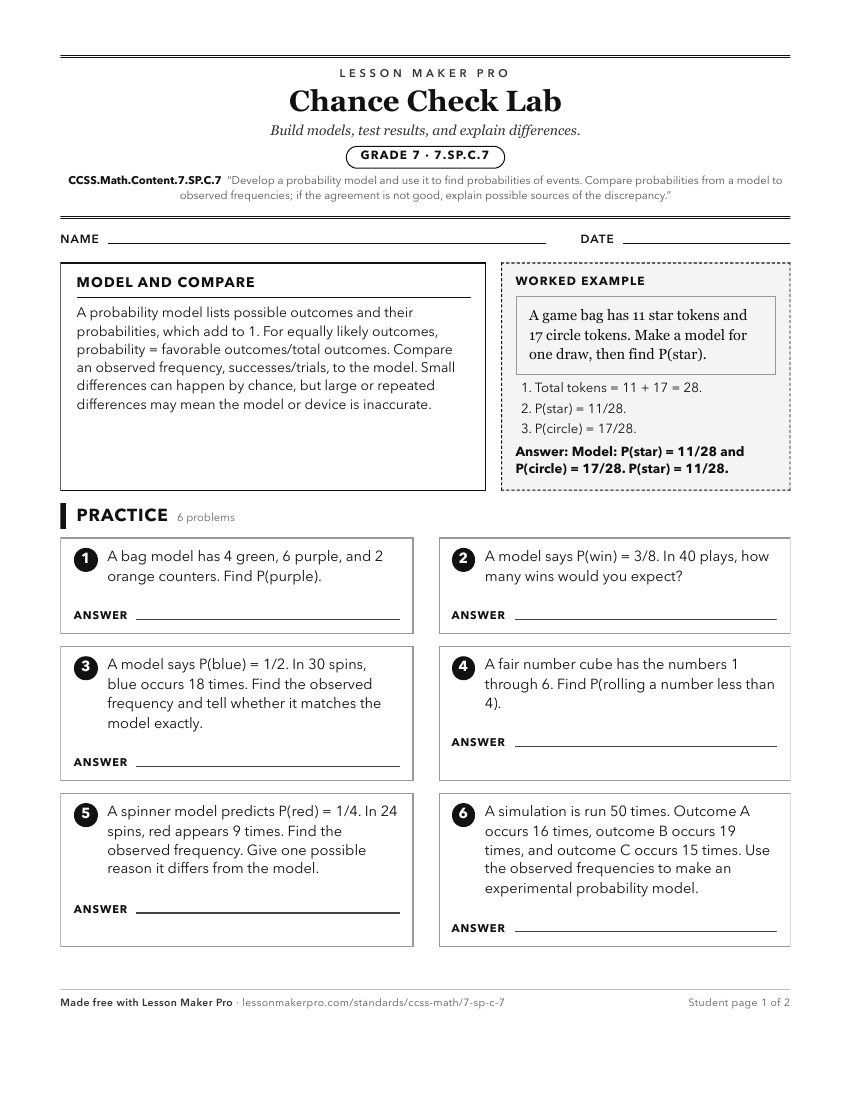
A ready-to-print activity worksheet aligned to CCSS.Math.Content.7.SP.C.7, with an answer key for the teacher on its own page. No account needed.
PDF, US Letter, prints cleanly in black and white.
Download the worksheetLearning progression
Where This Standard Sits
See the whole path on the Statistics & Probability progression map.
Before This Standard
If students are struggling here, check these first.
- CCSS.Math.Content.7.SP.C.6
Long-run relative frequency and predicted counts carry into checking whether a probability model matches observed data.
- CCSS.Math.Content.7.SP.C.5
Interpreting probabilities from 0 to 1 is needed to create models, judge likelihoods, and compare predictions with observed frequencies.
- CCSS.Math.Content.6.RP.A.1
Probability models and relative frequencies use ratios such as favorable outcomes to total outcomes and observed counts to trials.
What This Unlocks
Mastery here sets students up for these next.
- CCSS.Math.Content.HSS-MD.A.2
Expected value uses probabilities from a model to weight outcomes and interpret the distribution's mean.
- CCSS.Math.Content.7.SP.C.8
Using probability models for simple events supports finding compound event probabilities with lists, tables, trees, and simulations.
- CCSS.Math.Content.7.SP.C.8b
Understanding probability models, events, and observed outcomes supports listing compound-event sample spaces and selecting outcomes that match an event.
- CCSS.Math.Content.HSS-IC.A.2
Students must compare model-based probabilities with observed results before judging whether simulation data fit a specified model.
- CCSS.Math.Content.HSS-MD.A.1
Random variables and their distributions require assigning probabilities to sample-space events, which 7.SP.C.7 develops through probability models.
- CCSS.Math.Content.HSS-CP.A.1
Creating probability models gives students practice defining outcomes and events, which supports later set language for or, and, and not.
Keep exploring
Related Standards
- CCSS.Math.Content.7.SP.C.7a
Develop a uniform probability model by assigning equal probability to all outcomes, and use the model to determine probabilities of events.
- CCSS.Math.Content.7.SP.C.7b
Develop a probability model (which may not be uniform) by observing frequencies in data generated from a chance process.
- CCSS.Math.Content.7.SP.C
Investigate chance processes and develop, use, and evaluate probability models.
Turn this exact standard into a lesson
Grade, subject, topic, and the complete standard are prefilled. Create one free, no account needed.
Also for this standard:Make a WorksheetMake a QuizMake a Sub Lesson