CCSS.
The Standard
Describe events as subsets of a sample space (the set of outcomes) using characteristics (or categories) of the outcomes, or as unions, intersections, or complements of other events ("or," "and," "not").
Common Core State Standards for Mathematics
Teacher's field guide
What This Standard Means
What Students Need to Do
- Students define events by selecting outcomes from a sample space. They describe combined events using “or,” “and,” and “not,” then connect those words to union, intersection, and complement.
What Mastery Looks Like
- Students list the outcomes in an event from a stated sample space. They correctly represent “or,” “and,” and “not” with unions, intersections, complements, or labeled Venn diagrams.
Common Misconceptions
- Students may treat “or” as exclusive and leave out outcomes in both events. They may also confuse intersection with union or think a complement includes outcomes inside the event.
How to Assess It
- Give the sample space {1, 2, 3, 4, 5, 6}. Ask students to list outcomes for “even or greater than 4,” “even and greater than 4,” and “not even.”
Lesson moves
Ways to Teach It
Give pairs a deck of cards and have them sort outcomes for red, face card, red and face card, and not red.
Ask students to explain why “red or face card” includes red face cards, using a Venn diagram as evidence.
Play Event Match with cards showing verbal events, outcome lists, symbols, and Venn diagrams for students to pair.
Use school survey data to describe students who play a sport, play an instrument, do both, or do neither.
Free download
Printable HSS-CP.A.1 Worksheet
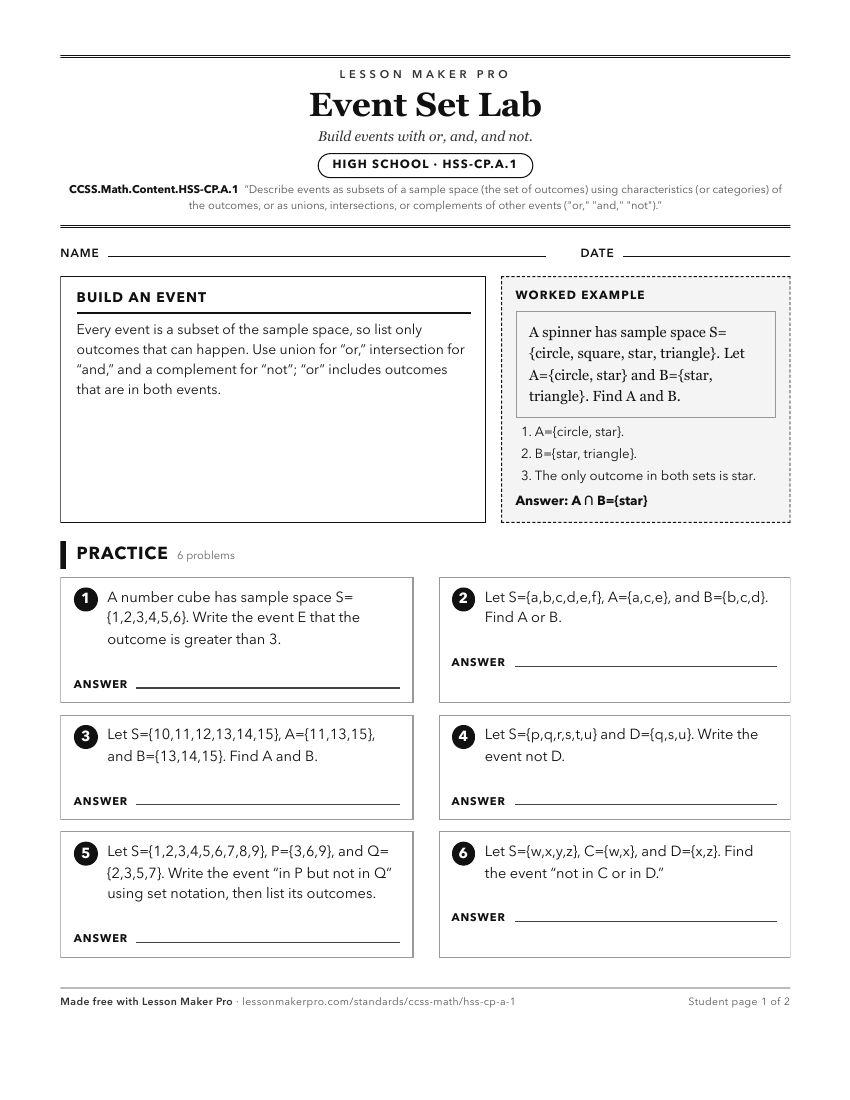
A ready-to-print activity worksheet aligned to CCSS.Math.Content.HSS-CP.A.1, with an answer key for the teacher on its own page. No account needed.
PDF, US Letter, prints cleanly in black and white.
Download the worksheetLearning progression
Where This Standard Sits
Before This Standard
If students are struggling here, check these first.
- CCSS.Math.Content.7.SP.C.8b
Listing sample spaces and matching everyday events to outcomes supports describing events as subsets, unions, intersections, and complements.
- CCSS.Math.Content.7.SP.C.8a
Understanding compound events through outcomes in a sample space supports describing events with sets and “and,” “or,” and “not.”
- CCSS.Math.Content.7.SP.C.7
Creating probability models gives students practice defining outcomes and events, which supports later set language for or, and, and not.
What This Unlocks
Mastery here sets students up for these next.
- CCSS.Math.Content.HSS-MD.A.3
Probability distributions require grouping sample-space outcomes into events for each random variable value and calculating their theoretical probabilities.
- CCSS.Math.Content.HSS-CP.A.4
Two-way tables require viewing category combinations as events in a sample space, including intersections and complements.
- CCSS.Math.Content.HSS-CP.A.3
Conditional probability and independence require seeing events as sets and interpreting A and B as their overlap within the sample space.
- CCSS.Math.Content.HSS-CP.A.2
Independence requires interpreting A and B occurring together as an intersection of events in the sample space.
- CCSS.Math.Content.HSS-CP.A.5
Conditional probability and independence rely on identifying events and their overlap, but can be introduced informally through everyday situations.
- CCSS.Math.Content.HSS-CP.B.7
Students must recognize events, “or” unions, and “and” intersections to apply the addition rule and interpret the probability.
Keep exploring
Related Standards
Turn this exact standard into a lesson
Grade, subject, topic, and the complete standard are prefilled. Create one free, no account needed.
Also for this standard:Make a WorksheetMake a QuizMake a Sub Lesson