CCSS.
The Standard
Understand that, just as with simple events, the probability of a compound event is the fraction of outcomes in the sample space for which the compound event occurs.
Common Core State Standards for Mathematics
Teacher's field guide
What This Standard Means
What Students Need to Do
- Students list every possible result of a chance process with two or more parts. They identify which results meet a condition and compare that count with the total number of outcomes.
What Mastery Looks Like
- Students organize all outcomes in a table, tree diagram, or list without omissions or repeats. They count the outcomes matching a condition, write the correct fraction, and simplify it.
Common Misconceptions
- Students may count only successful outcomes and forget to count the full sample space. They may confuse “and” with “or,” omit possible outcomes, or assume outcomes are equally likely when they are not.
How to Assess It
- Exit ticket: Flip a coin and roll a number cube. List the sample space, then find the probability of getting heads and an even number.
Lesson moves
Ways to Teach It
Pairs flip a coin and roll a number cube 24 times, record outcomes, then compare experimental results with the complete sample space.
Ask students to explain why heads and an even number has three successful outcomes out of twelve possible outcomes.
Play Sample Space Match, where students pair event cards with the correct outcome list and probability card.
Use a lunch choice menu with two mains and three sides to find the probability of randomly receiving a given meal combination.
Free download
Printable 7.SP.C.8a Worksheet
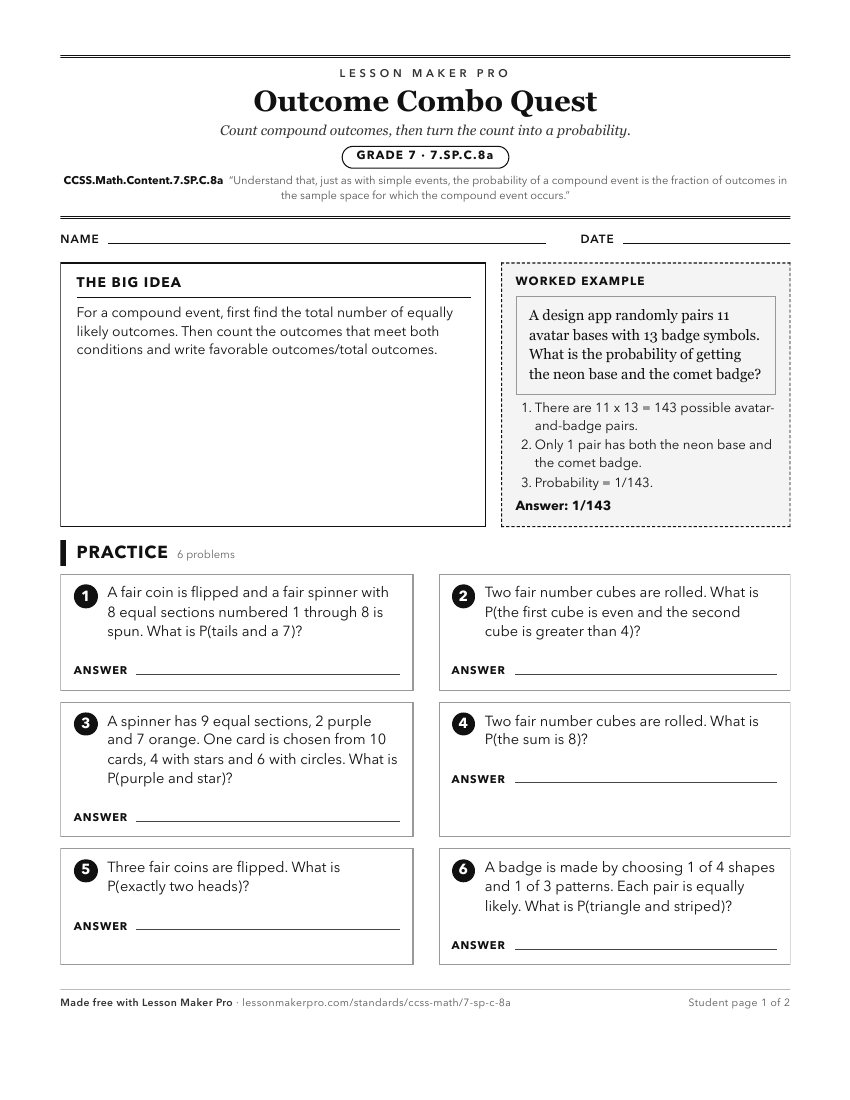
A ready-to-print activity worksheet aligned to CCSS.Math.Content.7.SP.C.8a, with an answer key for the teacher on its own page. No account needed.
PDF, US Letter, prints cleanly in black and white.
Download the worksheetLearning progression
Where This Standard Sits
Before This Standard
If students are struggling here, check these first.
- CCSS.Math.Content.7.SP.C.5
Interpreting probabilities from 0 to 1 helps students see compound-event fractions as measures of likelihood, not just counts.
- CCSS.Math.Content.7.SP.C.7a
Students need favorable-outcomes-over-total reasoning from uniform simple-event models before applying the same fraction idea to compound sample spaces.
- CCSS.Math.Content.6.RP.A.1
Probability as favorable outcomes out of total outcomes uses ratio thinking to compare two counts in a sample space.
What This Unlocks
Mastery here sets students up for these next.
- CCSS.Math.Content.7.SP.C.8
Students must connect favorable outcomes to the whole sample space before using lists, tables, trees, or simulations to find compound probabilities.
- CCSS.Math.Content.HSS-CP.B.7
Students need to see “A or B” and “A and B” as compound events before using the Addition Rule meaningfully.
- CCSS.Math.Content.HSS-CP.A.1
Understanding compound events through outcomes in a sample space supports describing events with sets and “and,” “or,” and “not.”
- CCSS.Math.Content.HSS-CP.A.3
Conditional probability requires finding the probability of the joint event A and B within a sample space.
Keep exploring
Related Standards
- CCSS.Math.Content.HSS-CP.B
Use the rules of probability to compute probabilities of compound events in a uniform probability model
- CCSS.Math.Content.7.SP.C.8b
Represent sample spaces for compound events using methods such as organized lists, tables and tree diagrams. For an event described in everyday language (e.g., ...
Turn this exact standard into a lesson
Grade, subject, topic, and the complete standard are prefilled. Create one free, no account needed.
Also for this standard:Make a WorksheetMake a QuizMake a Sub Lesson