CCSS.
The Standard
Recognize and represent proportional relationships between quantities.
Common Core State Standards for Mathematics · Ratios and Proportional Relationships
Teacher's field guide
What This Standard Means
What Students Need to Do
- Students decide whether two quantities have a constant ratio. They find the unit rate and use it as the constant of proportionality. They represent the relationship with tables, graphs, equations, and words.
What Mastery Looks Like
- Students correctly identify proportional relationships in tables, graphs, equations, and word problems. They find the constant of proportionality and write an equation in the form y = kx. They explain what the origin and the point (1, k) mean in context.
Common Misconceptions
- Students may assume any relationship that increases is proportional. They may use an additive pattern instead of checking for a constant quotient. They may also accept a straight graph that does not pass through the origin.
How to Assess It
- Give students a table with points (2, 5), (4, 10), and (6, 15). Ask them to find the constant of proportionality, write an equation, and sketch the graph.
Lesson moves
Ways to Teach It
Mix one cup of colored water with two cups of clear water, then scale the mixture and record each pair in a table.
Discuss whether a taxi fare with a starting fee is proportional, and support the answer with a table, equation, or graph.
Play a card sort matching tables, graphs, equations, and situations that show the same proportional relationship.
Compare grocery prices by finding cost per item, then write an equation for the total cost of each option.
Free download
Printable 7.RP.A.2 Worksheet
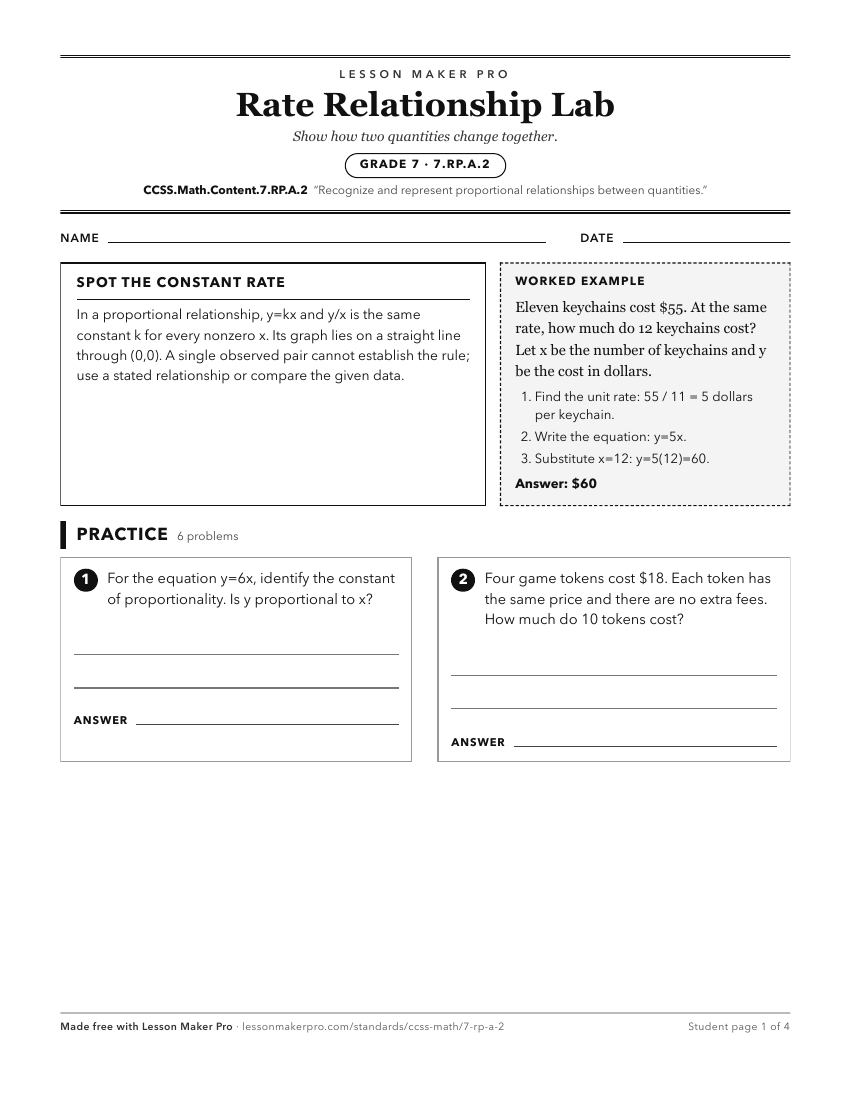
A ready-to-print activity worksheet aligned to CCSS.Math.Content.7.RP.A.2, with an answer key for the teacher on its own page. No account needed.
PDF, US Letter, prints cleanly in black and white.
Download the worksheetLearning progression
Where This Standard Sits
See the whole path on the Ratios & Proportional Relationships progression map.
Before This Standard
If students are struggling here, check these first.
- CCSS.Math.Content.6.RP.A.1
Recognizing proportional relationships depends on seeing constant ratios between quantities and describing what each ratio means.
- CCSS.Math.Content.6.RP.A.2
Unit rates carry into the constant of proportionality used to identify, table, graph, and equation proportional relationships.
- CCSS.Math.Content.6.RP.A.3a
Equivalent ratio tables and plotted pairs become the main evidence students use to identify and represent proportional relationships.
What This Unlocks
Mastery here sets students up for these next.
- CCSS.Math.Content.8.EE.B.5
Students must understand constants of proportionality and representations before interpreting that constant as graph slope and comparing forms.
- CCSS.Math.Content.7.RP.A.3
Students must identify and represent proportional relationships before using them to organize multistep ratio and percent calculations.
- CCSS.Math.Content.HSG-GPE.B.6
Partitioning a segment uses ratio reasoning to compare the two smaller lengths and translate that ratio into coordinate changes.
- CCSS.Math.Content.8.EE.B.6
Understanding constant rates and graphs through the origin supports seeing slope as a constant ratio and deriving y = mx.
- CCSS.Math.Content.7.G.A.1
Scale drawings require using a constant scale factor to relate drawing lengths to actual lengths and new copies.
- CCSS.Math.Content.HSF-TF.A.1
Proportional reasoning helps connect angle fraction, circumference fraction, and arc length when defining radians on the unit circle.
Keep exploring
Related Standards
- CCSS.Math.Content.8.EE.B
Understand the connections between proportional relationships, lines, and linear equations.
- CCSS.Math.Content.7.RP.A
Analyze proportional relationships and use them to solve real-world and mathematical problems.
- CCSS.Math.Content.7.RP.A.2a
Decide whether two quantities are in a proportional relationship, e.g., by testing for equivalent ratios in a table or graphing on a coordinate plane and observ...
- CCSS.Math.Content.7.RP.A.2c
Represent proportional relationships by equations.
Turn this exact standard into a lesson
Grade, subject, topic, and the complete standard are prefilled. Create one free, no account needed.
Also for this standard:Make a WorksheetMake a QuizMake a Sub Lesson