CCSS.
The Standard
Compute unit rates associated with ratios of fractions, including ratios of lengths, areas and other quantities measured in like or different units.
Common Core State Standards for Mathematics · Ratios and Proportional Relationships
Teacher's field guide
What This Standard Means
What Students Need to Do
- Students divide one fractional quantity by another to find an amount for one unit. They decide which quantity comes after “per” and attach correct units, such as miles per hour or dollars per pound.
What Mastery Looks Like
- Given 3/4 gallon for 2/5 acre, a student finds 15/8 gallons per acre or 8/15 acre per gallon when asked. Work shows division, use of the reciprocal, simplification, and correct labels.
Common Misconceptions
- Students may multiply the fractions instead of dividing, or take the reciprocal of the first fraction rather than the divisor. They may also reverse the rate or omit its units.
How to Assess It
- Exit ticket: A cyclist rides 2 1/4 miles in 3/8 hour. Find the speed in miles per hour, show the division, and label the answer.
Lesson moves
Ways to Teach It
Have pairs move 3/4 cup of water every 1/2 minute for two minutes, record totals, and calculate cups per minute.
Post a runner covering 2/3 mile in 1/4 hour, then ask students to defend whether the rate is 3/8 or 8/3 mph.
Make card sets showing a fractional ratio, division expression, unit rate, and label; teams race to build correct sets.
Give grocery ads with prices for fractional-pound packages, and have students calculate cost per pound before choosing the better buy.
Free download
Printable 7.RP.A.1 Worksheet
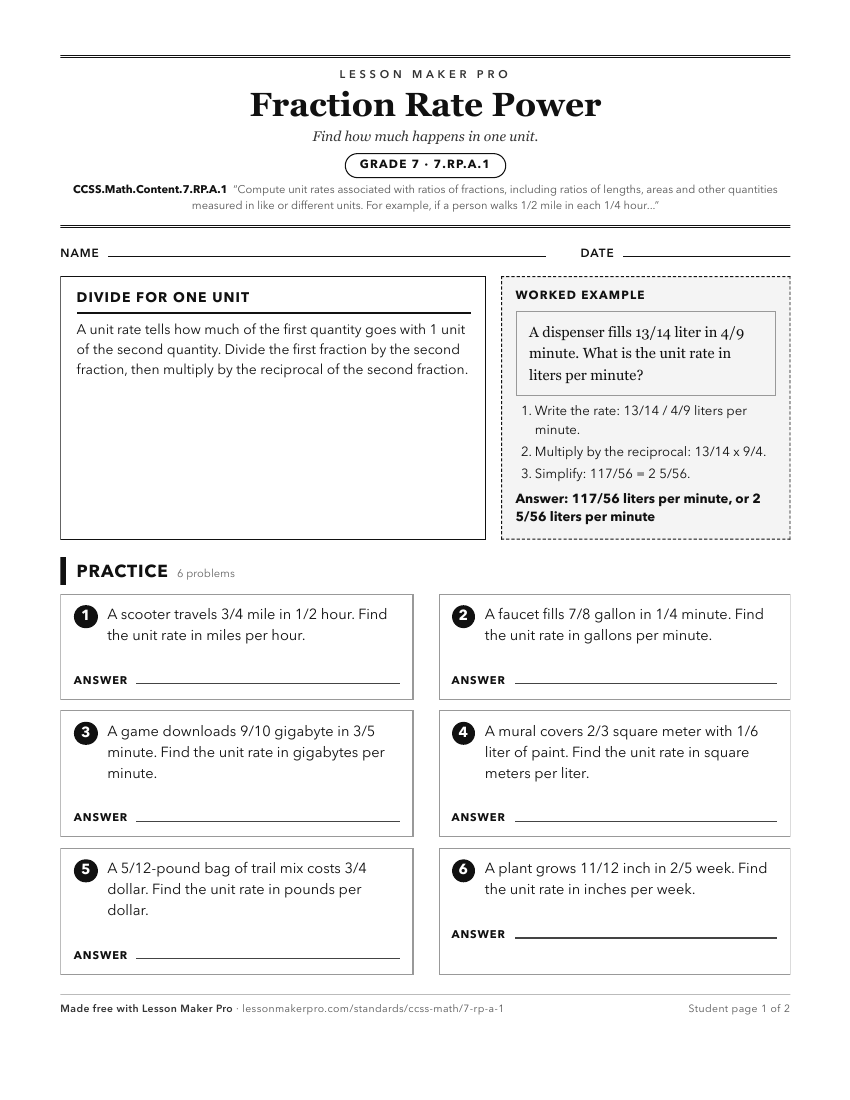
A ready-to-print activity worksheet aligned to CCSS.Math.Content.7.RP.A.1, with an answer key for the teacher on its own page. No account needed.
PDF, US Letter, prints cleanly in black and white.
Download the worksheetLearning progression
Where This Standard Sits
See the whole path on the Ratios & Proportional Relationships progression map.
Before This Standard
If students are struggling here, check these first.
- CCSS.Math.Content.6.RP.A.1
Unit rates are ratios expressed per one unit, so students need ratio meaning and language before interpreting rates with fractions.
- CCSS.Math.Content.6.RP.A.2
Students must understand unit rate as a per-one ratio before computing unit rates when the ratio quantities are fractions.
- CCSS.Math.Content.6.NS.A.1
Computing unit rates from fractional quantities requires interpreting the ratio as division and carrying out fraction division accurately.
What This Unlocks
Mastery here sets students up for these next.
- CCSS.Math.Content.HSG-MG.A.2
Area and volume density are unit rates, so students must compute and interpret quantities per square or cubic unit.
- CCSS.Math.Content.HSF-LE.A.1b
Unit rates help students identify the constant change per one unit that signals a linear situation.
- CCSS.Math.Content.HSN-Q.A.1
Computing unit rates with compound units supports using and interpreting units consistently in formulas and multi-step quantitative problems.
Keep exploring
Related Standards
- CCSS.Math.Content.5.MD.C.4
Measure volumes by counting unit cubes, using cubic cm, cubic in, cubic ft, and improvised units.
- CCSS.Math.Content.6.RP.A.3d
Use ratio reasoning to convert measurement units; manipulate and transform units appropriately when multiplying or dividing quantities.
- CCSS.Math.Content.5.MD.A
Convert like measurement units within a given measurement system.
Turn this exact standard into a lesson
Grade, subject, topic, and the complete standard are prefilled. Create one free, no account needed.
Also for this standard:Make a WorksheetMake a QuizMake a Sub Lesson