CCSS.
The Standard
Use units as a way to understand problems and to guide the solution of multi-step problems; choose and interpret units consistently in formulas; choose and interpret the scale and the origin in graphs and data displays.
Common Core State Standards for Mathematics · Quantities
Teacher's field guide
What This Standard Means
What Students Need to Do
- Students track units through every step of a calculation and use them to choose valid operations and conversions. They interpret units in formulas and select graph scales and origins that represent data clearly.
What Mastery Looks Like
- Students label each quantity, arrange conversion factors correctly, and report answers with appropriate units. They explain what units in a formula mean and spot graph choices that distort comparisons.
Common Misconceptions
- Students often treat units as labels added after calculating, or use conversion factors backward. They may combine incompatible units or read graph changes without checking axis intervals and origins.
How to Assess It
- Give this exit ticket: “A tank fills at 2.5 gallons per minute for 18 minutes. Convert the total to liters using 1 gallon = 3.785 liters, then propose a clear graph scale for times from 0 to 30 minutes.”
Lesson moves
Ways to Teach It
Give pairs a measuring tape and stopwatch to find walking speed in meters per second, convert it, and graph distance against time.
Show two graphs of the same wage data with different origins and ask, “Which display supports a fair comparison, and why?”
Run a unit-cancellation relay using cards for quantities, conversion factors, operations, and final units.
Have students estimate a monthly phone bill from price-per-gigabyte data, then choose an axis scale that shows several usage levels clearly.
Free download
Printable HSN-Q.A.1 Worksheet
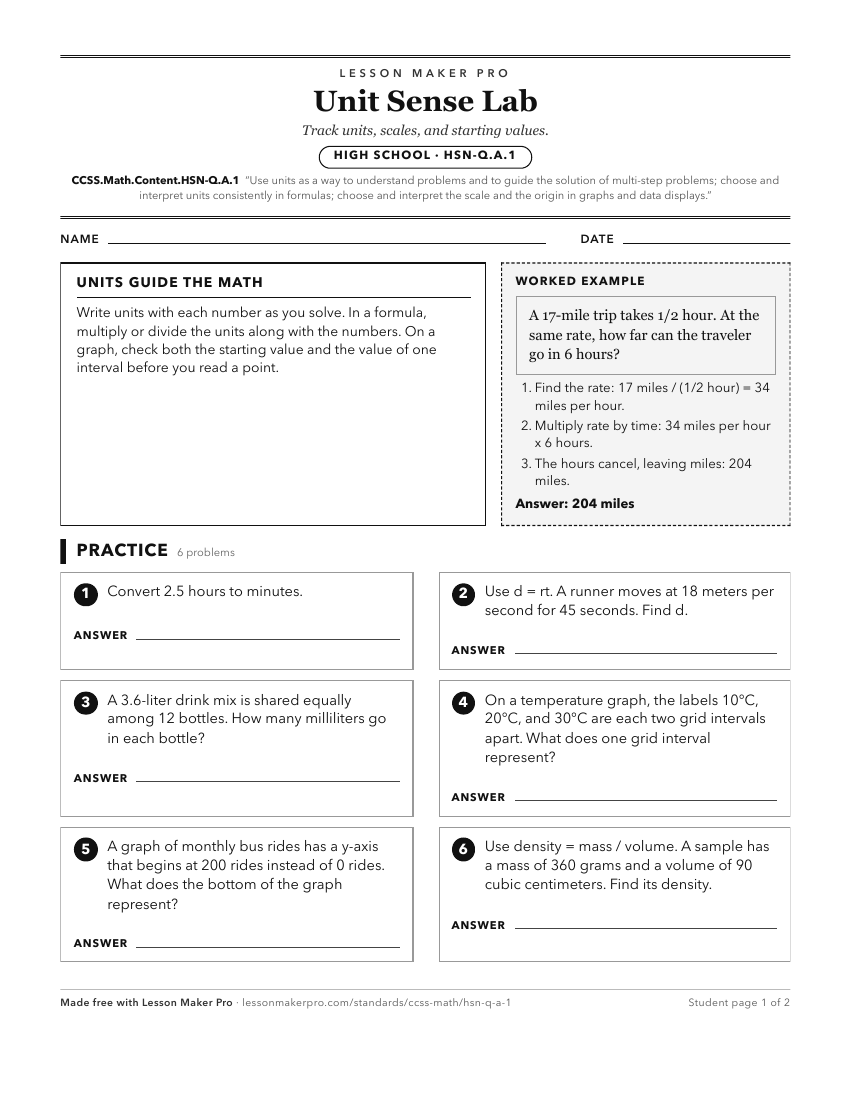
A ready-to-print activity worksheet aligned to CCSS.Math.Content.HSN-Q.A.1, with an answer key for the teacher on its own page. No account needed.
PDF, US Letter, prints cleanly in black and white.
Download the worksheetLearning progression
Where This Standard Sits
Before This Standard
If students are struggling here, check these first.
- CCSS.Math.Content.7.EE.B.3
Fluency with rational numbers, conversions, and reasonableness checks supports using units consistently in multi-step quantitative problems.
- CCSS.Math.Content.7.RP.A.1
Computing unit rates with compound units supports using and interpreting units consistently in formulas and multi-step quantitative problems.
What This Unlocks
Mastery here sets students up for these next.
- CCSS.Math.Content.HSN-Q.A.3
Interpreting units and display scales supports judging measurement precision and how many digits a reported quantity should reasonably include.
- CCSS.Math.Content.HSG-MG.A.2
Interpreting compound units and consistent units in formulas supports modeling densities such as people per square mile or BTUs per cubic foot.
- CCSS.Math.Content.HSN-Q.A.2
Choosing and interpreting units helps students decide which measurable quantities to define for a modeling situation.
- CCSS.Math.Content.HSA-SSE.A.1
Tracking units and quantities helps students explain what terms, factors, and coefficients in an expression mean in context.
- CCSS.Math.Content.HSG-MG.A.1
Choosing consistent units and interpreting measurements supports using geometric dimensions to model real objects with shapes.
- CCSS.Math.Content.HSG-GMD.A.3
Choosing and interpreting units in formulas carries over to using volume formulas correctly and reporting answers in cubic units.
Keep exploring
Related Standards
- CCSS.Math.Content.4.MD.A
Solve problems involving measurement and conversion of measurements from a larger unit to a smaller unit.
- CCSS.Math.Content.HSN-Q.A
Reason quantitatively and use units to solve problems.
- CCSS.Math.Content.6.RP.A.3d
Use ratio reasoning to convert measurement units; manipulate and transform units appropriately when multiplying or dividing quantities.
- CCSS.Math.Content.5.MD.A.1
Convert among different-sized standard measurement units within a given measurement system (e.g., convert 5 cm to 0.05 m), and use these conversions in solving ...
Turn this exact standard into a lesson
Grade, subject, topic, and the complete standard are prefilled. Create one free, no account needed.
Also for this standard:Make a WorksheetMake a QuizMake a Sub Lesson