CCSS.
The Standard
Apply concepts of density based on area and volume in modeling situations (e.g., persons per square mile, BTUs per cubic foot).
Common Core State Standards for Mathematics
Teacher's field guide
What This Standard Means
What Students Need to Do
- Students calculate an amount per unit area or per unit volume in a real setting. They use the resulting rate to compare spaces, estimate totals, or make decisions.
What Mastery Looks Like
- Students choose the correct area or volume formula, then divide the given amount by that measure. They label units correctly and use the density to compare spaces or find an unknown amount.
Common Misconceptions
- Students may compare total amounts instead of rates per unit area or volume. They may use perimeter when area is needed, or area when volume is needed. Units are often omitted or written incorrectly.
How to Assess It
- Exit ticket: A 2,400-square-foot library holds 96 people. Find the population density, include units, and compare it with a limit of 0.05 people per square foot.
Lesson moves
Ways to Teach It
Measure the classroom floor, count students, and calculate the class density in students per square meter.
Write a recommendation explaining which of two parks is more crowded, using visitor counts, areas, calculations, and units.
Match cards showing dimensions and quantities with cards showing the correct area or volume density.
Calculate the heating capacity needed for a warehouse from its dimensions and a given BTU requirement per cubic foot.
Free download
Printable HSG-MG.A.2 Worksheet
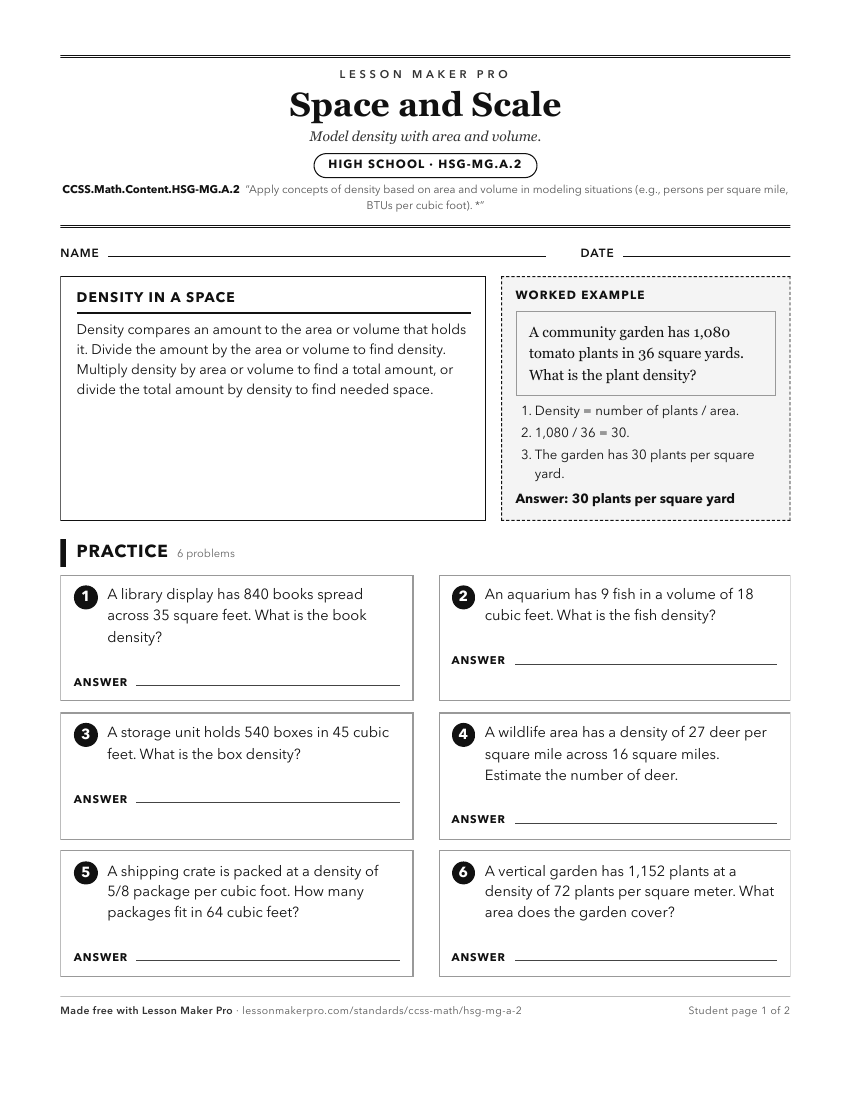
A ready-to-print activity worksheet aligned to CCSS.Math.Content.HSG-MG.A.2, with an answer key for the teacher on its own page. No account needed.
PDF, US Letter, prints cleanly in black and white.
Download the worksheetLearning progression
Where This Standard Sits
Before This Standard
If students are struggling here, check these first.
- CCSS.Math.Content.7.G.B.6
Area and volume problem solving carries over to interpreting and computing rates like people per square mile or BTUs per cubic foot.
- CCSS.Math.Content.HSN-Q.A.1
Interpreting compound units and consistent units in formulas supports modeling densities such as people per square mile or BTUs per cubic foot.
- CCSS.Math.Content.7.RP.A.1
Area and volume density are unit rates, so students must compute and interpret quantities per square or cubic unit.
Keep exploring
Related Standards
- CCSS.Math.Content.5.MD.C.4
Measure volumes by counting unit cubes, using cubic cm, cubic in, cubic ft, and improvised units.
- CCSS.Math.Content.HSG-GMD.A.3
Use volume formulas for cylinders, pyramids, cones, and spheres to solve problems.
- CCSS.Math.Content.3.MD.C.6
Measure areas by counting unit squares (square cm, square m, square in, square ft, and improvised units).
- CCSS.Math.Content.6.G.A
Solve real-world and mathematical problems involving area, surface area, and volume.
Turn this exact standard into a lesson
Grade, subject, topic, and the complete standard are prefilled. Create one free, no account needed.
Also for this standard:Make a WorksheetMake a QuizMake a Sub Lesson