CCSS.
The Standard
Solve real-world and mathematical problems involving area, volume and surface area of two- and three-dimensional objects composed of triangles, quadrilaterals, polygons, cubes, and right prisms.
Common Core State Standards for Mathematics · Geometry
Teacher's field guide
What This Standard Means
What Students Need to Do
- Students find area, surface area, or volume for shapes made from simpler polygons and right prisms. They split the object into familiar parts, use the correct formulas, and combine the results. They also interpret dimensions and use square or cubic units correctly.
What Mastery Looks Like
- Students break a composite figure into familiar shapes and label the needed dimensions. They calculate each part accurately, account for overlaps or shared faces, and combine the results. Final answers include correct square or cubic units.
Common Misconceptions
- Students may use volume when a problem asks for surface area, or mix square and cubic units. They may count shared faces as exterior surfaces. They may also add overlapping areas instead of subtracting them.
How to Assess It
- Give two rectangular prisms joined along a 2-by-2 face: one is 6 by 4 by 2, and one is 3 by 2 by 2. Ask students to find the total volume and exterior surface area, showing their setup and units.
Lesson moves
Ways to Teach It
Build a composite solid with unit cubes, sketch it, then calculate its volume and exposed surface area.
Ask students to explain why a shared face counts for volume but not for exterior surface area.
Run a card sort matching composite figures with decompositions, formulas, measurements, and correct units.
Model an L-shaped storage shed with two right prisms, then calculate its floor area, storage volume, and exterior wall area.
Free download
Printable 7.G.B.6 Worksheet
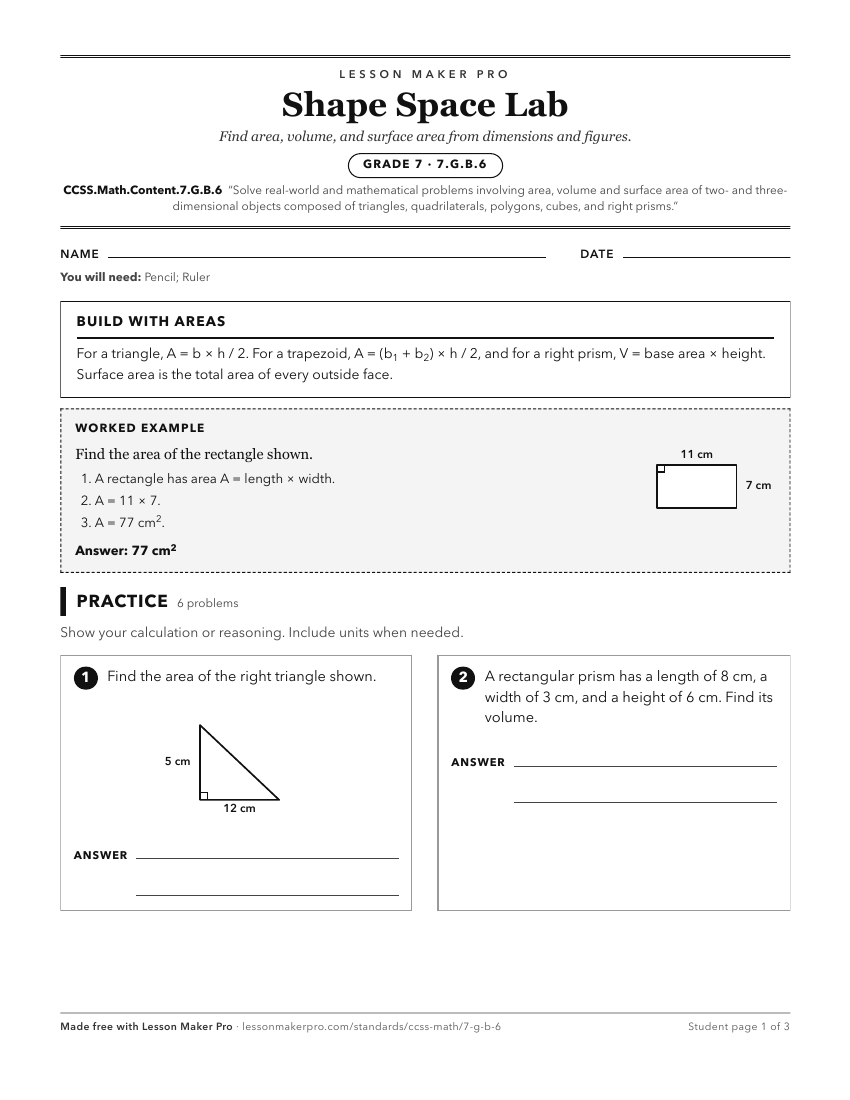
A ready-to-print activity worksheet aligned to CCSS.Math.Content.7.G.B.6, with an answer key for the teacher on its own page. No account needed.
PDF, US Letter, prints cleanly in black and white.
Download the worksheetBefore This Standard
If students are struggling here, check these first.
- CCSS.Math.Content.6.G.A.4
Using nets to decompose 3D figures into faces supports later surface area work with prisms and composite objects.
- CCSS.Math.Content.6.G.A.1
Area decomposition of triangles and polygons carries into composite area and finding surface area from the faces of prisms.
- CCSS.Math.Content.6.G.A.2
Rectangular prism volume with fractional edges supports later volume and surface area work for prisms and composite 3D objects.
What This Unlocks
Mastery here sets students up for these next.
- CCSS.Math.Content.HSG-MG.A.2
Area and volume problem solving carries over to interpreting and computing rates like people per square mile or BTUs per cubic foot.
- CCSS.Math.Content.HSG-GPE.B.7
Area formulas for triangles and rectangles carry over when coordinate side lengths are found with the distance formula.
- CCSS.Math.Content.HSG-GMD.A.1
Using area and prism volume in composite figures supports explaining cylinder volume and comparing pyramid or cone volumes.
- CCSS.Math.Content.HSG-MG.A.1
Area, volume, surface area, and simple composite solids support modeling real objects with measured geometric shapes, though modeling can begin qualitatively.
Keep exploring
Related Standards
- CCSS.Math.Content.8.G.C
Solve real-world and mathematical problems involving volume of cylinders, cones, and spheres.
- CCSS.Math.Content.7.G.B
Solve real-life and mathematical problems involving angle measure, area, surface area, and volume.
- CCSS.Math.Content.6.G.A
Solve real-world and mathematical problems involving area, surface area, and volume.
Turn this exact standard into a lesson
Grade, subject, topic, and the complete standard are prefilled. Create one free, no account needed.
Also for this standard:Make a WorksheetMake a QuizMake a Sub Lesson