CCSS.
The Standard
Give an informal argument for the formulas for the circumference of a circle, area of a circle, volume of a cylinder, pyramid, and cone.
Common Core State Standards for Mathematics
Teacher's field guide
What This Standard Means
What Students Need to Do
- Students explain where each measurement formula comes from rather than only substituting values. They use circumference-to-diameter ratios, rearranged pieces, matching cross-sections, and thinner slices. They connect these arguments to π and the one-third volume factor.
What Mastery Looks Like
- A student can justify C = 2πr and A = πr² with measurements, diagrams, or rearranged sectors. The student can explain V = Bh for cylinders and V = ⅓Bh for pyramids and cones using layers, dissection, or matching cross-sections.
Common Misconceptions
- Students often confuse circumference and area, especially the roles of 2πr and πr². Some use V = Bh for cones and pyramids, forgetting the one-third factor. Others apply Cavalieri’s principle after checking only the height and base area, not every matching cross-section.
How to Assess It
- Exit ticket: Cut a circle into equal sectors and rearrange them into an almost-rectangle. Label its base and height, then explain why its area is πr².
Lesson moves
Ways to Teach It
Cut paper circles into 16 sectors, alternate the pieces into an almost-rectangle, and label the base πr and height r.
Ask students to write: Why do equal areas in every matching horizontal slice imply equal volumes, even when solids look different?
Run a card sort matching each shape, formula, diagram, and justification, then require partners to explain every match.
Measure a soup can, then justify and calculate the label length, area of one circular end, and interior volume.
Free download
Printable HSG-GMD.A.1 Worksheet
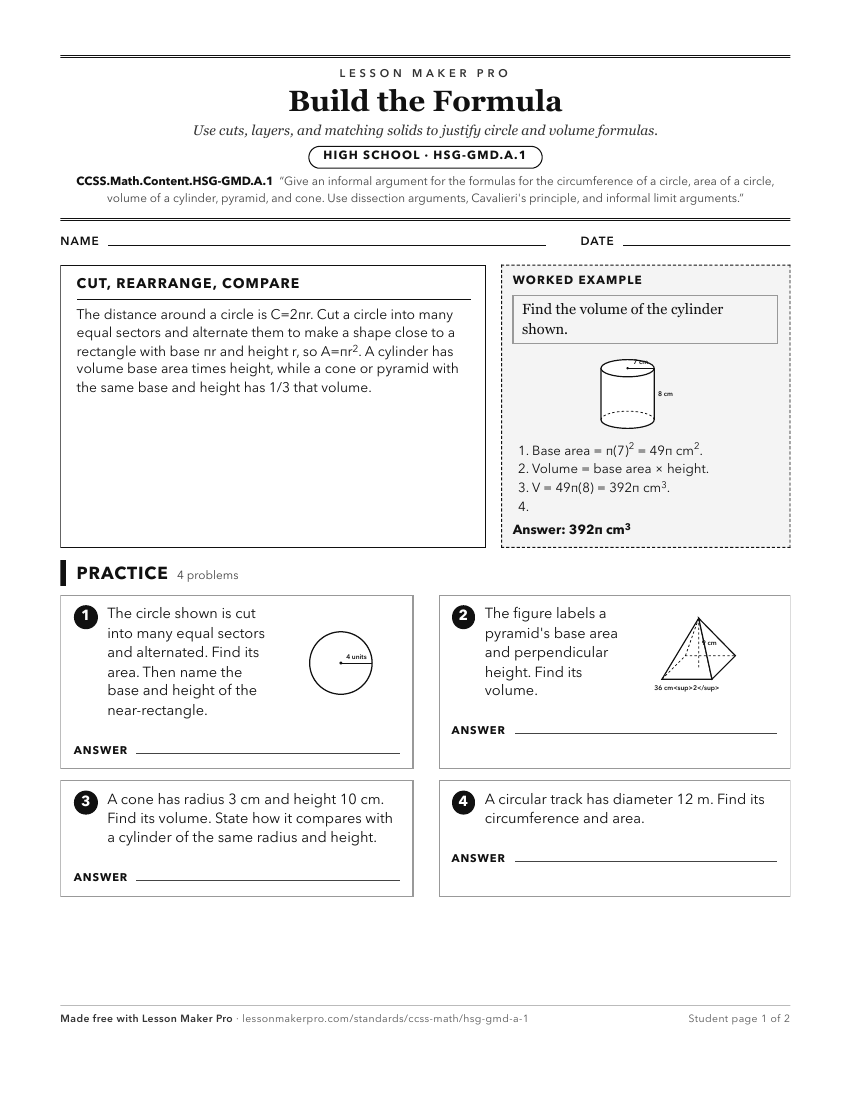
A ready-to-print activity worksheet aligned to CCSS.Math.Content.HSG-GMD.A.1, with an answer key for the teacher on its own page. No account needed.
PDF, US Letter, prints cleanly in black and white.
Download the worksheetLearning progression
Where This Standard Sits
Before This Standard
If students are struggling here, check these first.
- CCSS.Math.Content.7.G.B.4
Knowing and informally deriving circle circumference and area supports later arguments for circle formulas and volumes with circular bases.
- CCSS.Math.Content.7.G.B.6
Using area and prism volume in composite figures supports explaining cylinder volume and comparing pyramid or cone volumes.
- CCSS.Math.Content.HSG-GMD.B.4
Recognizing slices and rotations of solids supports visual arguments for circle, cylinder, cone, and pyramid formulas.
What This Unlocks
Mastery here sets students up for these next.
Keep exploring
Related Standards
Turn this exact standard into a lesson
Grade, subject, topic, and the complete standard are prefilled. Create one free, no account needed.
Also for this standard:Make a WorksheetMake a QuizMake a Sub Lesson