CCSS.
The Standard
(+) Give an informal argument using Cavalieri's principle for the formulas for the volume of a sphere and other solid figures.
Common Core State Standards for Mathematics
Teacher's field guide
What This Standard Means
What Students Need to Do
- Students compare two solids by slicing them at the same height and finding each cross-sectional area. They use matching slice areas to justify equal volumes and derive volume formulas.
What Mastery Looks Like
- A student can sketch a sphere and a cylinder with two cones removed, then compare slices at the same height. The student uses those equal areas to derive the sphere volume formula.
Common Misconceptions
- Students may compare only one slice instead of slices at every height. They may confuse cross-sectional area with surface area or assume solids with equal heights have equal volumes.
How to Assess It
- Exit ticket: A sphere of radius r is compared with a radius-r, height-2r cylinder after two height-r cones are removed. At distance x from the center, show the slice areas match, then find the sphere’s volume.
Lesson moves
Ways to Teach It
Use compasses to cut a sphere disk and comparison annulus for three heights, then verify their areas match.
Write an explanation answering: Why do equal cross-sectional areas at every shared height mean two solids have equal volume?
Match cards showing solids, slice-area expressions, and volume formulas, then justify each matched set before scoring a point.
Model a spherical water tank as an equal-volume cylinder with two cones removed, then calculate its capacity from a given radius.
Free download
Printable HSG-GMD.A.2 Worksheet
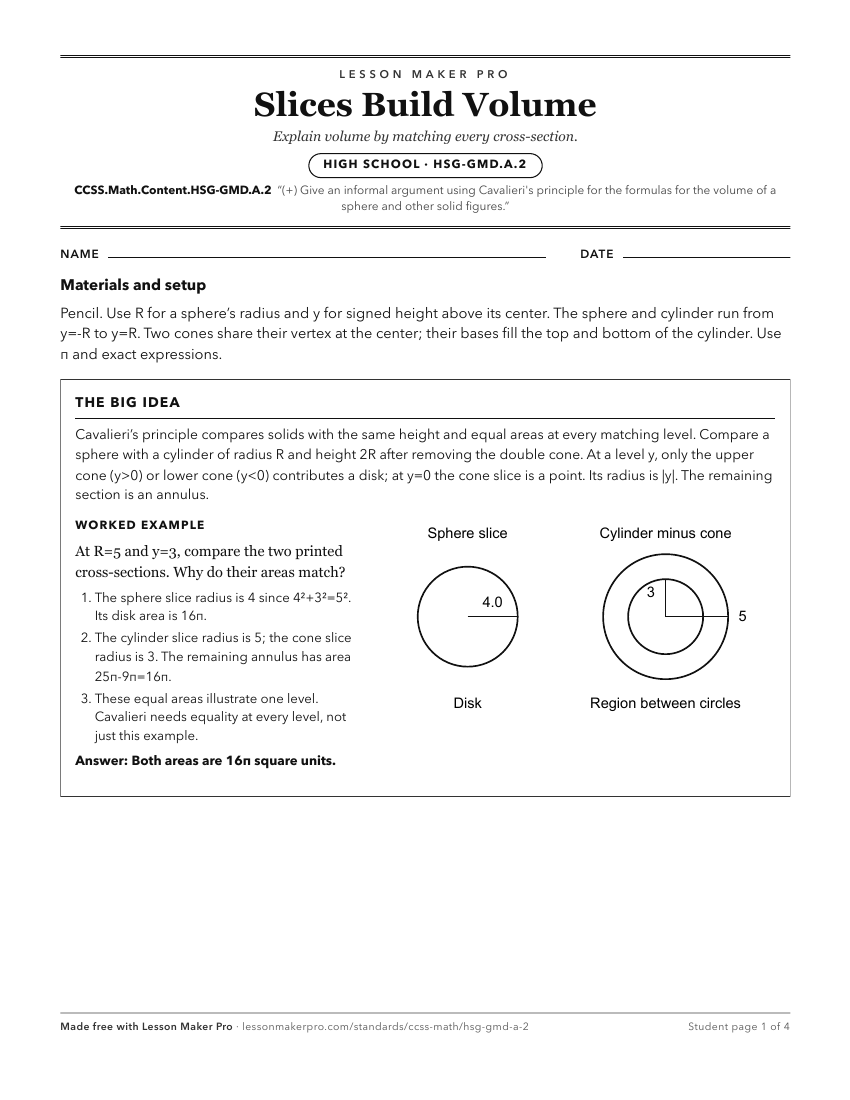
A ready-to-print activity worksheet aligned to CCSS.Math.Content.HSG-GMD.A.2, with an answer key for the teacher on its own page. No account needed.
PDF, US Letter, prints cleanly in black and white.
Download the worksheetLearning progression
Where This Standard Sits
Before This Standard
If students are struggling here, check these first.
- CCSS.Math.Content.HSG-GMD.A.1
Arguments for cylinder, pyramid, and cone volumes support Cavalieri comparisons and the sphere formula through cross-sections and known solid volumes.
- CCSS.Math.Content.HSG-GMD.B.4
Cavalieri arguments compare matching cross-sections, so recognizing slices of solids supports deriving sphere and other volume formulas.
- CCSS.Math.Content.7.G.B.4
Cavalieri arguments for sphere volume require computing circular cross sections with the circle area formula.
Keep exploring
Related Standards
- CCSS.Math.Content.HSG-GMD.A.3
Use volume formulas for cylinders, pyramids, cones, and spheres to solve problems.
- CCSS.Math.Content.8.G.C.9
Know the formulas for the volumes of cones, cylinders, and spheres and use them to solve real-world and mathematical problems.
- CCSS.Math.Content.HSG-GMD.A
Explain volume formulas and use them to solve problems
Turn this exact standard into a lesson
Grade, subject, topic, and the complete standard are prefilled. Create one free, no account needed.
Also for this standard:Make a WorksheetMake a QuizMake a Sub Lesson