CCSS.
Standard Cluster
Explain volume formulas and use them to solve problems
Common Core State Standards for Mathematics · High School — Geometry
Cluster contents
Standards in This Cluster
CCSS.Math.Content.HSG-GMD.A is a cluster heading. These are the individual standards under it.
- CCSS.Math.Content.HSG-GMD.A.1
Give an informal argument for the formulas for the circumference of a circle, area of a circle, volume of a cylinder, pyramid, and cone.
- CCSS.Math.Content.HSG-GMD.A.2
(+) Give an informal argument using Cavalieri's principle for the formulas for the volume of a sphere and other solid figures.
- CCSS.Math.Content.HSG-GMD.A.3
Use volume formulas for cylinders, pyramids, cones, and spheres to solve problems.
Teacher's field guide
What This Cluster Means
What Students Need to Do
- Students connect volume formulas to the shapes and measurements that create each solid. They use those formulas to find missing volumes or dimensions and justify why the formulas make sense.
What Mastery Looks Like
- Students choose the correct formula for a prism, cylinder, pyramid, cone, or sphere and label units as cubic units. They explain key formula features using base area, height, cross sections, or comparisons between solids.
Common Misconceptions
- Students may use surface area when the problem asks for volume. They often forget the one-third factor for pyramids and cones or confuse radius with diameter. Some assume equal heights guarantee equal volumes without checking base areas or cross sections.
How to Assess It
- Give students a cylinder and cone with equal base radii and heights. Ask them to find both volumes and explain why one volume is one-third of the other.
Lesson moves
Ways to Teach It
Fill a cone with rice three times and pour it into a matching cylinder to show the one-third relationship.
Ask students to write why doubling a cylinder’s radius changes its volume more than doubling its height.
Have pairs match solid cards, dimension cards, and volume expressions, then check each set with a calculator.
Compare two drink containers by measuring their dimensions and calculating which holds more liquid and how much more.
Free download
Printable HSG-GMD.A Worksheet
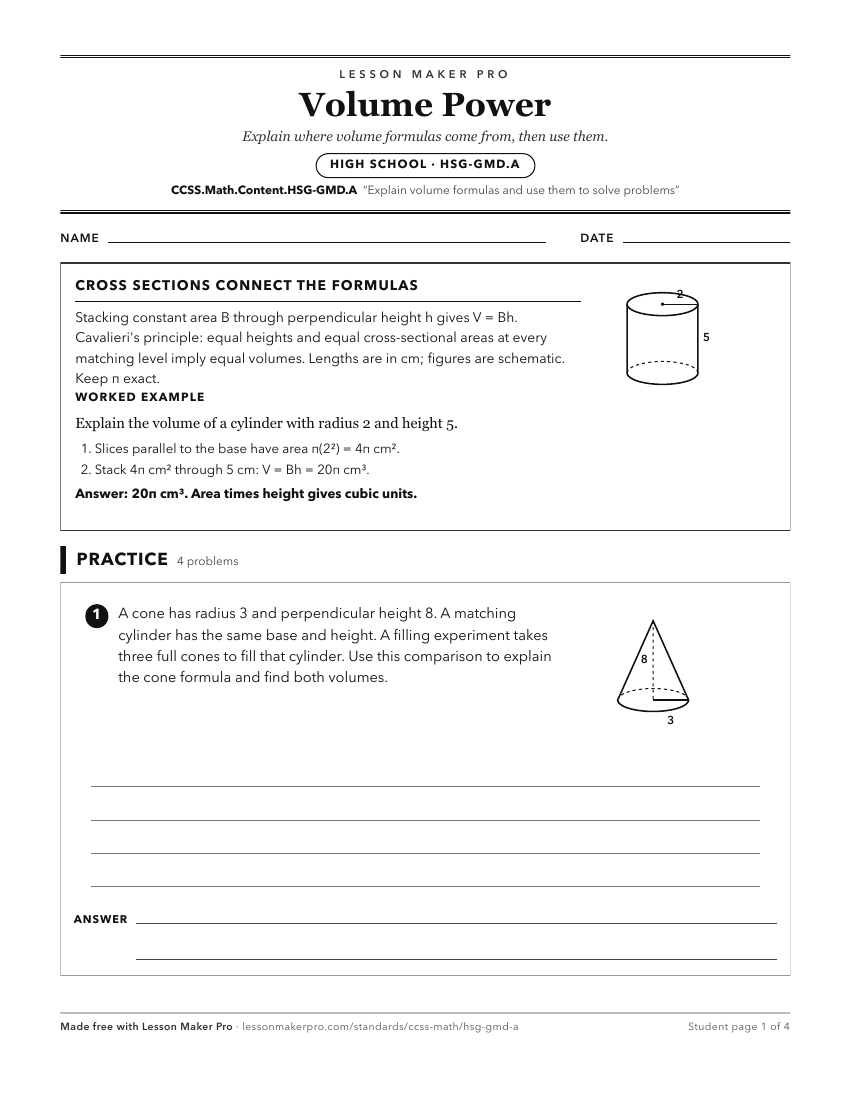
A ready-to-print activity worksheet aligned to CCSS.Math.Content.HSG-GMD.A, with an answer key for the teacher on its own page. No account needed.
PDF, US Letter, prints cleanly in black and white.
Download the worksheetKeep exploring
Related Standards
- CCSS.Math.Content.8.G.C
Solve real-world and mathematical problems involving volume of cylinders, cones, and spheres.
- CCSS.Math.Content.5.MD.C.5
Relate volume to the operations of multiplication and addition and solve real world and mathematical problems involving volume.
- CCSS.Math.Content.8.G.C.9
Know the formulas for the volumes of cones, cylinders, and spheres and use them to solve real-world and mathematical problems.
Turn this cluster into a lesson
Grade, subject, topic, and the complete cluster are prefilled. Create one free, no account needed.
Also for this cluster:Make a WorksheetMake a QuizMake a Sub Lesson