CCSS.
Standard Cluster
Solve real-world and mathematical problems involving area, surface area, and volume.
Common Core State Standards for Mathematics
Cluster contents
Standards in This Cluster
CCSS.Math.Content.6.G.A is a cluster heading. These are the individual standards under it.
- CCSS.Math.Content.6.G.A.1
Find the area of right triangles, other triangles, special quadrilaterals, and polygons by composing into rectangles or decomposing into triangles and other sha...
- CCSS.Math.Content.6.G.A.2
Find the volume of a right rectangular prism with fractional edge lengths by packing it with unit cubes of the appropriate unit fraction edge lengths, and show ...
- CCSS.Math.Content.6.G.A.3
Draw polygons in the coordinate plane given coordinates for the vertices; use coordinates to find the length of a side joining points with the same first coordi...
- CCSS.Math.Content.6.G.A.4
Represent three-dimensional figures using nets made up of rectangles and triangles, and use the nets to find the surface area of these figures. Apply these tech...
Teacher's field guide
What This Cluster Means
What Students Need to Do
- Students solve problems involving the area of polygons, the surface area of three-dimensional figures, and the volume of rectangular prisms. They use formulas, nets, decomposition, coordinates, and correct measurement units.
What Mastery Looks Like
- Students select the right measurement and formula, break complex figures into familiar shapes, and show accurate calculations. They use square units for area and surface area, and cubic units for volume.
Common Misconceptions
- Students may mix up area, surface area, and volume, or use square units for volume. They may count shared faces, omit hidden faces, or apply a rectangle formula to triangles and other polygons.
How to Assess It
- Give students a 6 cm by 4 cm by 3 cm rectangular prism. Ask them to find its volume and surface area, label units, and show their work.
Lesson moves
Ways to Teach It
Give pairs centimeter cubes and cardstock nets to build rectangular prisms, then calculate and verify surface area and volume.
Ask students to explain why a box can have a large volume but a small surface area, using dimensions in their example.
Run a formula sort where teams match diagrams, measurements, formulas, and correct square or cubic units.
Have students design a cereal box with set dimensions, then calculate cardboard needed and space inside the box.
Free download
Printable 6.G.A Worksheet
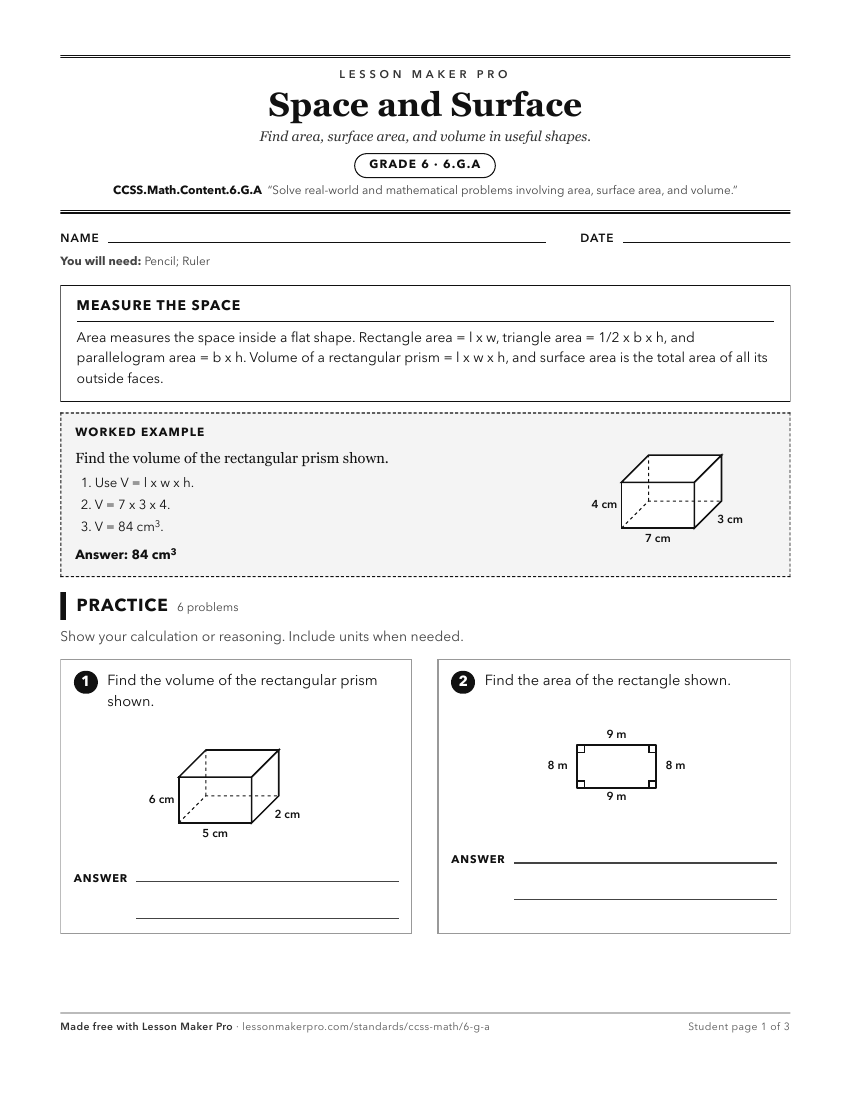
A ready-to-print activity worksheet aligned to CCSS.Math.Content.6.G.A, with an answer key for the teacher on its own page. No account needed.
PDF, US Letter, prints cleanly in black and white.
Download the worksheetKeep exploring
Related Standards
- CCSS.Math.Content.8.G.C
Solve real-world and mathematical problems involving volume of cylinders, cones, and spheres.
- CCSS.Math.Content.5.MD.C.5
Relate volume to the operations of multiplication and addition and solve real world and mathematical problems involving volume.
- CCSS.Math.Content.7.G.B
Solve real-life and mathematical problems involving angle measure, area, surface area, and volume.
- CCSS.Math.Content.7.G.B.6
Solve real-world and mathematical problems involving area, volume and surface area of two- and three-dimensional objects composed of triangles, quadrilaterals, ...
Turn this cluster into a lesson
Grade, subject, topic, and the complete cluster are prefilled. Create one free, no account needed.
Also for this cluster:Make a WorksheetMake a QuizMake a Sub Lesson