CCSS.
The Standard
Draw polygons in the coordinate plane given coordinates for the vertices; use coordinates to find the length of a side joining points with the same first coordinate or the same second coordinate. Apply these techniques in the context of solving real-world and mathematical problems.
Common Core State Standards for Mathematics · Geometry
Teacher's field guide
What This Standard Means
What Students Need to Do
- Students plot given vertices on a coordinate plane and connect them to form a polygon. They find horizontal and vertical side lengths by subtracting the coordinates that change, then use those lengths to solve problems.
What Mastery Looks Like
- Students accurately plot ordered pairs, connect them in order, and recognize horizontal and vertical sides. They find each side length using the positive difference between the changing coordinates and use those lengths in a problem.
Common Misconceptions
- Students may reverse the x-coordinate and y-coordinate when plotting points. They may count grid lines instead of unit spaces, or subtract coordinates without using the positive distance. Some try to find diagonal lengths using the same method as horizontal and vertical sides.
How to Assess It
- Give this exit ticket: Plot the points (-3, 2), (4, 2), (4, -2), and (-3, -2). Connect them in order, label each side length, and find the perimeter.
Lesson moves
Ways to Teach It
Use masking tape to make a floor grid; students stand at assigned vertices, connect yarn sides, then measure horizontal and vertical lengths.
Ask students to explain why the side from (2, -3) to (2, 5) has length 8 without counting grid spaces.
Give pairs coordinate cards; one student plots a polygon while the partner calculates side lengths, then they compare and switch roles.
Have students map a rectangular dog park on a coordinate grid, label its vertices, and calculate fencing needed for the perimeter.
Free download
Printable 6.G.A.3 Worksheet
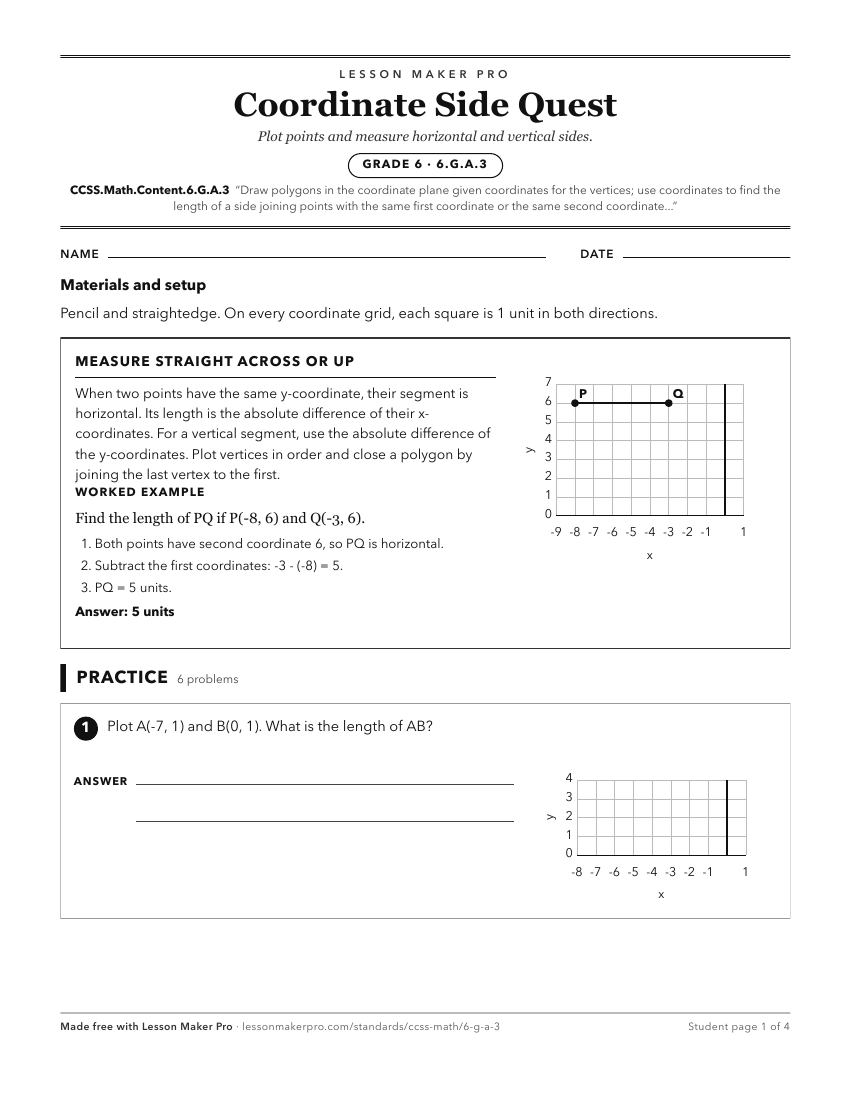
A ready-to-print activity worksheet aligned to CCSS.Math.Content.6.G.A.3, with an answer key for the teacher on its own page. No account needed.
PDF, US Letter, prints cleanly in black and white.
Download the worksheetWhat This Unlocks
Mastery here sets students up for these next.
- CCSS.Math.Content.8.G.A.3
Plotting coordinate polygons and reading vertex coordinates supports describing how transformations change a figure’s coordinates.
- CCSS.Math.Content.8.G.A.1a
Plotting polygons and measuring grid-aligned side lengths supports seeing transformed segments on the coordinate plane keep their length.
Keep exploring
Related Standards
- CCSS.Math.Content.6.NS.C.8
Solve real-world and mathematical problems by graphing points in all four quadrants of the coordinate plane. Include use of coordinates and absolute value to fi...
- CCSS.Math.Content.HSG-GPE.B.7
Use coordinates to compute perimeters of polygons and areas of triangles and rectangles, e.g., using the distance formula.
- CCSS.Math.Content.5.G.A
Graph points on the coordinate plane to solve real-world and mathematical problems.
- CCSS.Math.Content.5.G.A.2
Represent real world and mathematical problems by graphing points in the first quadrant of the coordinate plane, and interpret coordinate values of points in th...
Turn this exact standard into a lesson
Grade, subject, topic, and the complete standard are prefilled. Create one free, no account needed.
Also for this standard:Make a WorksheetMake a QuizMake a Sub Lesson