CCSS.
The Standard
Lines are taken to lines, and line segments to line segments of the same length.
Common Core State Standards for Mathematics
Teacher's field guide
What This Standard Means
What Students Need to Do
- Students apply translations, rotations, and reflections to lines and segments. They track several points to show that straightness and distance are preserved.
What Mastery Looks Like
- Students can identify the image of a line or segment after a translation, rotation, or reflection. They can measure or calculate to show that corresponding segments have equal lengths.
Common Misconceptions
- Students may think turning a segment changes its length because its direction changes. They may also confuse an infinite line with a segment or include dilations as rigid motions.
How to Assess It
- Exit ticket: Reflect A(1, 2) and B(4, 6) across the y-axis. Give the image points, compare both segment lengths, and explain why the image points remain collinear.
Lesson moves
Ways to Teach It
Trace a triangle and an extra line on transparency, then slide, turn, or flip it and compare corresponding lengths with a ruler.
Write: Why can a rigid motion change a segment's direction but not its length? Support your answer with a labeled sketch.
Match transformation cards to image diagrams, then earn a point by naming one preserved segment length and one preserved collinear set.
Use a tiled floor photo to identify a slide, turn, or flip, then measure corresponding edges to confirm equal lengths.
Free download
Printable 8.G.A.1a Worksheet
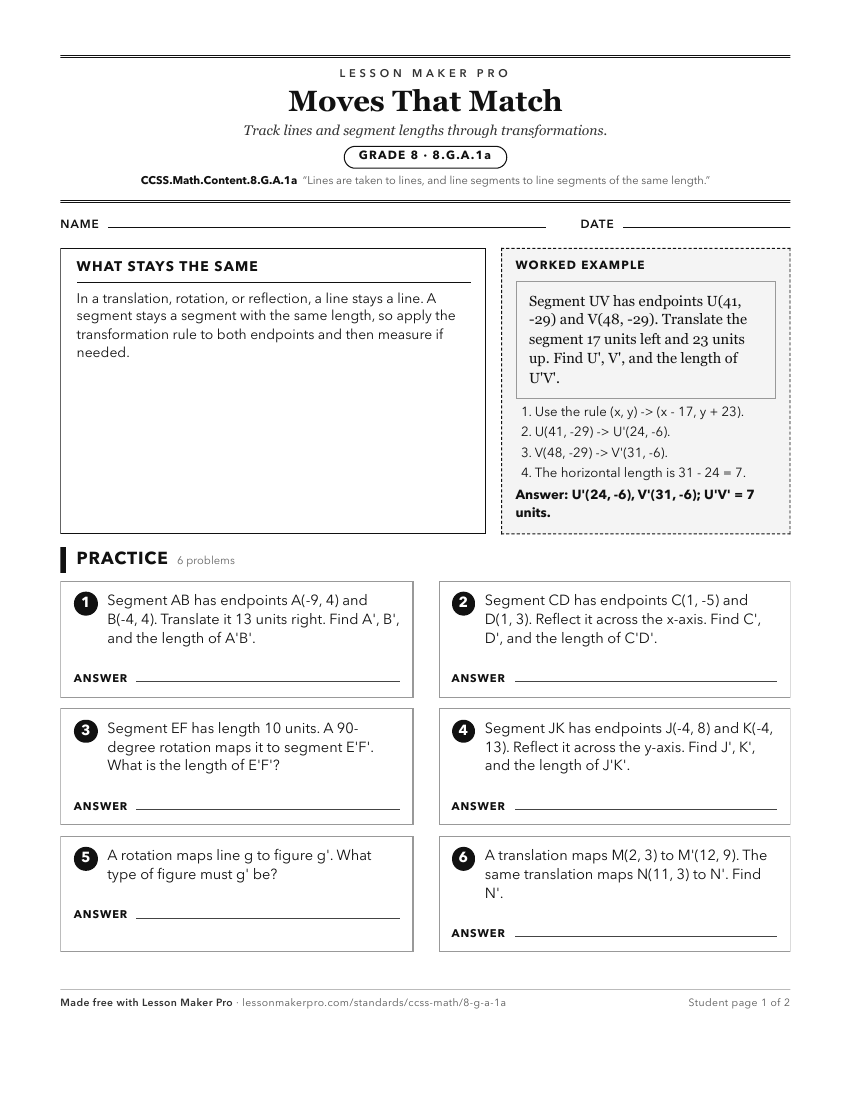
A ready-to-print activity worksheet aligned to CCSS.Math.Content.8.G.A.1a, with an answer key for the teacher on its own page. No account needed.
PDF, US Letter, prints cleanly in black and white.
Download the worksheetLearning progression
Where This Standard Sits
Before This Standard
If students are struggling here, check these first.
What This Unlocks
Mastery here sets students up for these next.
Keep exploring
Related Standards
- CCSS.Math.Content.HSG-SRT.A.1b
The dilation of a line segment is longer or shorter in the ratio given by the scale factor.
- CCSS.Math.Content.8.G.A.1b
Angles are taken to angles of the same measure.
- CCSS.Math.Content.HSG-SRT.A.1a
A dilation takes a line not passing through the center of the dilation to a parallel line, and leaves a line passing through the center unchanged.
Turn this exact standard into a lesson
Grade, subject, topic, and the complete standard are prefilled. Create one free, no account needed.
Also for this standard:Make a WorksheetMake a QuizMake a Sub Lesson