CCSS.
The Standard
Parallel lines are taken to parallel lines.
Common Core State Standards for Mathematics
Teacher's field guide
What This Standard Means
What Students Need to Do
- Students translate, rotate, or reflect a pair of parallel lines and draw their images. They explain why both image lines remain the same distance apart and never meet.
What Mastery Looks Like
- Given a diagram and a transformation rule, a student correctly locates the image of each line. The student identifies the image lines as parallel and supports the claim with slopes, angles, or equal spacing.
Common Misconceptions
- Students may think rotated or reflected lines are no longer parallel because their slant or position changed. They may transform only one line, confuse parallel with horizontal, or rely only on appearance.
How to Assess It
- Exit ticket: Graph y = x + 1 and y = x − 2, then reflect both lines across the y-axis. Label the images and give one reason they are parallel.
Lesson moves
Ways to Teach It
Lay two parallel strips of tape on tracing paper, then slide, turn, and flip the paper while students trace each new position.
Show a reflected pair of lines and ask, “What changed, what stayed the same, and what proves the images are parallel?”
Play Transformation Match: students pair cards showing original parallel lines, a transformation rule, and the correct image.
Photograph railroad tracks, shelf edges, or floor tiles, then sketch how a rotation or reflection would move each pair.
Free download
Printable 8.G.A.1c Worksheet
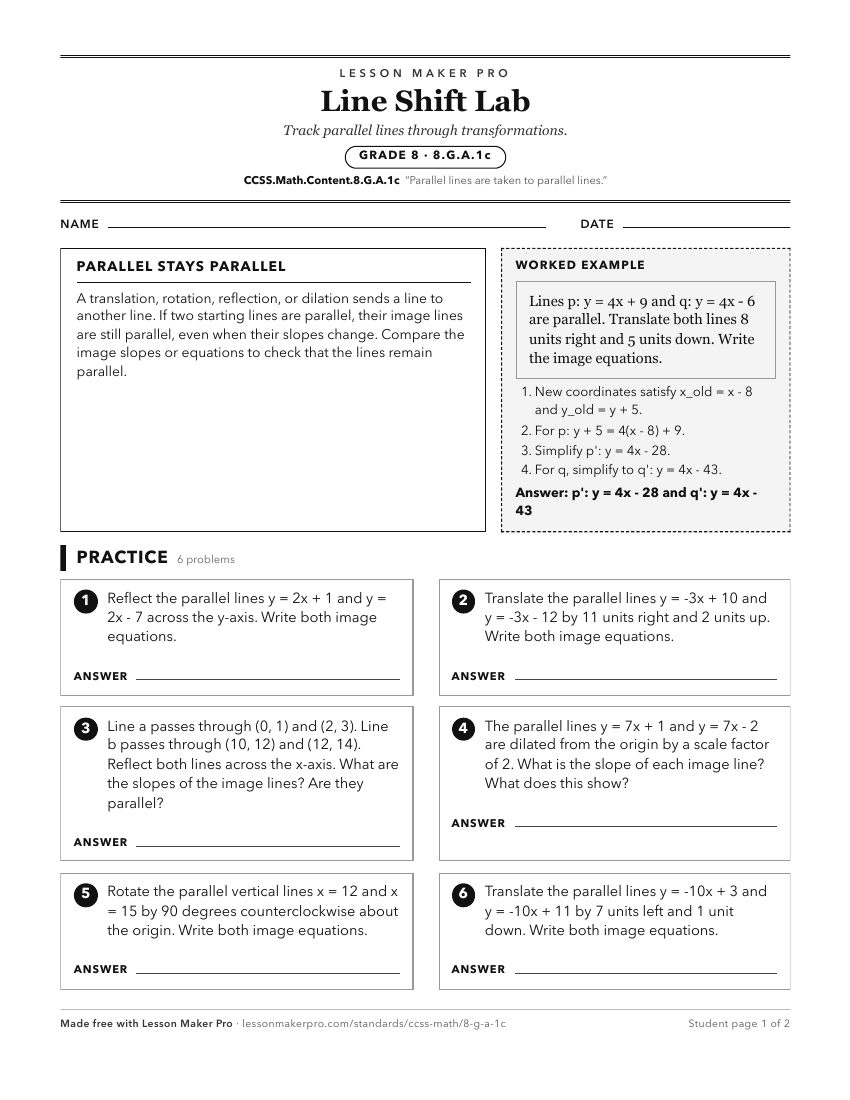
A ready-to-print activity worksheet aligned to CCSS.Math.Content.8.G.A.1c, with an answer key for the teacher on its own page. No account needed.
PDF, US Letter, prints cleanly in black and white.
Download the worksheetLearning progression
Where This Standard Sits
Before This Standard
If students are struggling here, check these first.
Keep exploring
Related Standards
- CCSS.Math.Content.HSG-GPE.B.5
Prove the slope criteria for parallel and perpendicular lines and use them to solve geometric problems (e.g., find the equation of a line parallel or perpendicu...
- CCSS.Math.Content.HSG-SRT.A.1a
A dilation takes a line not passing through the center of the dilation to a parallel line, and leaves a line passing through the center unchanged.
Turn this exact standard into a lesson
Grade, subject, topic, and the complete standard are prefilled. Create one free, no account needed.
Also for this standard:Make a WorksheetMake a QuizMake a Sub Lesson