CCSS.
The Standard
Prove the slope criteria for parallel and perpendicular lines and use them to solve geometric problems (e.g., find the equation of a line parallel or perpendicular to a given line that passes through a given point).
Common Core State Standards for Mathematics
Teacher's field guide
What This Standard Means
What Students Need to Do
- Students prove that parallel nonvertical lines have equal slopes and perpendicular nonvertical lines have slopes whose product is -1. They use these relationships to classify lines and write equations through given points.
What Mastery Looks Like
- Given equations, graphs, or coordinates, students can determine whether two lines are parallel, perpendicular, or neither and justify the result with slopes. They can write a parallel or perpendicular line through a given point and explain the slope rule, including horizontal and vertical cases.
Common Misconceptions
- Students often use opposite slopes instead of negative reciprocals for perpendicular lines. They may compare slopes before rewriting equations in slope-intercept form. Vertical lines need separate treatment because their slope is undefined, while horizontal lines have slope zero.
How to Assess It
- Exit ticket: Through (4, -1), write equations parallel and perpendicular to 2x + 3y = 6. Show the slope relationship that justifies each equation.
Lesson moves
Ways to Teach It
On grid paper, students draw slope triangles on pairs of lines, compare rise and run, and record patterns for parallel and perpendicular lines.
Ask students to explain why changing a slope from 2/3 to -3/2 creates a right angle, using a diagram or coordinates.
Give pairs of line-equation cards for students to sort into parallel, perpendicular, or neither, then require a slope calculation for each match.
Using a street map on a coordinate grid, students write equations for a parallel bike lane and a perpendicular crosswalk through marked points.
Free download
Printable HSG-GPE.B.5 Worksheet
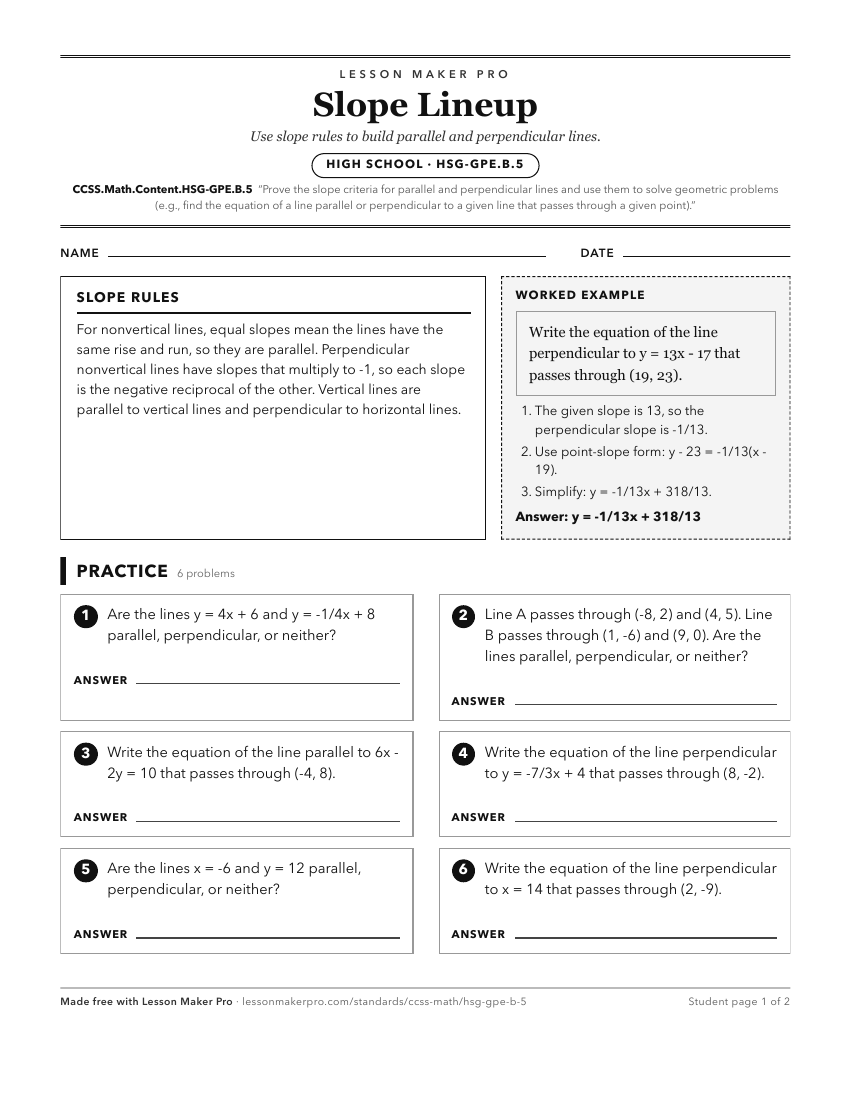
A ready-to-print activity worksheet aligned to CCSS.Math.Content.HSG-GPE.B.5, with an answer key for the teacher on its own page. No account needed.
PDF, US Letter, prints cleanly in black and white.
Download the worksheetLearning progression
Where This Standard Sits
Before This Standard
If students are struggling here, check these first.
- CCSS.Math.Content.8.EE.B.6
Students need constant slope and y=mx+b to prove parallel slopes and write equations through points.
- CCSS.Math.Content.8.F.A.3
Seeing y = mx + b as a line helps students use slope and line equations for parallel and perpendicular criteria.
- CCSS.Math.Content.HSG-CO.C.9
Angle theorems about parallel and perpendicular lines support proving why equal slopes are parallel and negative reciprocal slopes are perpendicular.
Keep exploring
Related Standards
Turn this exact standard into a lesson
Grade, subject, topic, and the complete standard are prefilled. Create one free, no account needed.
Also for this standard:Make a WorksheetMake a QuizMake a Sub Lesson