CCSS.
The Standard
Use similar triangles to explain why the slope m is the same between any two distinct points on a non-vertical line in the coordinate plane; derive the equation y = mx for a line through the origin and the equation y = mx + b for a line intercepting the vertical axis at b.
Common Core State Standards for Mathematics · Expressions and Equations
Teacher's field guide
What This Standard Means
What Students Need to Do
- Students draw right triangles along a nonvertical line and compare their vertical and horizontal side lengths. They use triangle similarity to justify constant slope, then connect slope and vertical intercept to a line’s equation.
What Mastery Looks Like
- Students can draw different slope triangles on one line and show that their corresponding side lengths are proportional. They can find the slope and vertical intercept, then write and explain the line’s equation.
Common Misconceptions
- Students may invert rise and run, change subtraction order for only one coordinate, or think larger slope triangles give different slopes. They may confuse the vertical intercept with the horizontal intercept or say a vertical line has zero slope.
How to Assess It
- Exit ticket: Plot (1,3), (3,7), and (5,11). Draw two different slope triangles, explain why their rise-to-run ratios match, and write the line’s equation.
Lesson moves
Ways to Teach It
On grid paper, students draw a line, create two different slope triangles, measure their legs, and compare the ratios.
Ask students to write: Why does choosing different points on the same line produce the same slope?
Run a card sort matching line graphs, slope triangles, slope values, and equations, with students correcting mismatched sets.
Overlay a grid on a staircase photo, calculate its rise per step, and write an equation relating height to horizontal distance.
Free download
Printable 8.EE.B.6 Worksheet
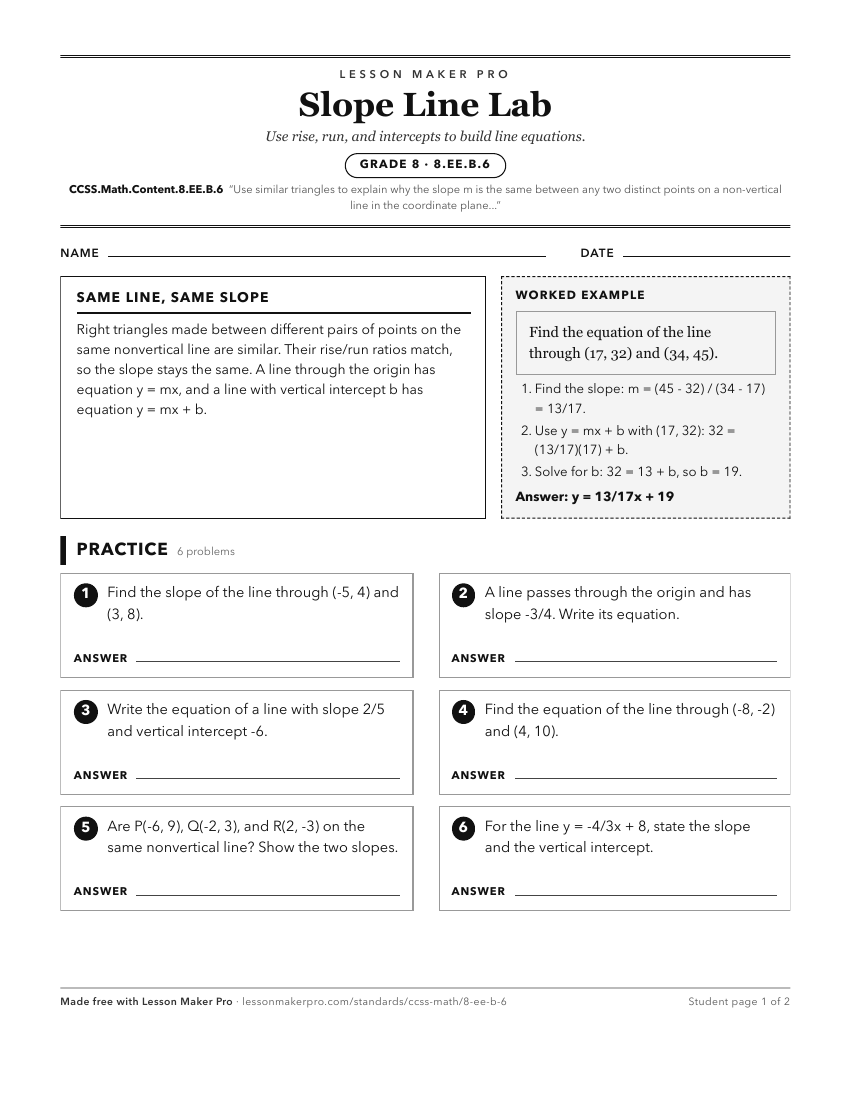
A ready-to-print activity worksheet aligned to CCSS.Math.Content.8.EE.B.6, with an answer key for the teacher on its own page. No account needed.
PDF, US Letter, prints cleanly in black and white.
Download the worksheetLearning progression
Where This Standard Sits
See the whole path on the Expressions & Equations progression map.
Before This Standard
If students are struggling here, check these first.
- CCSS.Math.Content.8.G.A.4
Explaining constant slope with similar triangles requires recognizing triangles as similar through dilations and rigid motions.
- CCSS.Math.Content.8.EE.B.5
Interpreting unit rate as slope prepares students to see constant rise over run and connect proportional graphs to linear equations.
- CCSS.Math.Content.7.RP.A.2
Understanding constant rates and graphs through the origin supports seeing slope as a constant ratio and deriving y = mx.
What This Unlocks
Mastery here sets students up for these next.
- CCSS.Math.Content.8.F.B.4
Understanding constant slope and y-intercept supports finding and interpreting a linear function’s rate of change and initial value.
- CCSS.Math.Content.HSG-GPE.B.5
Students need constant slope and y=mx+b to prove parallel slopes and write equations through points.
- CCSS.Math.Content.HSG-GPE.B.4
Coordinate proofs often use slope and line equations to show collinearity, parallel sides, or intercept relationships algebraically.
- CCSS.Math.Content.8.F.A.3
Deriving y=mx+b gives students the slope and intercept meaning needed to recognize its graph as a linear function.
- CCSS.Math.Content.HSF-IF.B.6
Understanding slope between two points and from graphs supports calculating and interpreting average rate of change over intervals.
Keep exploring
Related Standards
- CCSS.Math.Content.8.SP.A.3
Use the equation of a linear model to solve problems in the context of bivariate measurement data, interpreting the slope and intercept.
- CCSS.Math.Content.HSS-ID.C.7
Interpret the slope (rate of change) and the intercept (constant term) of a linear model in the context of the data.
Turn this exact standard into a lesson
Grade, subject, topic, and the complete standard are prefilled. Create one free, no account needed.
Also for this standard:Make a WorksheetMake a QuizMake a Sub Lesson