CCSS.
The Standard
Interpret the slope (rate of change) and the intercept (constant term) of a linear model in the context of the data.
Common Core State Standards for Mathematics
Teacher's field guide
What This Standard Means
What Students Need to Do
- Students connect each number in a linear equation to the situation represented by the data. They describe the slope as a rate with units and the intercept as the predicted value when the input is zero.
What Mastery Looks Like
- Students explain slope using a change in the response variable for each one-unit increase in the input. They explain the intercept as the predicted response when the input is zero and judge whether that value makes sense.
Common Misconceptions
- Students may treat slope as a single amount rather than an amount per unit. They may say the intercept is always the starting value, even when zero is outside the data range or has no practical meaning.
How to Assess It
- Give students the model y = 18 + 4.5x for a taxi ride, where x is miles and y is cost in dollars. Ask them to explain 4.5 and 18 in context, including units.
Lesson moves
Ways to Teach It
Measure water added to containers, graph height against volume, fit a line, and explain the slope and intercept using units.
Ask students to compare two interpretations of a phone-plan model and write which one correctly explains each coefficient.
Play coefficient match: teams pair linear equations with context cards describing rates and initial values, then justify each match.
Use a paycheck, taxi fare, or streaming subscription model to identify the per-unit rate and fixed starting charge.
Free download
Printable HSS-ID.C.7 Worksheet
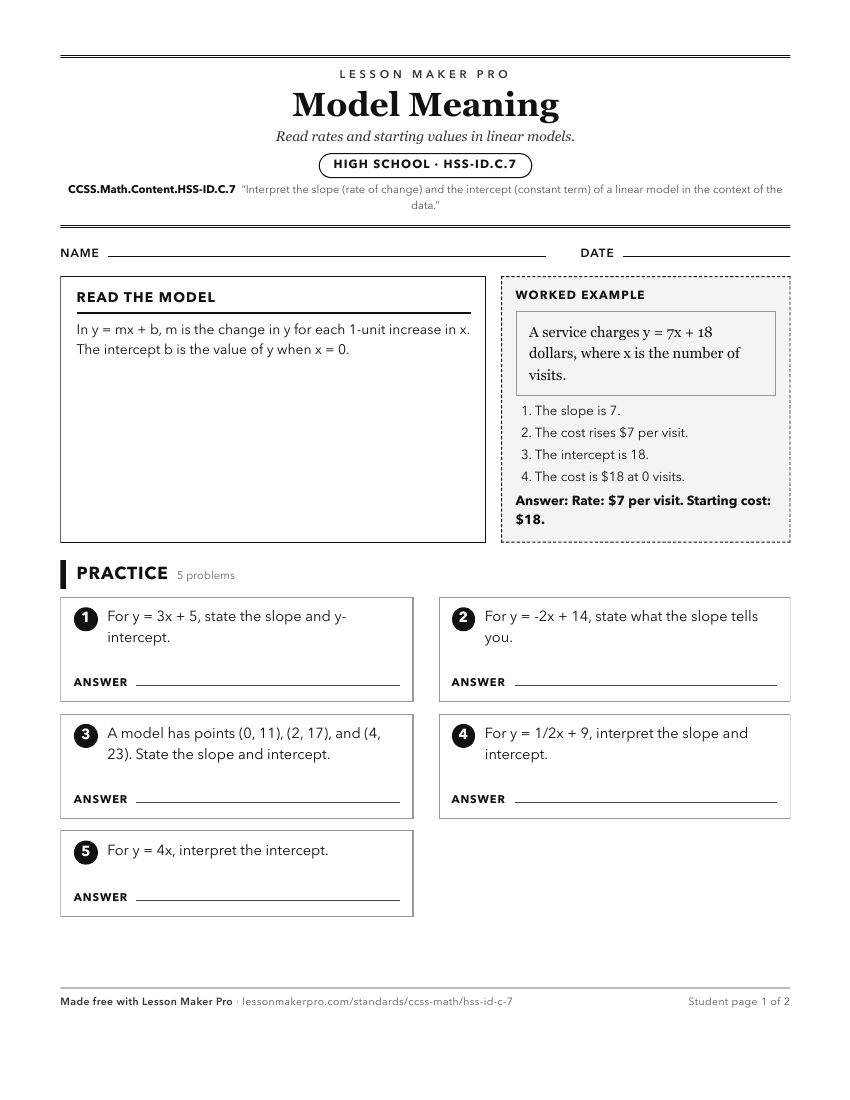
A ready-to-print activity worksheet aligned to CCSS.Math.Content.HSS-ID.C.7, with an answer key for the teacher on its own page. No account needed.
PDF, US Letter, prints cleanly in black and white.
Download the worksheetLearning progression
Where This Standard Sits
Before This Standard
If students are struggling here, check these first.
- CCSS.Math.Content.8.SP.A.3
Grade 8 interpretation of slope and intercept in data contexts directly prepares students to explain those parameters in high school linear models.
- CCSS.Math.Content.8.F.B.4
Students use rate of change and initial value understanding to interpret slope and intercept in a fitted data model.
- CCSS.Math.Content.HSS-ID.B.6c
Fitting a line to data prepares students to see its slope and intercept as meaningful features of the data context.
Keep exploring
Related Standards
Turn this exact standard into a lesson
Grade, subject, topic, and the complete standard are prefilled. Create one free, no account needed.
Also for this standard:Make a WorksheetMake a QuizMake a Sub Lesson